

What Chronic Anxiety Does to Attention and Memory
Understanding the Hidden Neurological Impact and Natural Brain-Based Solutions
📑 Table of Contents
- Understanding Chronic Anxiety and Brain Function
- When Anxiety Hijacks Attention Networks
- Memory Under Siege: The Cognitive Cost
- Neural Circuits and Anxiety’s Impact
- Prefrontal Cortex: The Executive Under Stress
- How LENS Neurofeedback Helps Restore Balance
- Research Evidence for Neurofeedback Therapy
- Brain Plasticity and Recovery Potential
- Frequently Asked Questions
- Next Steps: Your Path to Recovery
Chronic anxiety doesn’t just make you feel worried—it fundamentally rewires your brain’s attention and memory systems.
Research shows that anxiety disorders can promote a crippling focus upon negative life-events and make concentration difficult, which can lead to problems in both social and work environments.
When your brain remains in a constant state of vigilance, it diverts precious neural resources away from the cognitive processes you need for daily functioning.
Understanding how chronic anxiety affects attention and memory isn’t just academic—it’s essential for finding effective solutions.
The mechanisms by which anxiety may be related to impaired working memory are theorized to be a combination of top-down and bottom-up cognitive processes, with competition evidenced by similar neural circuitry involved in both working memory and anxiety, which reduces bandwidth for both storing and processing task-relevant information.
At MYNeuroBalance, we’ve witnessed how LENS neurofeedback therapy can help restore these hijacked cognitive systems, allowing more than 90% of our Los Angeles clients to experience noticeable improvements in focus, memory, and mental clarity.
Important Medical Disclaimer:
The information provided is for educational purposes only and is not intended as medical advice, diagnosis, or treatment. LENS neurofeedback is a wellness modality NOT intended to diagnose, treat, cure, or prevent any disease. Always consult a qualified healthcare professional before beginning any wellness program. Individual results vary. NeuroBalance does not provide medical services.
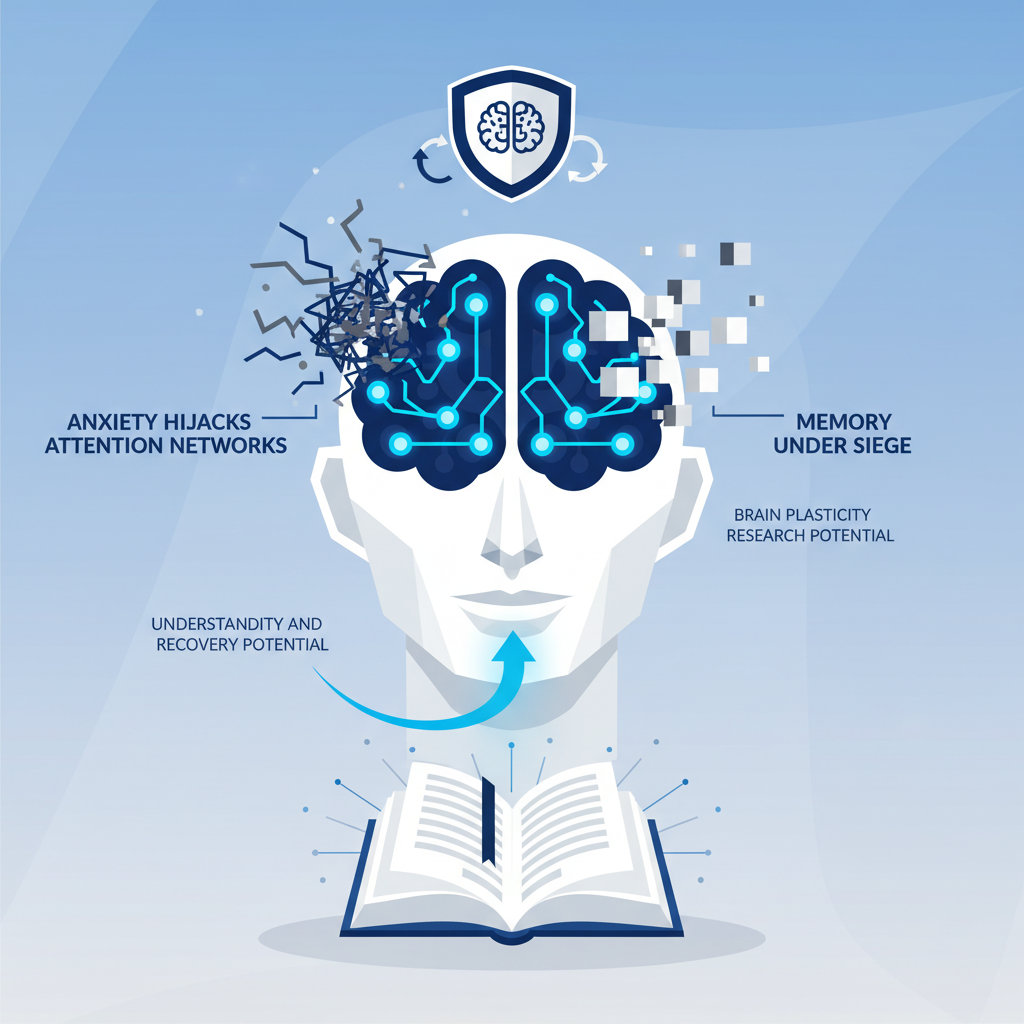
Understanding Chronic Anxiety and Brain Function
Chronic anxiety fundamentally alters how your brain processes information.
Both preclinical and clinical literature indicates that chronic stress negatively affects executive function. Throughout life, executive function can be challenged by intense or prolonged stress, and the dysregulation of these processes can reduce the quality of life and daily performance of otherwise healthy individuals.
When you experience persistent anxiety, your brain becomes trapped in what researchers call “neural gridlock.”
Neuroscientists believe that the brain’s defenses against stressors and trauma can create a “neural gridlock.”
This state prevents your cognitive systems from functioning optimally, creating a cascade of attention and memory problems.
The impact goes beyond just feeling distracted.
Anxiety can hamper brain function, which impacts memory and learning, as well as attention and focus, decision-making, and problem-solving. That’s because anxiety and brain function are closely linked, which affects cognitive ability.
The Stress Response System
Your brain’s stress response system, originally designed for survival, becomes chronically activated in persistent anxiety.
The stress response sheds light on how repeated anxiety can lead to memory loss. When your body reacts to real or perceived threats, electrical activity in the brain increases and produces adrenaline and cortisol.
This constant activation creates several problems:
– Cortisol elevation disrupts hippocampal function (critical for memory formation)
– Prefrontal cortex resources become depleted
– Amygdala hyperactivity overwhelms rational processing centers
– Neural efficiency decreases as the brain prioritizes threat detection
Our clients at NeuroBalance’s anxiety program often describe feeling like their brain is “stuck in overdrive,” unable to shift down from this hyper-vigilant state even when no real threat exists.
When Anxiety Hijacks Attention Networks
Research shows that under stress, controlled attention resources are reduced as they are allocated to the potential threat.
Your brain’s attention system becomes fundamentally biased toward scanning for danger, leaving fewer resources for the tasks you actually need to focus on.
The Three Attention Networks Under Attack
Research has identified three primary attention networks that anxiety disrupts:
**1. Alerting Network**:
State anxiety had a greater impact on the alerting and orienting networks of attention.
This network keeps you ready to respond to stimuli but becomes hyperactive in chronic anxiety.
**2. Orienting Network**: This directs attention to specific locations or objects. In anxiety, it becomes fixated on potential threats rather than task-relevant information.
**3. Executive Network**:
The brain’s executive network was less efficient in those with high trait anxiety than those with low trait-anxiety. High trait anxiety was associated with a reduced prefrontal response (the brain region related to controlling complex processes).
Working Memory Interference
Working memory—your brain’s ability to hold and manipulate information—suffers significantly under chronic anxiety.
At the bottom-up level, greater anxiety is related to worse filtering efficiency due to prioritization of threat-related cues. From a top-down perspective, there is competition for cognitive resources and interference between anxiety-related and task-related processes.
This creates what our LENS practitioners describe as “cognitive traffic jams”—your brain simply can’t process information efficiently when anxiety thoughts are constantly competing for attention resources.
Memory Under Siege: The Cognitive Cost
Chronic anxiety doesn’t just affect how well you pay attention—it fundamentally disrupts your brain’s ability to form, store, and retrieve memories.
Higher anxiety and stress scores were significantly associated with poorer memory and attention. Having clinically meaningful anxiety symptoms, or both anxiety and stress symptoms, was associated with poorer memory.
Short-Term vs. Long-Term Memory Impact
The relationship between anxiety and memory is complex and depends on the type of memory being affected.
The differential effect of threat of shock on short-term vs. long-term memory is also of note and might be attributed to the overlap in neural resources between anxiety and short-term memory. Short-term memory and anxiety both engage prefrontal mechanisms, and competition for this neural circuitry may result in temporary impairment due to disrupted maintenance of information.
**Short-Term Memory Deficits**:
– Difficulty holding information “online” for immediate use
– Problems with digit span and working memory tasks
– Reduced capacity to manipulate information mentally
– Frequent “blanking out” during conversations or tasks
**Long-Term Memory Complications**:
– Enhanced memory for negative or threat-related information
– Impaired ability to form positive memories
– Difficulty with contextual memory (remembering where/when something happened)
– Problems with memory retrieval under stress
Interesting Research Finding
Studies found that people with higher anxiety were able to remember words displayed over negative images. “Their memories were more emotionally tinted,” said the study’s co-author Myra Fernandes, “and as a result rendered more memorable.”
This shows how anxiety creates a bias toward remembering threatening information.
Our neurofeedback brain training approach at NeuroBalance specifically targets these memory disruptions by helping to restore balance between different brain regions involved in memory processing.
Neural Circuits and Anxiety’s Impact on Cognitive Function
When anxiety becomes chronic, it fundamentally alters key neural circuits in the brain
. Understanding how these changes occur helps explain why attention and memory problems persist even when the anxious person recognizes their symptoms are excessive.
The Amygdala-Prefrontal Cortex Connection
The relationship between the amygdala and prefrontal cortex is central to both emotional regulation and cognitive performance.
On the neural level, anxiety deficits have been closely linked to impaired, yet treatment-sensitive, prefrontal regulatory control over the amygdala
.
Anxiety weakens the connection between the ventrolateral prefrontal cortex and the amygdala, making you less likely to respond to threats rationally
. This disrupted communication creates a cascade of cognitive problems that extend far beyond the original anxiety-provoking situation.
📊 What Research Suggests:
Studies have shown neurofeedback therapy can help increase the connectivity and communication between the amygdala, prefrontal cortex, and hippocampus through exposure to stimuli that may have previously been anxiety inducing
.
The Hippocampus and Memory Formation
The hippocampus, located adjacent to the amygdala, plays a crucial role in memory formation and retrieval.
Located right next to the amygdala, the hippocampus is associated with memory formation. It communicates with the prefrontal cortex and the amygdala and has the ability to help or exacerbate anxiety
.
This three-way communication network becomes compromised in chronic anxiety, leading to memory problems and difficulty forming new positive associations. The hippocampus may actually contribute to maintaining anxiety by bringing up fear-related memories at inappropriate times.
Attention Networks Under Stress
Research identifies three primary attention networks that anxiety disrupts:
| Attention Network | Function | Anxiety Impact |
|---|---|---|
| Alerting Network | Maintaining vigilant state | Hypervigilance, scanning for threats |
| Orienting Network | Directing attention to specific locations | Difficulty focusing on relevant information |
| Executive Control | Resolving conflict, working memory | Reduced cognitive flexibility, poor decision-making |
When anxiety hijacks these networks, they become biased toward threat detection rather than balanced information processing. This creates the cognitive symptoms many people experience: difficulty concentrating, memory lapses, and feeling mentally “foggy.”
Prefrontal Cortex: The Executive Under Stress
The prefrontal cortex serves as the brain’s executive center, managing working memory, attention control, and cognitive flexibility. Under chronic anxiety, this crucial region becomes overwhelmed and underperforms, creating a cascade of cognitive difficulties.
Executive Function Breakdown
In particular, amygdala responsivity to negative stimuli is exaggerated while engagement of prefrontal regulatory control regions is attenuated
. This imbalance explains why anxious individuals often feel like their rational mind is “offline” during stressful situations.
The prefrontal cortex normally provides top-down control over emotional responses, but chronic anxiety reverses this hierarchy. Instead of the executive brain managing emotions, emotional centers begin driving cognitive processes.
💡 Understanding Brain Health:
Think of the prefrontal cortex as your brain’s CEO. In anxiety, it’s like having a fire alarm constantly going off in the office – even the best executive can’t concentrate on important decisions when there’s perceived danger everywhere.
Working Memory and Attention Control Deficits
Working memory – the ability to hold and manipulate information in your mind – becomes severely compromised when anxiety consumes prefrontal resources.
Left hemisphere neurofeedback training application improves working memory and concentration and increases executive planning performance and positive emotions
.
This explains common experiences like:
- Walking into a room and forgetting why you went there
- Reading the same paragraph multiple times without comprehension
- Difficulty following conversations in noisy environments
- Struggling to complete multi-step tasks
Decision-Making and Cognitive Flexibility Problems
Chronic anxiety creates rigid thinking patterns that make it difficult to adapt to changing situations. The brain becomes “stuck” in defensive mode, unable to shift perspectives or consider alternative solutions.
The anterior cingulate gyrus serves as the HUB for emotional regulation and limbic system control. It deals with mental flexibility, cooperation, attention, helps the brain to shift gears, and helps the young child to make transitions
.
💬 What Clients Share:
“Before LENS neurofeedback therapy, I felt like my brain was stuck in a loop. I couldn’t make simple decisions without overthinking everything. Now I feel clearer and more confident in my choices.” – Individual results may vary
The Stress Response Cycle
What makes chronic anxiety particularly damaging is how it creates a self-perpetuating cycle. Poor cognitive performance increases stress, which further impairs prefrontal function, leading to even worse performance.
This cycle explains why traditional “think your way out of anxiety” approaches often fail. When the thinking brain itself is compromised, purely cognitive interventions may not be sufficient to restore normal function.
How LENS Neurofeedback Helps Restore Balance
LENS neurofeedback therapy works from the bioelectrical side to alleviate brain based problems by sending a tiny low energy signal to the scalp that is precisely timed and very similar yet different in frequency to what your brain naturally produces. LENS neurofeedback helps the entire brain to regulate and rebalance itself
.
The LENS Technology Advantage
Unlike traditional neurofeedback that requires active participation,
LENS therapy is passive. As you relax in sessions, your brain does the work for you
. This is particularly beneficial for people with anxiety-related attention problems who might struggle with traditional approaches.
For a fraction of a second, a tiny and imperceptible electromagnetic signal (1/300th of that omitted by a cell phone) is delivered. This signal causes a slight fluctuation in your brainwaves that allows the brain to reorganize and better regulate itself
.
💡 Understanding Brain Health:
LENS works like a gentle “reset” for stuck neural patterns. Imagine your brain’s circuitry is like a computer that needs a restart – LENS provides that restart signal, allowing healthier patterns to emerge naturally.
Disrupting Maladaptive Patterns
LENS effectively disrupts the old neural connectivity that causes the dysfunctional patterns and resets them for much faster and lasting results
. This mechanism is particularly effective for anxiety because it directly addresses the rigid neural patterns that maintain the condition.
Its mechanism of action is based on subtle disruptions to dysfunctional neural patterns, encouraging the brain to self-correct and optimize function
. Rather than training specific behaviors, LENS allows the brain to find its own optimal state.
At our Los Angeles neurofeedback center, we’ve observed how this approach helps clients break free from the anxiety-attention cycle that traditional methods often struggle to address.
Restoring Neural Network Communication
Studies have shown that neurofeedback may help strengthen the connection between the ventrolateral prefrontal cortex and the amygdala. With the connection restored, the ventrolateral prefrontal cortex can effectively provide an appropriate response to potential threats
.
This restoration of communication between brain regions is key to recovering both emotional regulation and cognitive function. When the prefrontal cortex can once again communicate effectively with the emotional brain, attention and memory naturally improve.
Personalized and Adaptive Treatment
The process is personalized because the computer software program allows the signal to adapt in real time, to what is most appealing to the brain that it’s connected to. Then it reads the data it receives just milliseconds before and makes the proper adjustments in frequencies to the specific area of the brain in need
.
This real-time adaptation means each session is tailored to your brain’s current state and needs. Whether you’re dealing with anxiety-specific symptoms or attention difficulties, the system adjusts to provide optimal therapeutic benefit.
Research Evidence for Neurofeedback Therapy
The scientific foundation for neurofeedback’s effectiveness in treating anxiety-related cognitive issues continues to grow, with multiple peer-reviewed studies demonstrating significant improvements in both attention and emotional regulation.
Clinical Success Rates and Outcomes
LENS is remarkably effective, and over 85% of people who have used LENS have benefited significantly from it. Results can be seen quickly, often beginning within the first session, and are long lasting
.
The number of sessions, on average, hovers around 11 when seen on a weekly basis
. This relatively brief treatment duration represents a significant advantage for people struggling with anxiety who need relief without lengthy therapeutic commitments.
📊 What Research Suggests:
The present results demonstrate for the first time that successful self-regulation of amygdala-prefrontal top-down regulatory circuits may represent a novel intervention to control anxiety
.
Brain Imaging Evidence
Advanced neuroimaging studies provide compelling evidence for neurofeedback’s ability to create lasting changes in brain function.
Brain Injury Journal published a University of California San Diego study that compared MEG images before and after treatment. “The present study demonstrates, for the first time, the neuroimaging-based documentation of the effect of LIP-tES treatment on brain functioning”
.
Research specifically targeting anxiety shows promising results.
Reduced amygdala responses were associated with improved well-being at follow-up. Our findings suggest beneficial effects of the NF training indicated by reduced amygdala responses that were associated with improved symptom severity and affective state four weeks after the NF training
.
Long-term Effectiveness
One of the most encouraging aspects of neurofeedback research is the durability of improvements.
Furthermore, Direct LENS Neurofeedback has been found to have long-lasting effects, with many patients experiencing continued improvement even after treatment has ended
.
This persistence suggests that neurofeedback creates fundamental changes in neural organization rather than temporary symptom suppression. For people with chronic anxiety affecting their cognitive function, this represents hope for lasting recovery.
Jon Haupers’ Clinical Experience and Approach
At MYNeuroBalance, Jon S. Haupers brings over 12 years of specialized experience in LENS neurofeedback therapy. Trained directly by Dr. Len Ochs, the founder of LENS technology, Jon has witnessed firsthand how this approach can transform lives affected by anxiety-related cognitive difficulties.
“More than 90% of our Los Angeles clients notice meaningful improvements in their ability to focus and remember within just a few sessions,” notes Jon. “The key is that LENS doesn’t just manage symptoms – it helps the brain restore its natural balance.”
⚕️ Important Note:
Individual results vary. LENS neurofeedback should be considered as part of a comprehensive approach to wellness. Consult your healthcare provider about how neurofeedback might fit into your treatment plan.
The research consistently shows that neurofeedback offers a unique pathway to address the root neurological causes of anxiety-related cognitive problems. Unlike approaches that only target symptoms, neurofeedback helps restore the underlying neural networks responsible for attention, memory, and emotional regulation.
If you’re interested in learning more about how neurofeedback brain training might help with anxiety-related attention and memory issues, our experienced team can provide personalized guidance based on your specific situation.
Brain Plasticity and Recovery Potential
The remarkable concept of neuroplasticity fundamentally transforms how we understand brain recovery from chronic anxiety.
Neuroplasticity refers to the ability of the brain to form new neural pathways and reorganize itself in response to experiences, learning, and changes in your environment.
This scientific understanding offers profound hope for those experiencing anxiety’s cognitive impacts.
Research demonstrates that
chronic stress, which can precipitate or exacerbate depression, disrupts neuroplasticity, while antidepressant treatment produces opposing effects and can enhance neuroplasticity.
This means the brain changes that occur with chronic anxiety aren’t permanent—they can be reversed and optimized through proper intervention.
### The Brain’s Remarkable Adaptability
Neuroplasticity is the brain’s natural ability to reorganize itself by forming new neural connections in response to our thoughts, experiences, and behaviors. Psychologist and expert in Positive Neuroplasticity Dr. Rick Hanson describes the brain as adaptable, constantly rewiring itself according to what we focus on and practice.
When anxiety becomes chronic,
The more often you use a neural pathway, the more ingrained that skill or behavior becomes. So if you have a panic attack every time you go to the store, over time, that will become your brain’s default response to the situation.
However, this same principle works in our favor for recovery.
By building neural pathways that promote calmness and confidence, you give your brain an alternative response. The pathways that led to your panic attack won’t go away, but you may be able to make other pathways more dominant.
### Timeline for Brain Recovery
Understanding recovery timelines can provide realistic expectations for healing.
Rewiring your brain doesn’t happen overnight, but consistent effort leads to change.
However, the brain’s capacity for change is remarkably responsive to proper stimulation.
In fact, consistent mental practices can strengthen these neural pathways, helping the brain become less reactive to stress and more resilient over time. Through neuroplasticity exercises, anyone struggling with anxiety can learn to reset their mind, harnessing the brain’s natural ability to heal and grow.
The process involves creating new patterns:
For instance, when we repeatedly expose ourselves to positive experiences or practice stress-reducing techniques rooted in neuroscience, our brain starts forming new, healthier neural connections. Over time, these new pathways become stronger, and our default response to stress begins to shift. Instead of immediately resorting to the “fight or flight” response, our brain becomes more adept at assessing the situation and responding in a balanced and measured manner.
The NeuroBalance Approach to Anxiety Recovery
At NeuroBalance, Jon S. Haupers brings over 12 years of specialized experience in LENS neurofeedback therapy for anxiety-related cognitive challenges. His approach combines the gentle power of LENS technology with personalized treatment protocols that respect each client’s unique healing journey.
### A Gentle, Passive Approach to Brain Training
Unlike traditional neurofeedback approaches,
LENS (Low Energy Neurofeedback System) is a gentle brain training therapy that uses weak electromagnetic signals to help your brain self-regulate and heal naturally. Unlike traditional neurofeedback which requires conscious effort LENS works passively by delivering tiny feedback signals based on your real-time brainwave patterns encouraging your nervous system to reset and optimize its functioning without any active participation from you.
This passive approach is particularly beneficial for individuals with anxiety whose attention and focus have been compromised.
With the LENS, the client doesn’t need to “do” anything, and there is nothing to learn. The typical session with the LENS lasts 3-4 minutes. This means that the LENS works well for people who either cannot pay attention to a computer screen for longer time periods like those used in “traditional neurofeedback.”
### Evidence-Based Results
The effectiveness of LENS neurofeedback is supported by substantial clinical evidence.
Over 85% of people who have used the LENS have benefited significantly from it. Results can be seen quickly, often beginning within the first session, and are lasting.
In clinical research studies,
After an average of only 20 treatments the mean average of patient symptom ratings (0-10) declined from 7.92 to 3.96, a 50% improvement.
Importantly,
It particularly produces rapid improvements in the first five to six sessions.
### Client Success Stories and Real-World Outcomes
Clients at NeuroBalance frequently report meaningful improvements in multiple areas of their lives.
In just a few sessions, clients often experience better focus, increased energy and improved mood. Anxiety and depression symptoms lift. Insomniacs sleep. Children and teens with ADD or ADHD can focus.
One remarkable aspect of LENS therapy is its broad effectiveness:
Addresses multiple symptoms simultaneously
, meaning clients often experience improvement in areas they hadn’t anticipated. As
By facilitating neuroplasticity, LENS helps the brain to “relearn” healthier patterns of activity, leading to long-lasting improvements in brain function.
### The NeuroBalance Treatment Process
At NeuroBalance, we understand that each brain is unique.
The process is personalized because the computer software program allows the signal to adapt in real time, to what is most appealing to the brain that it’s connected to. Then it reads the data it receives just milliseconds before and makes the proper adjustments in frequencies to the specific area of the brain in need. The software technology and treatment plans are custom designed to follow a “repair route” or map each brain makes that is used to follow in a specific order that leads to the fastest way towards health.
Common early improvements include better sleep increased energy improved mood stability and enhanced mental clarity. At MyNeuroBalance LA we typically recommend starting with 20 sessions to allow your brain sufficient opportunity to establish new healthier patterns.
### Integration with Holistic Wellness
Jon Haupers’ approach recognizes that brain health occurs within a broader context of overall wellness. While LENS neurofeedback provides the foundation for neuroplastic healing, the treatment may be enhanced when combined with complementary approaches such as cognitive rehabilitation and lifestyle modifications that support brain health.
Frequently Asked Questions
Take the Next Step Toward Cognitive Recovery
If anxiety has been affecting your attention and memory, understanding the connection between chronic stress and cognitive function is the first step toward recovery. LENS neurofeedback offers a gentle, evidence-based approach to help your brain restore its natural balance and optimize cognitive performance.
At NeuroBalance, Jon S. Haupers brings over 12 years of specialized experience helping clients in Los Angeles recover from anxiety-related cognitive challenges. Our personalized approach combines the latest LENS technology with compassionate care to support your unique healing journey.
🧠 What to Expect in Your First Visit:
- Comprehensive consultation to understand your specific concerns
- Initial brain mapping to identify areas of dysregulation
- Personalized treatment plan designed for your unique brain patterns
- Comfortable, relaxing environment with no pressure or expectations
Ready to explore how LENS neurofeedback can help restore your cognitive clarity? We invite you to learn more about our approach through our comprehensive FAQ page or explore our client testimonials to hear about real recovery experiences.
📍 Convenient Los Angeles Location
4029 Alla Road, Los Angeles, CA 90066
Serving Los Angeles, Santa Monica, Beverly Hills, and surrounding areas
Easy parking • Professional, calming environment
Ready to Reclaim Your Cognitive Clarity?
Take the first step toward supporting your brain’s natural healing capacity. Schedule a consultation to learn if LENS neurofeedback might be right for your anxiety recovery journey.
📞 424.625.5445 | ✉️ [email protected]
📍 4029 Alla Road, Los Angeles, CA 90066
Chronic anxiety doesn’t have to permanently compromise your cognitive abilities. Research shows that the brain’s remarkable capacity for neuroplasticity allows for significant recovery when provided with the right support. By understanding how anxiety affects attention and memory systems, we can take informed steps toward restoration.
Whether you’re exploring options for anxiety support, looking to understand ADHD and attention challenges, or interested in cognitive optimization, NeuroBalance provides educational resources and gentle, evidence-based support for your brain wellness journey.
🌱 Explore Your Options:
Learn more about getting started with NeuroBalance, explore our comprehensive LENS guide, or browse our FAQ for detailed information about how neurofeedback supports brain wellness.
This content is for educational purposes only and is not intended as medical advice. LENS neurofeedback is an educational tool for brain optimization and is not intended to diagnose, treat, cure, or prevent any medical condition. Individual results may vary. Always consult with qualified healthcare professionals regarding your health concerns and before making any changes to your healthcare regimen.