

Why Chronic Anxiety Feels So Physical
Chronic anxiety isn’t primarily a mental disorder—it’s a nervous system disorder. Your body’s dysregulation drives the racing heart, breathlessness, and exhaustion that feel inescapable. Understanding the physical mechanisms behind anxiety is the first step toward real recovery.
- Chronic anxiety is fundamentally a dysregulation of the autonomic nervous system, not a thinking problem
- The HPA axis and chronic cortisol elevation create a cascade of physical symptoms independent of conscious worry
- Vagal tone disruption explains the cardiac, respiratory, and digestive symptoms that characterize anxiety disorders
- Somatic therapies like LENS neurofeedback target the nervous system directly, making them more effective than talk therapy alone
If you have chronic anxiety, you know the physical toll. According to the National Institute of Mental Health, approximately 19.1% of American adults experience an anxiety disorder in any given year, yet fewer than 40% seek treatment—often because they don’t realize their racing heart, trembling hands, and gut pain are neurobiological, not imaginary. The medical community has historically separated mental illness from physical illness, but neuroscience has revealed the truth: chronic anxiety is primarily a body problem. Your autonomic nervous system is stuck in a dysregulated state, your HPA axis is flooding your bloodstream with stress hormones, and your vagal tone is compromised. This article explores why anxiety feels so overwhelmingly physical and what that understanding means for your recovery.
The Autonomic Nervous System: Your Anxiety’s True Root

When you experience chronic anxiety, your autonomic nervous system—the part of your nervous system that runs on autopilot—has become dysregulated. The autonomic nervous system has two primary branches: the sympathetic nervous system (accelerator) and the parasympathetic nervous system (brake). In a healthy state, these work in balance. Your sympathetic system activates when you face a genuine threat, triggering the fight-or-flight response. Once the threat passes, your parasympathetic system kicks in, restoring calm and returning your body to baseline.
In chronic anxiety, this system becomes stuck. Your brain perceives danger even in safe situations. Your sympathetic nervous system stays partially activated, your parasympathetic system fails to fully engage, and your body remains in a state of semi-emergency—what neuroscientists call “defensive arousal.” This isn’t a psychological failure; it’s a neurobiological pattern your nervous system has learned. Over time, your threshold for threat perception lowers. Everyday situations—a phone call, a crowded store, a work deadline—trigger the same physiological cascade as an actual emergency. This is why your anxiety feels so physical and why willpower alone cannot shut it off.
The HPA Axis and the Cortisol Trap
The hypothalamic-pituitary-adrenal (HPA) axis is the body’s central stress response system. When your brain perceives threat, your hypothalamus releases corticotropin-releasing hormone (CRH), which signals your pituitary gland to release adrenocorticotropic hormone (ACTH). This triggers your adrenal glands to produce cortisol—the primary stress hormone. In acute stress, cortisol mobilizes energy, sharpens focus, and suppresses non-essential functions like digestion and immune response. This is survival machinery.
In chronic anxiety, your HPA axis remains chronically activated. Cortisol levels stay elevated throughout the day. Research published in the journal Psychoneuroendocrinology (2019) found that individuals with generalized anxiety disorder showed significantly flattened cortisol awakening response and sustained daytime elevation compared to controls. This persistent cortisol exposure creates cascading problems: impaired immune function, poor sleep architecture, muscle tension, metabolic dysfunction, and enhanced pain sensitivity. Your body is essentially running a marathon while you’re sitting on the couch. The physical exhaustion you feel is real—your nervous system is genuinely exhausted from constant mobilization. No amount of rest eliminates it because the problem isn’t fatigue from exertion; it’s the ongoing neurobiological demand of stress hormone production.
Vagal Tone and the Heart-Brain Connection
The vagus nerve is the longest cranial nerve, running from your brainstem down through your chest and abdomen, innervating your heart, lungs, and digestive system. The vagus nerve is the primary pathway of the parasympathetic nervous system—your body’s brake pedal. Vagal tone refers to the strength and efficiency of vagal signaling. High vagal tone means your parasympathetic system can quickly downregulate your stress response. Low vagal tone means your brake is weak; your body struggles to shift out of sympathetic activation even when the threat has passed.
In chronic anxiety, vagal tone is consistently low. This explains why your heart races, why you feel pressure in your chest, why your breathing becomes shallow and rapid, and why digestive problems accompany your anxiety. A weak vagus cannot slow your heart rate, deepen your breathing, or restore stomach acid production. Heart rate variability (HRV)—a measure of the beat-to-beat variation in your heartbeat—is a reliable proxy for vagal tone. Studies consistently show that individuals with anxiety disorders have reduced HRV. Your heart is essentially stuck in tachycardia, unable to recover its normal variability even during rest. This creates a vicious cycle: low vagal tone maintains sympathetic dominance, which further deconditions the vagus, which deepens your anxiety symptoms.
The Gut-Brain Axis and Somatic Symptoms
Your gut and brain communicate constantly through the vagus nerve and through chemical signaling via neurotransmitters and bacterial metabolites. Approximately 90% of your body’s serotonin is produced in your gut. When your autonomic nervous system is dysregulated, your digestive system receives mixed signals. Sympathetic activation inhibits stomach acid production, slows intestinal motility, and increases intestinal permeability. Many people with chronic anxiety report nausea, constipation, diarrhea, bloating, or irritable bowel syndrome. These aren’t imaginary; they’re direct neurobiological consequences of autonomic dysregulation.
Furthermore, dysbiosis (imbalanced gut bacteria) is more common in individuals with anxiety disorders. Stressed intestinal tissue allows bacterial lipopolysaccharides to enter the bloodstream, triggering low-grade systemic inflammation and activating your immune system’s danger response. This creates a bidirectional problem: anxiety dysregulates your gut, which then produces inflammatory signals that your brain interprets as threat, which deepens anxiety. This gut-brain dysfunction explains why conditions like fibromyalgia and the nervous system so often accompany anxiety—the underlying mechanism is the same: a dysregulated nervous system creating systemic somatic symptoms.
Interoceptive Sensitivity and the Anxiety Amplification Loop
Interoception is your nervous system’s awareness of internal bodily states—your heartbeat, breathing, temperature, digestive sensations. In chronic anxiety, interoceptive sensitivity becomes pathologically heightened. You notice every skip in your heartbeat, every change in breathing, every stomach gurgle. Neuroscience research using functional MRI has shown that individuals with anxiety disorders have hyperactive anterior insula activation—the brain region that processes interoceptive signals.
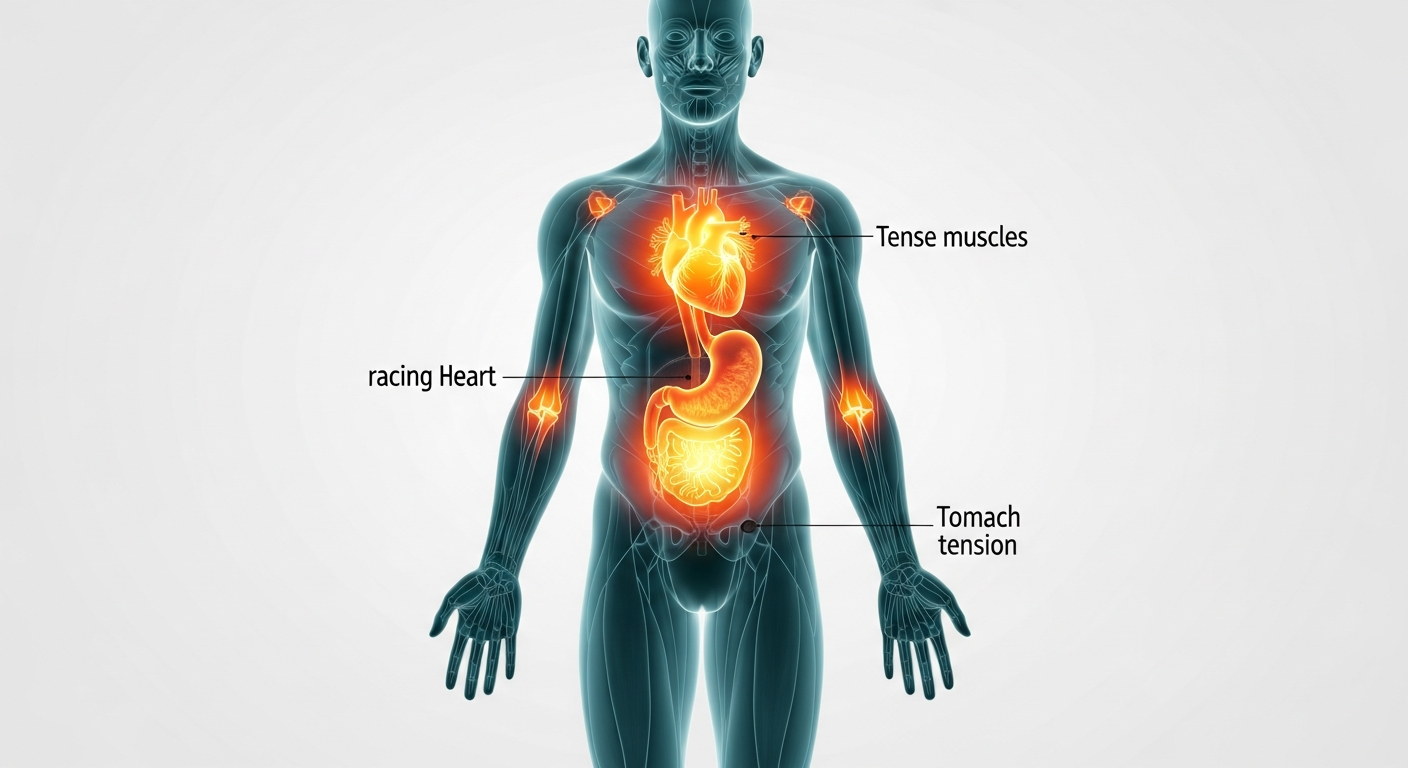
This creates a self-amplifying cycle: your dysregulated nervous system produces physical symptoms (racing heart, shallow breathing, stomach tension), your heightened interoceptive awareness detects these symptoms, your brain interprets them as evidence of danger, which triggers more sympathetic activation, which produces more symptoms. You become hypervigilant to your own body. A slight heart rate increase that would pass unnoticed in a healthy person becomes a catastrophic threat in your mind. This is why reassurance from doctors (“your heart is fine”) doesn’t help—the problem isn’t your heart’s actual safety; it’s your nervous system’s threat perception. Understanding this mechanism is crucial because it reveals why cognitive reassurance alone often fails to reduce anxiety. You need to retrain your nervous system’s threat detection, not just your thinking patterns.
The Trauma Connection: Why Anxiety Feels Like Danger
Chronic anxiety often develops after trauma or prolonged stress. Your nervous system has learned—through actual threat exposure or through observational learning—that the world is dangerous. This learning occurs at a subcortical level, in structures like the amygdala and locus coeruleus. Your nervous system isn’t being irrational; it’s responding to survival programming. Whether your anxiety traces back to childhood trauma, recent loss, prolonged workplace stress, or medical crisis, your nervous system remains in a protective state. It produces the physical symptoms of anxiety not because you’re catastrophizing, but because your threat-detection system is stuck in an elevated setting. This is why understanding PTSD and the body illuminates chronic anxiety—the mechanisms are nearly identical. Both represent nervous system dysregulation rooted in threat learning.
How Neurofeedback Addresses This
LENS neurofeedback trains your brain to recognize safety signals and reduce false-alarm responses. By training lower-frequency brain wave patterns associated with calm alertness, neurofeedback teaches your nervous system to distinguish between actual threat and benign stimuli, naturally lowering your baseline arousal.
Neurofeedback specifically trains dorsal vagal and ventral vagal function, restoring your parasympathetic brake. Improved vagal tone directly translates to lower resting heart rate, deeper breathing, improved heart rate variability, and restored digestive function—the physical symptoms of anxiety resolve as your nervous system rebalances.
By training deeper relaxation states, neurofeedback reduces chronic cortisol elevation. Over weeks of training, your HPA axis downregulates—cortisol awakening response normalizes, daytime elevation decreases, and your body exits the persistent stress state that fuels anxiety’s physical toll.
As your nervous system stabilizes and somatic symptoms improve, you naturally avoid fewer situations. Neurofeedback addresses the root dysregulation rather than relying on gradual exposure, making it possible to access anxiety avoidance loops from a place of nervous system safety rather than pushing through terror.
Frequently Asked Questions
Why doesn’t deep breathing alone fix my anxiety?
Deep breathing can temporarily activate your parasympathetic system, but if your nervous system is chronically dysregulated, it remains stuck in threat mode underneath. Occasional breathing exercises are like trying to drain a bathtub without turning off the faucet. Your nervous system needs consistent retraining to genuinely reset its baseline threat perception. Neurofeedback provides this systematic retraining at the neurobiological level rather than relying on conscious effort.
Is medication necessary if my anxiety is rooted in nervous system dysregulation?
Not always. While anti-anxiety medications can provide temporary symptom relief, they don’t retrain your nervous system. SSRI antidepressants work over weeks to months by affecting neurotransmitter levels, but they address the brain chemistry layer, not the dysregulation pattern itself. Many people benefit from anxiety treatment without medication through neurofeedback alone. Others benefit from combining neurofeedback with medication during the retraining process. The key is addressing the underlying dysregulation rather than indefinitely masking symptoms.
How long does it take for nervous system retraining to show results?
Most people begin noticing subtle shifts—slightly deeper sleep, marginally less heart racing, reduced startle response—within 2-3 weeks of consistent neurofeedback training. Noticeable improvements in anxiety symptoms typically emerge within 4-8 weeks. However, nervous system dysregulation often develops over years, so complete retraining usually requires 3-6 months of consistent sessions. This is still far faster than waiting months for medications to stabilize or years of talk therapy alone.
Can anxiety return after neurofeedback training is complete?
Your nervous system can be reconditioned by new stressors or trauma, but the retraining itself is relatively permanent. It’s similar to learning to ride a bike—once your brain has learned a new pattern, it retains that capacity. However, life inevitably brings new stressors. People who complete neurofeedback training are better equipped to handle future challenges because their nervous system is no longer stuck in dysregulation. Some people benefit from periodic maintenance sessions, especially during high-stress periods.
Is neurofeedback effective if my anxiety is just worry and racing thoughts?
Even pure-cognitive anxiety—where physical symptoms feel minimal—is rooted in nervous system dysregulation. Your racing thoughts are the cognitive manifestation of sympathetic activation. By retraining your nervous system to calm, your brain naturally produces fewer anxious thoughts. Neurofeedback is not about thought-stopping or cognitive reappraisal; it works by creating genuine physiological safety, which allows your mind to settle.
Ready to Support Your Brain Health?
Your anxiety isn’t a character flaw or a thinking problem—it’s a nervous system problem with a neurobiological solution. LENS Neurofeedback retrains your brain to recognize safety, restores your vagal tone, and breaks the physical cycle of chronic anxiety. Schedule a free consultation to discuss how neurofeedback can help you reclaim your calm.
Schedule Your Free Consultation
Call us: (424) 625-5445 · Los Angeles, CA
Disclaimer: This content is for informational purposes only and does not constitute medical advice, diagnosis, or treatment. LENS Neurofeedback is not FDA-approved for all conditions mentioned. Please consult with a qualified healthcare provider before beginning any new treatment program.