

The Brain and Chronic Pain: Understanding the Feedback Loop
Chronic pain isn’t simply a signal of ongoing tissue damage—it’s a self-perpetuating neurological loop driven by central sensitization, glial activation, and maladaptive brain networks. Understanding this mechanism reveals why neurofeedback can interrupt the cycle where conventional treatments often fail.
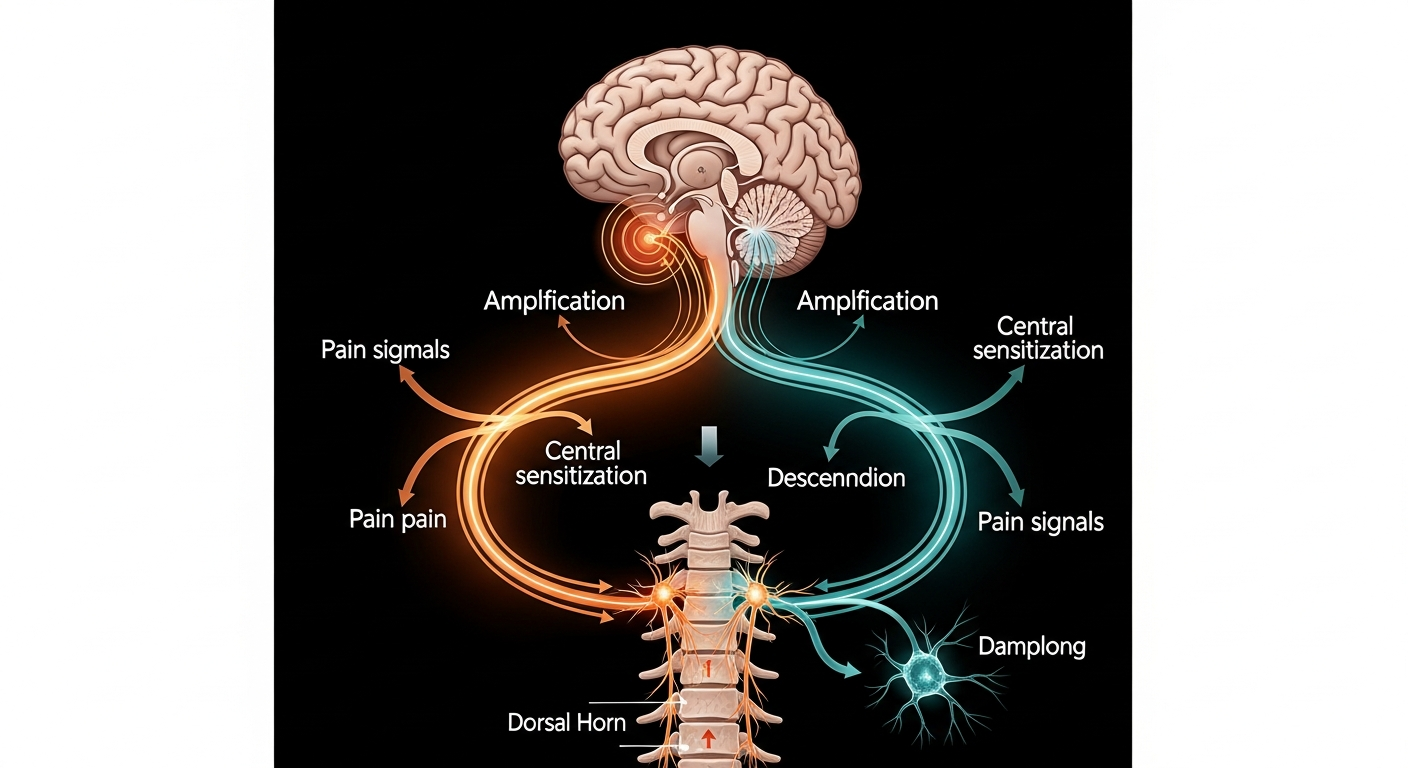
- Central sensitization amplifies pain signals in the nervous system long after initial injury heals
- The anterior cingulate cortex and insula become hyperactive, trapping the brain in chronic pain perception
- Microglia and astrocytes perpetuate inflammation and pain signaling through glial activation
- LENS neurofeedback resets dysregulated brain activity to restore normal pain processing
Approximately 20.4% of U.S. adults experience chronic pain, yet the majority receive treatment aimed only at symptoms rather than the underlying neurobiology driving their condition, according to the National Institute of Neurological Disorders and Stroke (2023). For decades, the pain model was purely mechanical—tissue damage equals pain. But modern neuroscience reveals a far more complex reality: the brain itself becomes the pain generator. Once central sensitization takes hold, pain persists even when the original tissue injury has completely healed. This distinction fundamentally changes how we should approach chronic pain treatment, moving from symptom suppression toward resetting the brain networks maintaining the pain state.
Central Sensitization: When the Nervous System Turns Up the Volume

Central sensitization is the process by which the nervous system amplifies pain signals disproportionate to the stimulus. Imagine your pain perception system as a volume knob—in central sensitization, the knob gets stuck at maximum, and even minor touches or temperature changes produce intense pain. This happens through a cascade of neurological changes: the spinal cord and brain become hyper-responsive, the threshold for activating pain neurons decreases, and pain-modulating circuits malfunction.
Research published in the Journal of Pain (2022) found that individuals with central sensitization show measurable differences in how their brains process sensory input. The dorsal horn of the spinal cord—where pain signals are first integrated—exhibits wind-up: repeated low-level stimuli produce increasingly larger pain responses. Meanwhile, the brain’s pain-suppressing systems, which rely on dopamine and serotonin, become depleted. This isn’t psychological; it’s quantifiable neurochemistry. Individuals experience real, objective amplification of pain signals, which is why conventional approaches addressing only the peripheral injury fail. The problem has moved to the central nervous system.
The Anterior Cingulate Cortex and Insula: The Brain’s Pain Command Center
Two brain regions dominate chronic pain perception: the anterior cingulate cortex (ACC) and the anterior insula. The ACC handles the emotional and motivational aspects of pain—it’s why chronic pain feels threatening and urgent. The insula processes the sensory-discriminative qualities of pain—the intensity, location, and character. In healthy brains, these regions activate briefly in response to actual pain, then quiet down. In chronic pain states, these regions remain persistently activated, firing even in the absence of ongoing tissue damage.
Functional MRI studies consistently show hyperactivity and altered connectivity in these regions in chronic pain patients. A 2023 meta-analysis in Nature Neuroscience found that ACC hyperactivity correlates directly with pain intensity ratings. The insula becomes prone to catastrophic interpretation of normal bodily sensations—a slight muscle tension gets decoded as dangerous damage. This creates a feedback loop: hyperactive pain regions amplify signals from lower levels of the nervous system, which in turn reinforce the hyperactivity of these regions. Understanding neural adaptation to chronic pain mechanisms helps explain why patients often feel pain getting worse despite medical reassurance—their brains have learned to interpret safety as threat.
Glial Cell Activation: The Nervous System’s Inflammatory Engine
Beyond neurons, chronic pain involves glial cells—microglia and astrocytes—which comprise roughly 50% of the brain’s cellular population. These cells are normally protective, cleaning up debris and supporting neuronal health. But when activated inappropriately, they become pain amplifiers. Activated microglia release pro-inflammatory cytokines including TNF-alpha, IL-1β, and IL-6, which directly sensitize pain neurons and amplify pain signaling through the spinal cord and brain.
Chronic pain patients often show elevated levels of these neuroimmune markers in cerebrospinal fluid—objective evidence that glial activation is occurring. The triggers for glial activation vary: initial injury, psychological stress, sleep disruption, and infection can all initiate the process. Once activated, microglia maintain a “memory” of threat, remaining sensitized for months or years. This explains why some patients develop chronic pain after relatively minor injuries—their glial cells have been primed by prior stress or trauma. Interestingly, conditions like fibromyalgia and the nervous system research consistently shows elevated glial activation as a core mechanism, offering a biological explanation for widespread pain that imaging studies often fail to reveal.
Fear-Avoidance and the Psychological Amplification Cycle
Chronic pain creates a predictable psychological pattern: pain leads to fear of movement, which leads to avoidance, which leads to deconditioning and anxiety amplification. The amygdala—the brain’s threat-detection center—becomes hyperactive, learning to associate normal activities with danger. This isn’t malingering; it’s learned pain. The brain genuinely perceives threat because past pain has trained it to do so. This fear-avoidance cycle recruits the hypothalamic-pituitary-adrenal (HPA) axis, keeping stress hormones elevated, which further sensitizes pain networks.
Neuroimaging shows that patients with strong fear-avoidance beliefs exhibit greater activation in threat-processing regions during pain tasks. The expectation of pain actually triggers pain—a process called nocebo hyperalgesia. Interestingly, trauma history compounds this; patients with PTSD and pain comorbidity show even greater amygdala-insula connectivity and stronger fear-conditioning to pain cues. Breaking this cycle requires not just cognitive restructuring but actual neuroplasticity—rewiring the brain’s threat-response systems at the network level.
The Vicious Loop: How Pain Becomes Self-Perpetuating
The chronic pain feedback loop operates on multiple levels simultaneously. Initial tissue injury activates nociceptors—pain-sensing nerve endings. Normally, as tissue heals, nociceptor firing decreases and the nervous system recalibrates. But when stressors, sleep deprivation, or previous trauma are present, the central nervous system fails to downregulate. Instead, hyperactivity in the ACC and insula intensifies pain perception. This heightened perception triggers fear and avoidance. Avoidance deconditioning and stress hormone elevation maintain glial activation. Activated glia perpetuate neuroinflammation, which keeps pain neurons sensitized. And round it goes—a self-sustaining circuit entirely independent of peripheral tissue status.
Standard treatments often address only one level of this system. Pain medication targets nociceptors. Physical therapy targets the periphery. Cognitive-behavioral therapy addresses thoughts and behaviors. But unless the dysregulated brain networks themselves are reset, the feedback loop persists. Patients improve temporarily, then regress. The brain is still “stuck” in pain-amplification mode, waiting to be recalibrated.
How LENS Neurofeedback Disrupts the Central Sensitization Loop
LENS (Low Energy Neurofeedback System) operates on a principle of mirror-and-correct: it detects dysregulation in real-time brain electrical activity via EEG and delivers minute electromagnetic stimulation that mirrors and prompts the brain to self-correct. The mechanism differs fundamentally from traditional biofeedback. Rather than asking patients to consciously control brain activity, LENS works at the level of natural oscillatory patterns, allowing the brain to reorganize its dysregulated networks without volitional effort.
In chronic pain, LENS targets the hyperactive default mode network and the abnormal connectivity between the ACC and insula. By delivering microsecond-level stimulation synchronized to the brain’s own electrical rhythms, LENS prompts the ACC and insula to downregulate from their pain-amplifying state. Simultaneously, it restores normal autonomic balance, reducing HPA axis overactivity and allowing stress-hormone levels to normalize. Reduced stress hormones permit glial deactivation, lowering neuroimmune activation. As central sensitization gradually resolves, pain perception normalizes and fear-avoidance cycles lose their grip. Patients report not that pain “goes away” artificially, but that their nervous system relearns how to process pain signals proportionately again.
How Neurofeedback Addresses This
LENS directly targets ACC and insula hyperactivity, reducing pain-perception amplification at the source rather than merely masking symptoms with medication.
By normalizing stress hormones and brain electrical dysregulation, LENS permits glial deactivation, lowering the pro-inflammatory cascade driving central sensitization.
As dysregulation resolves, the amygdala-insula circuit normalizes, allowing the brain to decondition from pain-threat associations and rebuild confidence in movement and activity.
LENS complements physical therapy, medication, and psychology by addressing the neurobiological root, making other interventions more effective and sustainable.
Frequently Asked Questions
How do I know if I have central sensitization rather than ongoing tissue damage?
Several clinical clues suggest central sensitization: pain disproportionate to what imaging shows, pain that spreads beyond the original injury, multiple widespread pain sites, elevated pain with stress or poor sleep, and a long history of unresolved pain despite appropriate treatment. A healthcare provider can assess your pattern; LENS providers are trained to recognize central sensitization markers and recommend appropriate testing if needed.
Can LENS neurofeedback replace my pain medication?
LENS works as an adjunct to medical care, not a replacement. Many patients do reduce medication over time as their nervous system recalibrates and pain perception normalizes, but this must be done under physician supervision. Some patients achieve significant pain reduction, while others maintain medication at lower doses. Your prescribing doctor should be aware you’re pursuing neurofeedback so medications can be adjusted safely as you improve.
How long does it take to see results from LENS treatment?
Most patients notice subtle shifts within 4-8 sessions: better sleep, slightly less irritability, or occasional pain-free moments. Meaningful pain reduction typically emerges over 12-20 sessions. The brain’s neural networks reshape gradually through neuroplasticity. Chronic pain that took months or years to develop often requires 3-6 months of consistent LENS treatment to substantially resolve, though individual timelines vary based on pain severity and how entrenched the dysregulation is.
Is LENS neurofeedback safe if I have other neurological conditions or take multiple medications?
LENS is a non-invasive, non-pharmacological intervention with no known serious adverse effects. However, your medical history should be reviewed by a qualified neurofeedback provider before starting. Some conditions (active psychosis, uncontrolled seizures) require additional medical coordination. LENS doesn’t interact with medications, but your provider needs to know your full health picture to tailor the protocol appropriately.
What happens after LENS treatment ends? Will my pain come back?
LENS creates lasting neuroplasticity—it doesn’t suppress symptoms temporarily. Once brain networks have been recalibrated, they tend to maintain the new state, similar to how physical therapy creates lasting strength gains. However, major new stressors or trauma can potentially reactivate old patterns. Most patients complete an initial course (typically 20-40 sessions) and then either discontinue or use occasional maintenance sessions to prevent relapse.
Ready to Support Your Brain Health?
If chronic pain has trapped your nervous system in a sensitization loop, resetting your brain’s pain-processing networks is possible. LENS neurofeedback addresses the neurobiological root of central sensitization. Get started with a free consultation to learn whether your pain pattern matches central sensitization and how LENS can help interrupt the feedback loop.
Schedule Your Free Consultation
Call us: (424) 625-5445 · Los Angeles, CA
Disclaimer: This content is for informational purposes only and does not constitute medical advice, diagnosis, or treatment. LENS Neurofeedback is not FDA-approved for all conditions mentioned. Please consult with a qualified healthcare provider before beginning any new treatment program.