

Why Children's Brains Need Boredom
Boredom is where children build executive function. Unstructured, self-directed time forces a developing brain to generate its own goals, sequence its own plans and tolerate its own discomfort — the exact skills that scheduled activities supply from the outside. The American Academy of Pediatrics considers protecting this time a clinical priority.
- Free play builds executive function: working memory, flexible thinking and self-regulation
- The AAP recommends pediatricians actively advocate for and protect unstructured play
- Boredom is the starting condition for self-direction, not a problem to be solved for the child
- Constantly filled schedules outsource the planning a child’s brain needs to practice itself
The American Academy of Pediatrics published a clinical report titled The Power of Play in 2018, reaffirmed in 2025, recommending that pediatricians write what one of its lead authors described as a prescription for play. The reasoning is developmental rather than sentimental: developmentally appropriate play is described as a singular opportunity to promote the social-emotional, cognitive, language and self-regulation skills that build executive function. Boredom, in that framing, is not a gap in a child’s day. It is the condition under which some of the most important development happens.
What Is Actually Happening in a Bored Child's Brain?

When external structure disappears, something has to supply direction from the inside. That internal supply is executive function — the family of skills covering working memory, flexible thinking and self-regulation.
In a structured activity, an adult provides the goal, the sequence and the transition cues. The child executes. In unstructured time, the child has to generate all three. They must decide what to do, hold that plan in mind while carrying it out, notice when it stops working, and switch approach without anyone signalling that it is time.
That is a demanding cognitive workout, and it happens to be the same workout that predicts later academic and emotional outcomes, and it is why children need more play than we realize. Play enhances brain structure and function and promotes executive function — the process of learning rather than the content — which is what allows children to pursue goals and ignore distractions.
Why Does the Uncomfortable Part Matter?
The discomfort is the mechanism, not a side effect. Boredom is a mildly aversive state, and tolerating it while generating a response is precisely how children build frustration tolerance and self-direction.
When an adult resolves that discomfort immediately — with a screen, a suggestion, an activity — the child gets relief but skips the rep. Do that consistently and a pattern forms: discomfort is something someone else fixes, and quickly.
This is worth stating carefully, because it is easily misread as an argument for neglect. It is not. A child who is bored and safe, with materials available and an adult nearby, is in a productive state. A child who is bored, unsupervised and unsupported is in a different situation entirely. The goal is protected unstructured time, not absence.
Haven't Children Always Been Bored?
Yes — and that is exactly the point. What has changed is not children’s capacity for boredom but the availability of an instant exit from it.
Historically, boredom had no reliable escape hatch. A child who ran out of things to do eventually invented something, because inventing something was the only option. That constraint did the developmental work automatically.
A device removes the constraint. It offers immediate, effortless, highly stimulating relief at the exact moment the brain would otherwise have started generating. The problem is not screen time in the abstract; it is that screens most often fill precisely the gaps where self-direction would have developed. Our earlier guide on why downtime is healthy for the brain covers the same principle for adults.
What About Children Who Genuinely Cannot Tolerate It?
Some children find unstructured time genuinely distressing rather than mildly uncomfortable, and the distinction matters. For a child whose attention regulation is already effortful, an empty afternoon is not an invitation — it is an overwhelming set of undefined options.
For these children the answer is usually a smaller version rather than none: shorter windows, a defined physical space, a few open-ended materials, and an adult available but not directing. Our what to expect page explains how an assessment works if you want a clearer picture first. The skill is built by graduated exposure, the same as any other.
If a child’s difficulty with unstructured time sits alongside persistent trouble with focus, transitions or emotional regulation across settings, that is worth evaluating properly rather than managing indefinitely. Our page on ADD/ADHD treatment explains how attention regulation is assessed and addressed.
How Much Unstructured Time Do Children Need?
There is no validated number, and it would be dishonest to invent one. What the AAP position supports is a direction rather than a dose: unstructured play should be actively protected in homes and schools rather than treated as the first thing to cut.
In practice, the useful question for a family is not how many minutes but whether any genuinely open time exists at all. A week composed entirely of school, homework, scheduled activities and screens contains no window in which a child directs themselves.
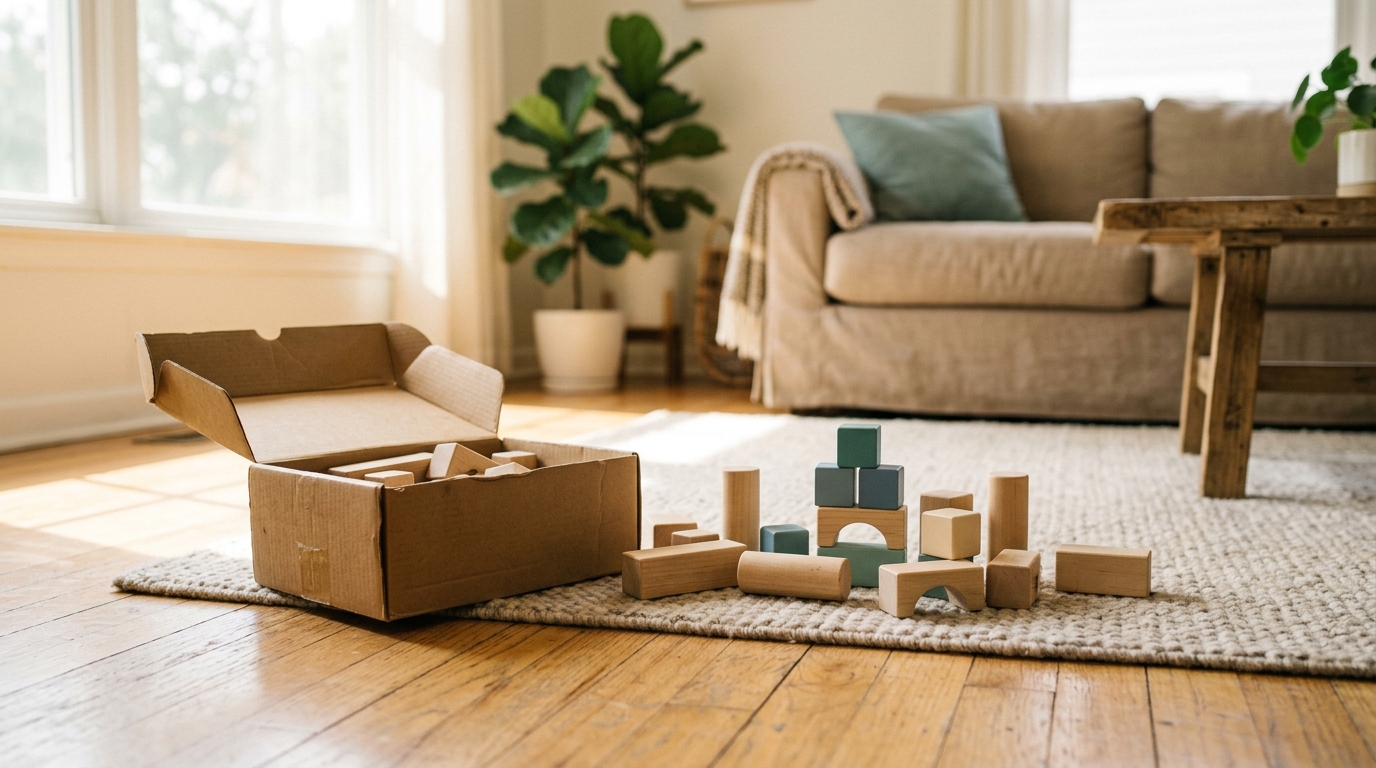
One caution: unstructured does not mean unsupervised or unresourced. Open-ended materials — blocks, art supplies, a safe outdoor space — give a child something to build a plan around. A bare room and an instruction to entertain themselves is a harder task than most children can meet.
What Should Parents Actually Do?
Mostly, less — deliberately. Resist filling the gap the moment a child announces they are bored. The announcement is often the beginning of the process rather than a request for rescue, and the few minutes after it are where the generating happens.
Say plainly that boredom is allowed. Children take cues about what states are acceptable; a child who learns that boredom is a problem requiring adult intervention will keep bringing it to an adult.
Protect one predictable window rather than overhauling the schedule. Consistency matters more than duration here — the same principle that makes routine so regulating for developing brains. And if what looks like boredom intolerance is really persistent dysregulation, address that directly rather than scheduling around it.
When Unstructured Time Is Not the Issue
Some Children Are Dysregulated, Not Overscheduled
If a child cannot settle in any condition — structured or free — the underlying issue is usually regulation rather than how the calendar is arranged.
Attention Difficulty Shows Up Everywhere
Genuine attention regulation problems appear across settings and over time, not only during unstructured moments. That pattern is worth evaluating properly.
Assessment Before Assumption
Brain mapping measures how a child’s brainwave patterns are actually regulating, so support is based on findings rather than on behavioral guesswork.
Training Works With Development
Neurofeedback aims to support the brain’s own regulatory capacity, which is what allows a child to tolerate open time rather than avoid it.
Frequently Asked Questions
Is boredom really good for children, or is that just a saying?
The defensible version is narrower than the slogan. Boredom itself is not beneficial; what is beneficial is what a child does in response to it when given the room and materials to respond. Unstructured, self-directed play is well supported by the American Academy of Pediatrics as a driver of executive function development. Boredom is the entry condition to that play, which is why removing it too quickly removes the opportunity.
How is unstructured play different from just letting kids do whatever?
Unstructured play is child-directed but adult-supported: a safe space, open-ended materials, an available adult, and a genuine absence of imposed goals. Letting children do whatever with no framework, no supervision and unlimited screen access is a different thing and does not produce the same developmental benefit. The structure is in the environment; the direction comes from the child.
My child says they're bored constantly. Is something wrong?
Usually not — frequent boredom complaints are common, especially in children accustomed to a high level of stimulation, and they often ease as the child rebuilds tolerance. It is worth a closer look if the child cannot settle in any context, if boredom reliably escalates into significant distress, or if it sits alongside ongoing difficulty with focus, transitions or emotional regulation across school and home.
Does this mean I should cut all my child's activities?
No. Structured activities have real value — skill development, physical activity, belonging, and adult relationships outside the family. The concern is a week with no open time at all. The practical goal is protecting one predictable unstructured window rather than dismantling a schedule that is otherwise working.
At what age does this matter most?
Executive function develops across childhood and adolescence rather than during one critical window, so unstructured time matters throughout — the form simply changes. For younger children it looks like open-ended imaginative play; for adolescents it looks like genuinely unscheduled time to pursue their own interests. The adolescent version is often the first thing cut, which is worth noticing given that executive function is still maturing well into the twenties.
Sources
- Power of Play in Early Childhood — American Academy of Pediatrics
- Neuroplasticity — StatPearls, NCBI Bookshelf
- ADHD in Children Ages 5-17 — CDC NCHS Data Brief No. 499 (March 2024)
Concerned About Your Child's Focus or Regulation?
If your child struggles to settle regardless of how their day is structured, the issue may be regulation rather than scheduling. At MyNeuroBalance in Los Angeles we assess how a child’s brain is actually regulating before recommending anything. Schedule a consultation to talk it through.
Schedule Your Free Consultation
Call us: (424) 625-5445 · Los Angeles, CA
Disclaimer: This content is for informational purposes only and does not constitute medical advice, diagnosis, or treatment. LENS Neurofeedback is not FDA-approved for all conditions mentioned. Please consult with a qualified healthcare provider before beginning any new treatment program.