

The Brain's "Smoke Alarm": Understanding the Amygdala
The amygdala is the brain’s threat-detection system — fast, automatic and deliberately imprecise. It is built to react before you consciously understand why, because hesitation was historically more costly than a false alarm. Problems arise not when it works, but when it stops standing down.
- The amygdala is designed for speed over accuracy — false alarms are the intended trade-off
- It reacts before conscious awareness, which is why you cannot reason your way out of the first second
- Chronic stress strengthens amygdala connectivity while thinning the regions that regulate it
- In PTSD, amygdala hyperactivity is paired with reduced prefrontal regulation
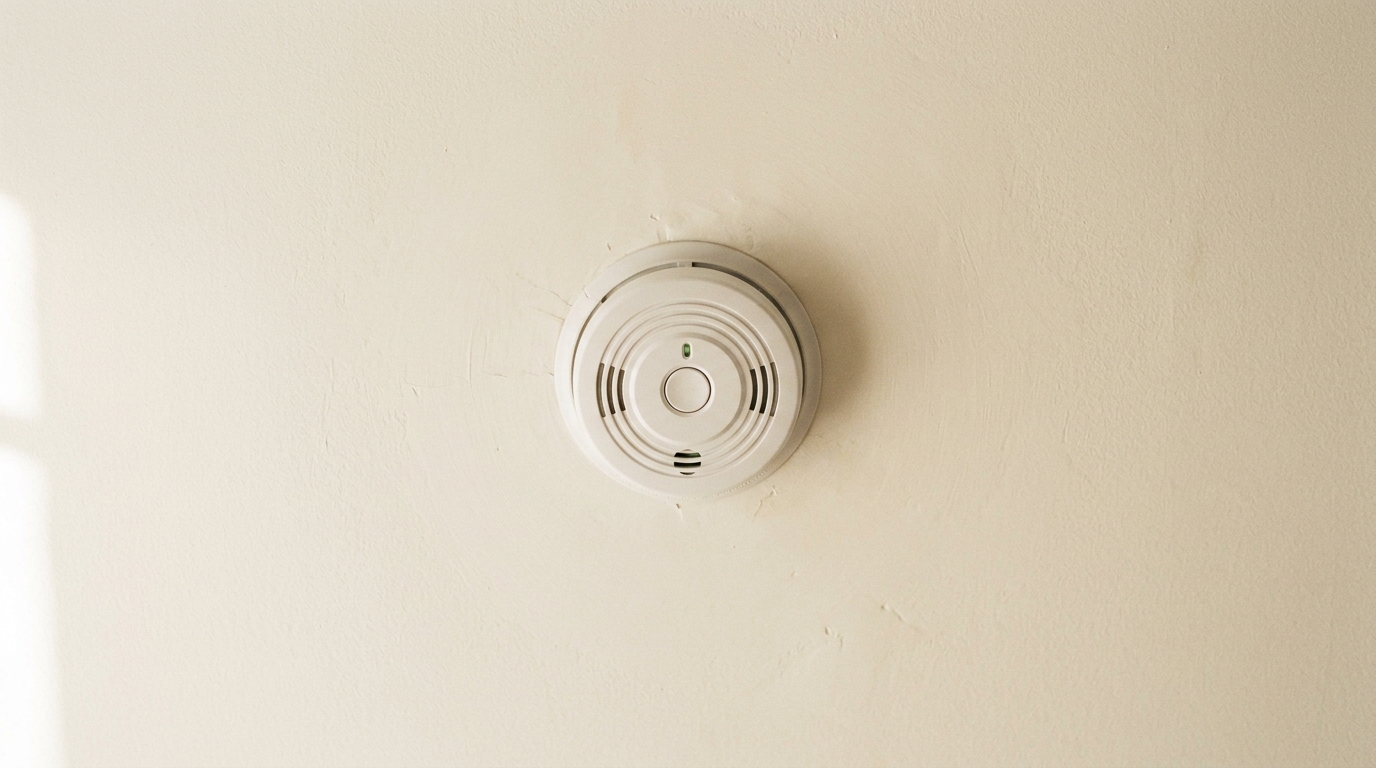
A smoke alarm that only triggered for confirmed house fires would be a bad smoke alarm. Its usefulness depends on it going off for burnt toast, because the cost of a false alarm is trivial next to the cost of missing a real one. The amygdala is built on the same logic, and understanding that single design decision explains most of what people find baffling about their own fear, anxiety and reactivity.
What Does the Amygdala Actually Do?

The amygdala is a pair of almond-shaped structures deep in the temporal lobes, and it functions as a critical brain region for fear learning and expression — the centre of what researchers call the fear circuit.
Its role is rapid significance-tagging. It receives sensory input and answers one question extremely quickly: does this matter, and is it dangerous? If the answer is yes, it initiates a coordinated response before slower, more analytical regions have finished processing the situation.
That response is whole-body: heart rate rises, breathing changes, muscles tense, attention narrows, non-essential functions like digestion are deprioritized. None of it waits for a conscious decision, which is why you are often already reacting before you have identified what you reacted to.
Why Is It So Often Wrong?
Because it is optimized for speed rather than accuracy, and those trade off against each other. Precise threat assessment requires context, comparison and time. The amygdala has none of these, by design.
It works on rough pattern matching. Something resembles a past threat closely enough, and the alarm sounds. That resemblance can be crude — a tone of voice, a particular light quality, a smell, a physical sensation similar to one present during an earlier frightening event.
In evolutionary terms this is a sound bargain. A false alarm costs a jolt of adrenaline; a missed alarm could cost everything. The asymmetry justifies a heavily biased system. The difficulty is that modern life presents very few genuine physical threats and a great many pattern matches, so the same system that once saved lives now fires during performance reviews.
Can You Think Your Way Out of an Amygdala Response?
Not the first second of one. The amygdala’s fast pathway reaches it before the information has been fully processed by the cortex, so the reaction is already underway by the time you are consciously evaluating whether it was warranted.
What you can influence is what happens next. The prefrontal cortex provides top-down regulation, assessing whether the alarm is justified and dampening the response when it is not. That regulation is real but slower, which is why the useful skill is not preventing the initial surge but shortening how long it runs.
This is why just calm down
and you know it’s not dangerous
fail so consistently. Both address a system that is not currently in charge. Knowing intellectually that a situation is safe does not reach the structure that has already decided otherwise.
What Makes an Amygdala Overprotective?
Two things, mainly: repeated activation and weakened regulation — and chronic stress produces both simultaneously.
In the basolateral amygdala, chronic stress strengthens the structural basis of synaptic connectivity through dendritic growth. Meanwhile the prefrontal cortex, which supplies the regulatory braking, shows dendritic loss under the same conditions. The alarm gets louder and better wired while the system that quiets it gets thinner.
This is the structural picture behind persistent anxiety. It is not that anxious people are choosing to overreact; it is that the ratio between alarm and regulation has physically shifted. Our article on the hidden cost of constant stress covers that remodeling in detail.
What Happens to the Amygdala After Trauma?
Trauma produces a particularly clear version of this imbalance. Individuals with PTSD typically display increased amygdala activity across study paradigms and populations, and that activation correlates with symptom severity.
The regulation side is affected in parallel. Symptoms generally arise from decreased activity in the medial prefrontal cortex and ventral hippocampus alongside hyperactivity in the amygdala — exaggerated amygdala reactivity resulting partly from insufficient top-down regulation.
There is a generalization effect too. Fear learning in PTSD is biased toward stimuli of higher emotional intensity than the original conditioned threat, which is one reason the range of triggering situations tends to expand rather than narrow over time. This is a circuit-level finding, and it is why PTSD treatment that addresses regulation matters alongside processing the memory itself.
How Do You Turn the Volume Down?
Not by arguing with the alarm. The approaches that work operate on the body and the regulatory balance rather than on the belief.
Slow exhalation is the most immediate lever, because extended exhale engages parasympathetic activity directly — a physiological input the amygdala responds to, unlike reassurance. Sleep matters enormously, since sleep deprivation reliably increases amygdala reactivity and weakens prefrontal regulation, meaning a tired brain is a more reactive one by default.
Over a longer horizon, the goal is strengthening the regulatory side rather than eliminating alarms. An amygdala that never fired would be dangerous. The aim is a system that raises an alarm, gets accurately evaluated, and stands down.
Where that stand-down is not happening, LENS neurofeedback therapy works on the regulation pattern directly, giving the nervous system feedback about its own activity so a calmer state becomes reachable and repeatable.
How Neurofeedback Addresses an Overactive Alarm
It Targets Regulation, Not Reassurance
Training works on the brainwave patterns underlying the alarm-regulation balance rather than trying to talk a threat system out of its conclusion.
No Need to Retell the Story
Because it works with brain activity directly, progress does not require recounting distressing events — often important for trauma-related reactivity.
It Helps Locate a Calmer State
People whose alarm has run for years often cannot find a regulated state unaided. Feedback helps the brain find it, then practice it.
It Starts From Measurement
Brain mapping shows how your regulation is actually patterned, so training addresses your nervous system rather than a general profile.
Frequently Asked Questions
Can you damage or remove the amygdala to stop fear?
You would not want to. The amygdala is essential for detecting genuine danger and for normal emotional learning, and people with significant amygdala damage show impaired threat recognition that puts them at real risk. The clinical goal is never to eliminate the alarm but to restore the balance between the alarm and the regulatory systems that evaluate it.
Why do I react before I even know what scared me?
Because the amygdala receives a fast, rough version of sensory input and initiates a response before the cortex has finished processing the details. The physical reaction is genuinely underway before conscious identification occurs. This is normal design, not a malfunction — the system trades accuracy for speed on the reasoning that a delayed response to a real threat is more costly than a false alarm.
Is an overactive amygdala the same as anxiety?
Not exactly. Anxiety is a clinical picture involving many systems, and reducing it to one structure oversimplifies it. That said, the imbalance between amygdala reactivity and prefrontal regulation is a well-supported part of the mechanism, and it usefully explains why anxiety resists reasoning and why chronic stress makes it worse. It is a significant part of the story rather than the whole of it.
Does breathing actually do anything, or is it a distraction?
It does something physiological. Extended exhalation engages parasympathetic activity, which directly influences the body state the threat system is monitoring. That is a different mechanism from distraction. It works best as a practiced skill rather than an emergency measure — a technique rehearsed only during panic is one your nervous system has never learned in a calm state.
How long does it take to reduce an overactive threat response?
It varies with how long the pattern has run, whether trauma is involved, sleep quality, and the state of the regulatory systems. Anyone offering a fixed timeline is overstating what the evidence supports. What is consistent is that change tends to be gradual and to depend on repeated experience of a regulated state rather than on understanding the problem — which is why insight alone so often fails to shift it.
Sources
- Brain circuit dysfunction in post-traumatic stress disorder — National Library of Medicine (PMC)
- Impact of Stress on Brain Morphology — National Library of Medicine (PMC)
- Structural Neuroimaging of Hippocampus and Amygdala Subregions in PTSD — National Library of Medicine (PMC)
Is Your Alarm System Stuck On?
If you are reacting to situations you know are not dangerous, the issue is the balance between your brain’s alarm and its regulation — not your reasoning. At MyNeuroBalance in Los Angeles we measure that pattern and train it directly. Schedule a brain health assessment to start.
Schedule Your Free Consultation
Call us: (424) 625-5445 · Los Angeles, CA
Disclaimer: This content is for informational purposes only and does not constitute medical advice, diagnosis, or treatment. LENS Neurofeedback is not FDA-approved for all conditions mentioned. Please consult with a qualified healthcare provider before beginning any new treatment program.