
The Brain That Won't Shut Off at Night: Why Exhaustion and Sleeplessness Coexist
Physical exhaustion and an active mind at bedtime feel like they should cancel each other out. They often don't. The neuroscience of what happens in the brain during those hours offers a clearer picture of why.
There is a question that most people in this situation never quite articulate, because the experience feels too obvious to require one. You are exhausted. You have been exhausted since mid-afternoon — heavy limbs, slow thinking, the particular kind of tired that is not just fatigue but something more accumulated, more total. Your body is doing exactly what bodies do when they are worn out. And then you lie down, and something happens that makes no immediate sense: you become more awake.
The thoughts that were manageable during the day become sharper. The things left unresolved feel more urgent. The room is dark and quiet, which is exactly what you were told to want, and somehow the quiet is making it worse. An hour passes. Then another. The exhaustion is still there — you can feel it — and so is the wakefulness. They are both real, and they appear to be operating independently.
The question worth asking is: why?
The intuitive explanations — too much on your mind, too much screen time, too much worry — are not wrong. They describe conditions that can contribute to this pattern. But they don’t explain the mechanism, and without a clearer picture of the mechanism, the experience stays something to be managed through discipline or will rather than understood. What sleep research has been building toward is a model that explains this more precisely. It begins not with the thoughts themselves but with the brain’s arousal system — and with what that system is actually doing in the hours before sleep.
Why Doesn't Exhaustion Guarantee Sleep?
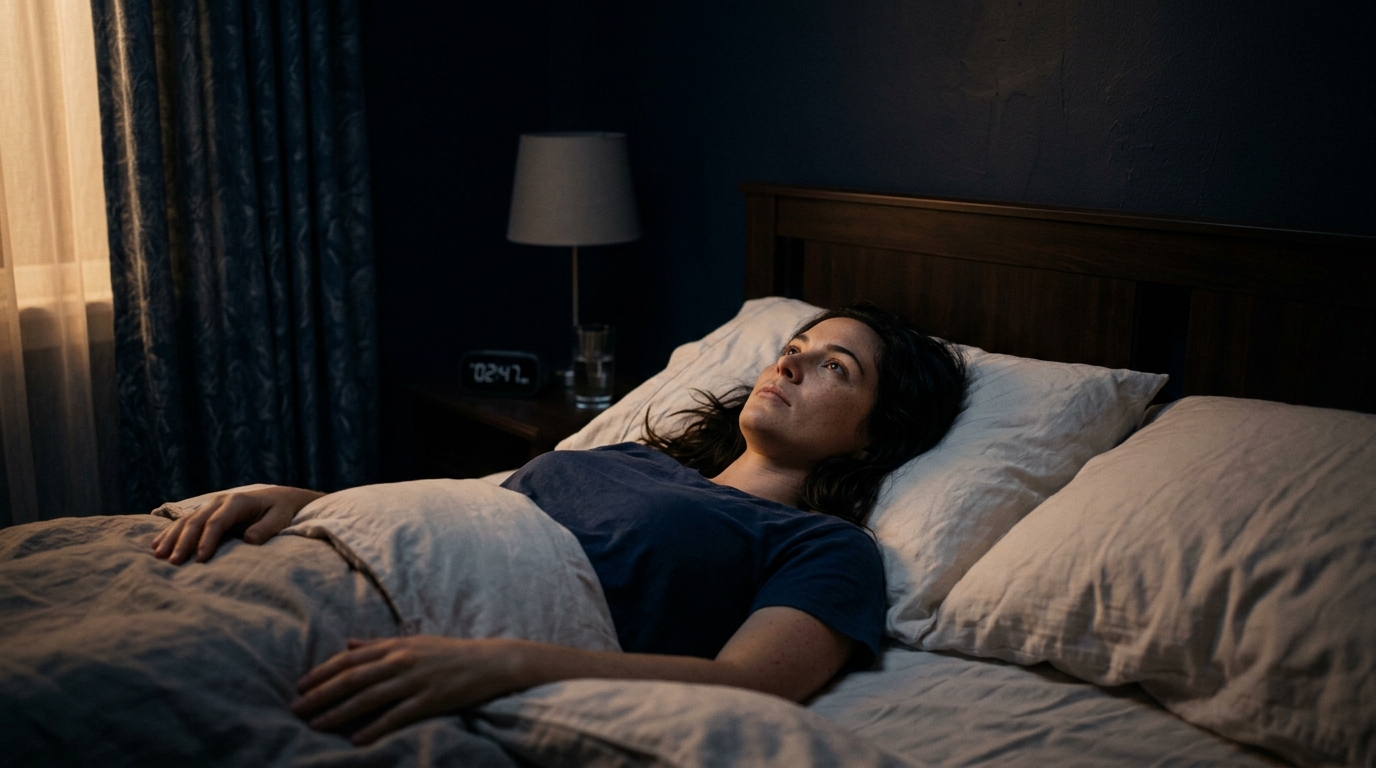
The common assumption about sleep is that it arrives when the body is tired enough. This is broadly true in ordinary circumstances — accumulated sleepiness does drive sleep, and after enough hours awake, the pressure to sleep becomes irresistible. But this model of sleep as simple depletion leaves out something important: sleep is not merely the absence of wakefulness. It is a state the brain has to actively enter, and it competes with a system whose job is to prevent that from happening too easily.
The arousal system is not a design flaw. Its function is to keep the organism alert and responsive — to maintain the kind of wakefulness that allows for threat detection, problem solving, and engagement with the environment. When that system is appropriately calibrated, it recedes in the evening as the homeostatic pressure for sleep builds, and the brain transitions into sleep without much conscious effort. The problem that insomnia research describes is what happens when the arousal system fails to recede on schedule.
A 2026 review by Huang and colleagues describes insomnia disorder through what researchers call the hyperarousal model — a framework that characterizes the disorder as involving cognitive, emotional, cortical, neuroendocrine, and autonomic overactivation (Huang Y et al.; 2026, PMID 42523963). Each of those words describes a different layer of the same problem. Cognitive overactivation means the mind is generating thought at a pace and urgency inconsistent with rest. Emotional overactivation means the threat-detection system is treating ordinary circumstances as requiring heightened response. Cortical overactivation is a measurable property of the brain’s electrical activity — the brain is running hotter, in physiological terms, than it needs to be. Neuroendocrine and autonomic overactivation describe the downstream effects: the hormone systems and the body’s automatic regulation are both primed for readiness rather than rest.
What the hyperarousal model does is shift the center of gravity of the explanation. The problem is not primarily a problem with sleep — it is a problem with the arousal system that is supposed to step aside so sleep can happen. Exhaustion creates pressure for sleep. Hyperarousal creates counterpressure. When the two systems are roughly in balance, the result is the experience described above: tired, but awake.
What Is Actually Happening in the Hours Before Sleep?
The question of what distinguishes the brain of someone with chronic sleeplessness from the brain of someone who sleeps easily is not merely philosophical. It is measurable, and recent research has been measuring it with increasing precision.
A 2026 study by Cui and colleagues used optically pumped magnetometer magnetoencephalography — a technique that measures the brain’s magnetic fields with high temporal resolution — to compare 26 people with insomnia disorder against 29 healthy controls during the pre-sleep hours (Cui F et al.; 2026, PMID 42529863). What they found was altered aperiodic activity and altered microstate dynamics specifically in the evening, before sleep was even attempted. The aperiodic spectral exponent the researchers measured is an index of the ratio of neural excitation to inhibition — a way of capturing whether the brain is running in a more excitable or more inhibited state. In the insomnia group, this measure was altered in the evening session in a way that was not present in healthy controls.
This finding matters because it is physical, not psychological. It is not a report of what the participant was thinking or feeling. It is a direct measurement of how the brain was firing in the period before sleep. The difference between the two groups was detectable before either group lay down to sleep — which means the divergence between the exhausted body and the wakeful brain is already established by the time bedtime arrives.
This is consistent with what the hyperarousal model predicts, but it adds specificity: the hyperarousal is not distributed evenly across the day. It has an evening signature. For people with insomnia disorder, the approach of sleep does not produce a quieting of the brain’s activity. In the data from this study, something closer to the opposite was occurring.
Why Does the Quiet Room Make Things Louder?
The observation that the thoughts get sharper when the room gets quiet is one of the most consistently reported features of this pattern, and it is also one of the most counterintuitive. The logic of rest suggests that removing external demands should lower mental activity. In a normally functioning sleep system, that is roughly what happens. In insomnia disorder, the evidence suggests something different.
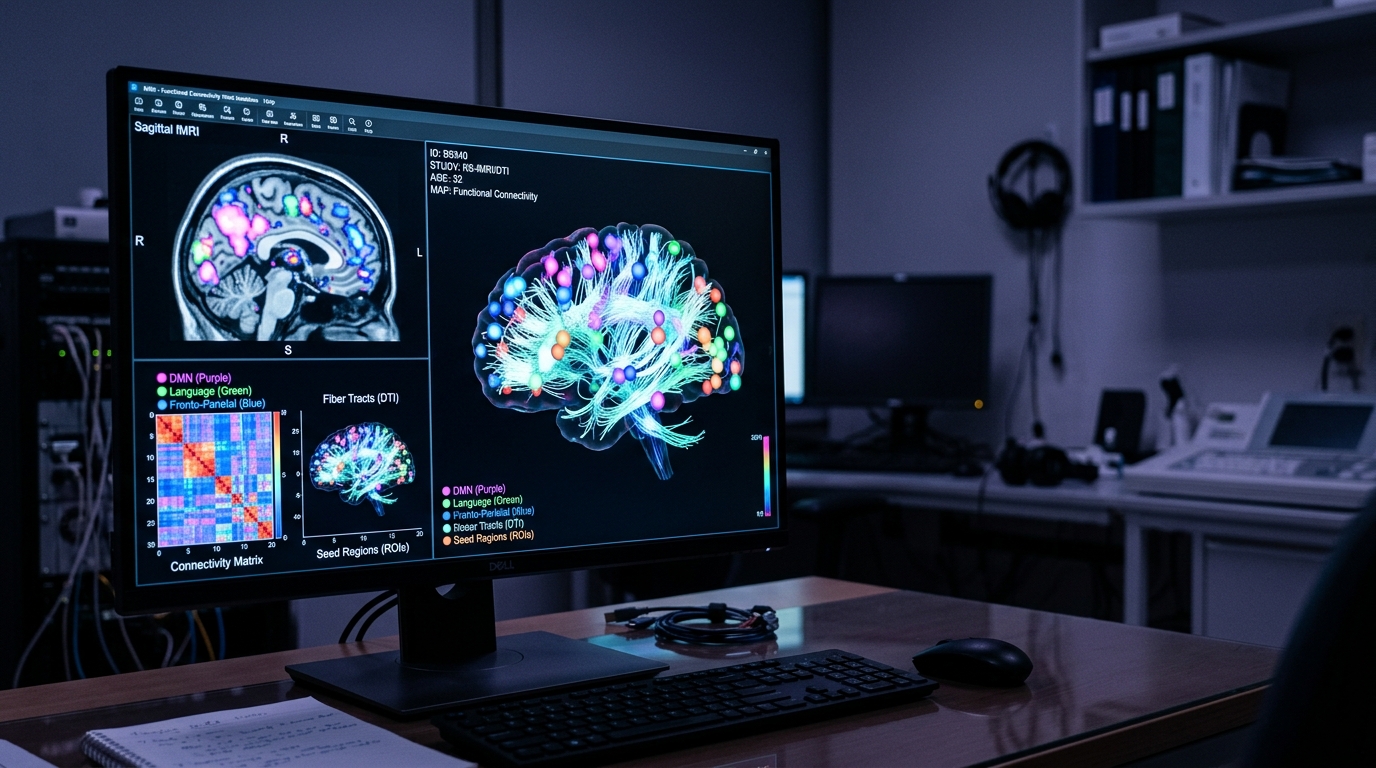
A 2026 systematic review by Zhang and colleagues synthesized 24 neuroimaging studies involving 1,229 people with insomnia disorder and 1,077 healthy controls, looking specifically at resting-state functional connectivity — the patterns of communication between brain regions when no task is being performed (Zhang Y et al.; 2026, PMID 42701814). The networks that showed consistent alterations in the insomnia group included the default mode network, the salience network, and the executive control network, among others.
The default mode network is worth understanding in some detail here, because it is directly relevant to what people experience when they lie awake. The DMN is the brain’s self-referential network — the system that activates when external demands drop and the mind turns inward. Memory processing, self-related thought, mental simulation of future scenarios, and the kind of reviewing that happens when there is nothing else to attend to are all associated with DMN activity. In ordinary circumstances, the DMN is constrained by external tasks during the day and is partly down-regulated during sleep. In insomnia disorder, the systematic review found that the DMN is among the altered networks, and the nature of those alterations is complex — both increased and decreased connectivity were observed across different studies, suggesting a system that is dysregulated rather than uniformly active.
The salience network governs what the brain treats as requiring attention and response. Research by Tan and colleagues, examining sleep quality and network connectivity across two datasets totalling more than 1,300 participants, found that poorer sleep quality was associated with distinct patterns of both DMN and salience network connectivity (Tan S et al.; 2026, PMID 42128467). The associations differed by age and sex, which is important: the relationship between network function and sleep is not uniform across people.
What this picture suggests is that when the exhausted person lies down in a dark room and the external demands of the day disappear, the brain does not simply receive a quieting signal. For the brain with insomnia-pattern dysregulation, the reduction in external demands may remove the very thing that was constraining the DMN’s self-referential activity. The quiet room is not adding new thoughts — it is removing the competition for attention, leaving the self-referential system with more room to run.
What Does This Have to Do With Anxiety?
Anxiety and the insomnia pattern frequently appear together, and there are people who experience both without being certain which came first — or whether the distinction is even meaningful. The neuroscience offers some clarity on why these patterns are related while also being distinct.
The hyperarousal model of insomnia described by Huang and colleagues (2026, PMID 42523963) includes, alongside cortical and cognitive overactivation, the activation of the hypothalamic-pituitary-adrenal axis and autonomic imbalance. The HPA axis is the brain-body pathway that regulates the stress response. It governs cortisol production and sets the background level of physiological alertness — the readiness of the system to respond to demands. When the HPA axis is chronically elevated, as can occur in sustained anxiety states, the downstream effect on sleep is not simply that the person is worried at bedtime. It is that the physiological conditions for sleep are compromised at a hormonal level that precedes any particular thought.
This connection between HPA activation and insomnia does not mean that anxiety causes insomnia in a simple linear way. The relationship is more circular than that. A brain running at elevated arousal at bedtime is more likely to generate anxious content — the threat-detection system, when active, looks for threats, and in the absence of external ones, may find them in memories, anticipated future events, or the monitoring of the body itself. Waking up in the middle of the night and failing to return to sleep can produce concern about waking up and failing to return to sleep, which becomes its own arousal input. The circadian and HPA components described by Huang and colleagues suggest that the system can sustain itself through physiological means even when the original stressor is long past.
This also means that the experience of anxiety being most noticeable at night is not simply a matter of having more time to notice it. The architecture of the arousal system at bedtime may create conditions in which anxiety symptoms are amplified — the salience network is more active, the DMN is less constrained, and the HPA axis may not have returned to its resting state. For some people, nighttime anxiety is not a version of daytime anxiety experienced at a different hour. It is an interaction between the anxiety pattern and the specific neurological conditions of the pre-sleep brain.
What the Research Does Not Yet Establish
Several important cautions apply to the evidence summarized here.
The hyperarousal model, though widely used in insomnia research, is a framework rather than a confirmed mechanistic account. Huang and colleagues (2026) explicitly note that the model alone does not fully account for the chronic persistence, relapse tendency, and multisystem associations of insomnia disorder. The model describes what is observed without yet specifying all of the mechanisms that produce it, and its predictions at the individual level are constrained by this.
The neuroimaging study by Cui and colleagues (2026) used a relatively small sample — 26 people with insomnia disorder compared against 29 healthy controls. The altered aperiodic activity and microstate dynamics they found are specific to their protocol and population and should be understood as preliminary evidence that the pre-sleep brain differs measurably in insomnia disorder, not as an established characterization of all insomnia. The study cannot establish whether these differences cause the sleep problems, result from them, or arise from shared underlying factors.
The systematic review by Zhang and colleagues (2026) found both increased and decreased connectivity across the networks studied, which the authors acknowledge as reflecting both methodological variability across studies and genuine heterogeneity in the insomnia population. Insomnia disorder is not a single condition with a single neural signature — it describes a range of presentations, and the resting-state findings across studies reflect that range. The finding that the default mode and salience networks are consistently implicated is meaningful, but the direction and magnitude of those alterations differ across studies.
The research by Tan and colleagues (2026) found that the relationship between sleep quality and network connectivity differed significantly by age and sex. What is true at the population level in these studies — that poorer sleep quality is associated with altered network connectivity — is not directly predictive for any individual person’s experience, and the moderating factors identified in that study suggest the picture is complex in ways that are not yet fully mapped.
None of this means the research is unreliable. It means the findings are at an early or intermediate stage of specificity, and what they offer is an understanding of mechanisms rather than a roadmap to an individual’s sleep. Any decision about a person’s specific sleep difficulties should involve their own clinicians and healthcare providers who know their history and circumstances.
Frequently Asked Questions
Is it possible to be genuinely exhausted and genuinely unable to sleep at the same time?
Yes. The experience of being physically exhausted while remaining mentally alert is explained by the hyperarousal model of insomnia — the idea that the brain’s arousal system and the body’s homeostatic pressure for sleep are competing processes. When the arousal system is elevated, it can sustain wakefulness even when the accumulated sleep pressure from the day is high. Exhaustion and wakefulness are not contradictory because they arise from different systems. One signals that the body needs rest; the other reflects that the brain’s arousal circuitry has not sufficiently down-regulated to allow sleep to begin.
Why do thoughts feel more intrusive when lying in bed at night?
Several converging factors contribute to this. The default mode network — the brain’s system for self-referential thought, memory processing, and mental simulation — is partly constrained during the day by external task demands. When those demands are removed at bedtime, the DMN has more room to generate internal content. Research on insomnia disorder has found consistent alterations in the default mode network’s functional connectivity, suggesting its regulation differs in people with sleep difficulties. The salience network, which determines what the brain treats as requiring attention, also shows altered connectivity patterns in insomnia. Together, these factors mean that the reduction in external stimulation at night does not necessarily produce mental quieting — it may remove the constraint that was keeping self-referential activity in check during the day.
What is the hyperarousal model of insomnia?
The hyperarousal model is a framework used in insomnia research that characterizes the disorder as involving overactivation across multiple systems — cognitive, emotional, cortical, neuroendocrine, and autonomic. The core idea is that insomnia is not primarily a problem with the sleep system itself but with the arousal system that should recede to allow sleep. When cognitive activity remains at a high pace, when the body’s stress-response hormones remain elevated, and when the brain’s electrical activity is running at a higher level of excitability than rest requires, the conditions for sleep are compromised even when the person is tired. The model does not fully explain all aspects of insomnia — particularly its persistence and its association with multiple body systems — and researchers continue to extend and refine it.
Does anxiety cause insomnia, or does insomnia cause anxiety?
The relationship is likely circular rather than unidirectional. Anxiety involves elevated activity in the brain’s threat-detection system and HPA axis, both of which are also implicated in the hyperarousal model of insomnia. A brain running at elevated arousal at bedtime is more likely to generate anxious content; waking and failing to return to sleep can produce worry about sleep itself, which becomes its own arousal input. In many cases, anxiety and sleep difficulty reinforce each other through shared physiological pathways rather than one causing the other in a simple sequence. This is clinically significant because addressing only one without attention to the other may leave the loop partially intact.
Is the brain in insomnia disorder different in a measurable way, or is it just perception?
Research using neuroimaging and electrophysiological methods has found measurable differences in how the brains of people with insomnia disorder function, both during sleep and during the waking hours. A 2026 OPM-MEG study found altered cortical excitability in the evening pre-sleep period in people with insomnia compared to healthy controls — a physical measurement, not a self-report. A systematic review of 24 neuroimaging studies found consistent alterations in resting-state functional connectivity across multiple brain networks in insomnia disorder. These findings suggest that the experience of difficulty sleeping corresponds to detectable differences in brain function, though the research also makes clear that insomnia is not a single uniform condition and that the neural signatures vary across individuals and studies.
Sources
- Huang Y et al. (2026). Circadian-immune crosstalk in insomnia disorder: mechanisms and therapeutic implications. — PubMed / NCBI
- Cui F et al. (2026). Altered Evening Aperiodic Activity and Microstate Dynamics in Insomnia Disorder: An OPM MEG Study. — PubMed / NCBI
- Zhang Y et al. (2026). Resting-State Functional Connectivity Alterations in Insomnia Disorder: A Systematic Review. — PubMed / NCBI
- Tan S et al. (2026). Sleep quality is associated with default mode and salience network connectivity differently across age and sex. — PubMed / NCBI
Understand Your Nervous System
If the pattern of being exhausted but unable to sleep — or of waking and finding the mind immediately active — is a consistent part of life, understanding what is happening in the nervous system is a reasonable starting point. A one-to-one brain health assessment looks at how the nervous system is currently functioning and what factors may be relevant to the picture. It does not begin with assumptions; it begins with measurement.
Schedule Your Free Consultation
Call us: (424) 625-5445 · Los Angeles, CA
Disclaimer: This content is for informational purposes only and does not constitute medical advice, diagnosis, or treatment. LENS Neurofeedback is not FDA-approved for all conditions mentioned. Please consult with a qualified healthcare provider before beginning any new treatment program.

A balanced brain is a better brain for a happier life.