
Why Trauma Can Change Your Sense of Time
A biological look at why a past event can feel neurologically present — tracing how episodic memory fragments, bodily signals become conditioned alarms, and the brain loses its grip on when.
When someone describes a flashback, they often reach for the same phrase: it felt like I was there. Not “I remembered it vividly.” Not “I felt afraid thinking about it.” They say: it felt present. That distinction is the one this article follows.
The question is whether there is something biological about it — whether the nervous system has a mechanism that specifically collapses the distance between then and now. The short answer, supported by three separate lines of research published between 2023 and 2024, is yes. What follows is a walk through those mechanisms, step by step, from the moment of threat to the way time feels afterward.
How Memory Splits at the Moment of Threat
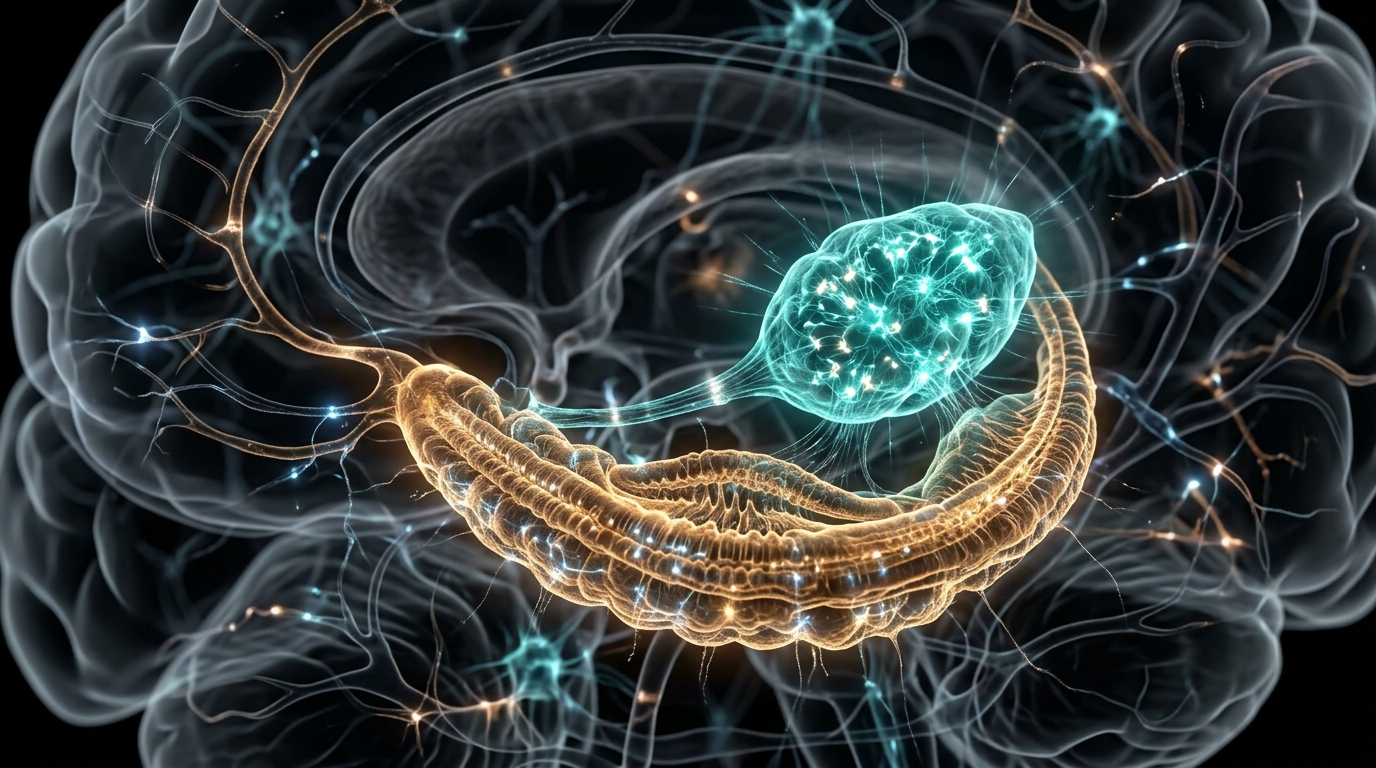
The brain does not store a traumatic experience the way it stores where you parked your car. At the moment of acute threat, two parallel systems engage simultaneously — and they record different things.
The hippocampus, a curved structure deep in each temporal lobe, normally binds the who, where, when, and what of an experience into a coherent episode. This is episodic memory: the kind that has a beginning, middle, and end; the kind you can locate in time and place in sequence relative to other events in your life.
The amygdala, positioned nearby and intimately connected to it, tracks something simpler and faster. It registers threat-associated cues — a smell, a sound, a sudden shift in ambient pressure, a specific angle of light — and locks them into associative fear memories. These are not stories. They are pairings: this stimulus equals danger. The amygdala’s encoding is rapid, implicit, and built for durability.
During a traumatic event, both systems activate simultaneously. But they do not produce equal results. What the research increasingly shows is that the two recordings diverge from each other — and that divergence is central to why time feels wrong afterward.
What Happens to Fear Memory in the Days After — Evidence from 2024
A 2024 study published in Nature Communications by Cortese, Ohata, Alemany-González, Kitagawa, and Imamizu examined how the brain handles fear-related memories in the period following a threatening event. Using fMRI imaging, the researchers tracked how participants’ neural activity changed across time in relation to two distinct types of fear memory.
They found a striking dissociation. Cue-based associative fear memories — the kind the amygdala specializes in — became stronger and more consolidated in the days that followed the event. Meanwhile, episodic memories of the sequence of what happened became less coherent. The narrative of events fragmented even as the fear attached to specific cues intensified.
The researchers identified the dorsolateral prefrontal cortex as the region responsible for integrating episodic sequences — for assembling the story into a chronological whole. In individuals with high trait anxiety, this integration was significantly weaker. The fear associations remained vivid; the contextual story did not hold together as well.
The authors propose this asymmetry as a plausible mechanism for persistent fear: the brain retains the alarm system while losing reliable access to the memory that would mark the alarm as historical. The fear cue fires. There is no clear narrative anchor to place it in the past. From the nervous system’s perspective, the calendar entry has gone missing.
It is important to note what this study did not do: it used a controlled laboratory setting with healthy adult participants and mild analog stressors — not clinical populations with severe or prolonged trauma histories. The researchers describe their findings as a mechanistic model, not a clinical account. Whether this pattern holds across the full range of traumatic experience is a separate question their study was not designed to answer.
When the Body Becomes a Conditioned Alarm
The second mechanism involves the body’s own internal signals — and what those signals become after threat.
Interoception is the process by which the brain registers, interprets, and responds to signals from inside the body: the pace of a heartbeat, the tension held across the chest, the hollow pressure in the stomach. During a threatening event, these signals are intense. Heart rate accelerates. Breathing shifts. The gut responds. These are normal physiological responses to acute danger — they are the body preparing to act.
A 2023 review published in Focus (the journal of the American Psychiatric Association) by Joshi, Aupperle, and Khalsa, researchers at the Laureate Institute for Brain Research in Tulsa, examined how these bodily sensations interact with fear learning. Their analysis, now available through PubMed Central (PMC10316209), proposes that interoceptive signals serve a specific and underappreciated role in the aftermath of trauma: they become conditioned stimuli.
In standard fear conditioning, a neutral external cue — a sound, a visual — becomes associated with a threat. After conditioning, the cue alone is enough to trigger a fear response. What Joshi and colleagues propose is that the body’s own internal sensations can play the same role. If a particular pattern of arousal — elevated heart rate, chest tightness, shallow breathing — co-occurred with a dangerous event, those sensations themselves may later trigger threat responses, even when they arise for entirely ordinary reasons: exercise, caffeine, heat, a stressful deadline.
This matters for the question of time. The body does not experience time the way a calendar does. If a bodily state that accompanied a past threat reappears in the present — for a benign reason — the nervous system has no automatic mechanism to note that years have elapsed. The signal arrives now. The response matches the signal. The past, in that moment, is physically present.
Joshi and colleagues are careful to note that this model remains under investigation and that the precise role of interoception in human fear learning — as opposed to animal models — is not yet fully mapped. Individual differences in interoceptive awareness are large. The same bodily state will carry different informational weight for different people.
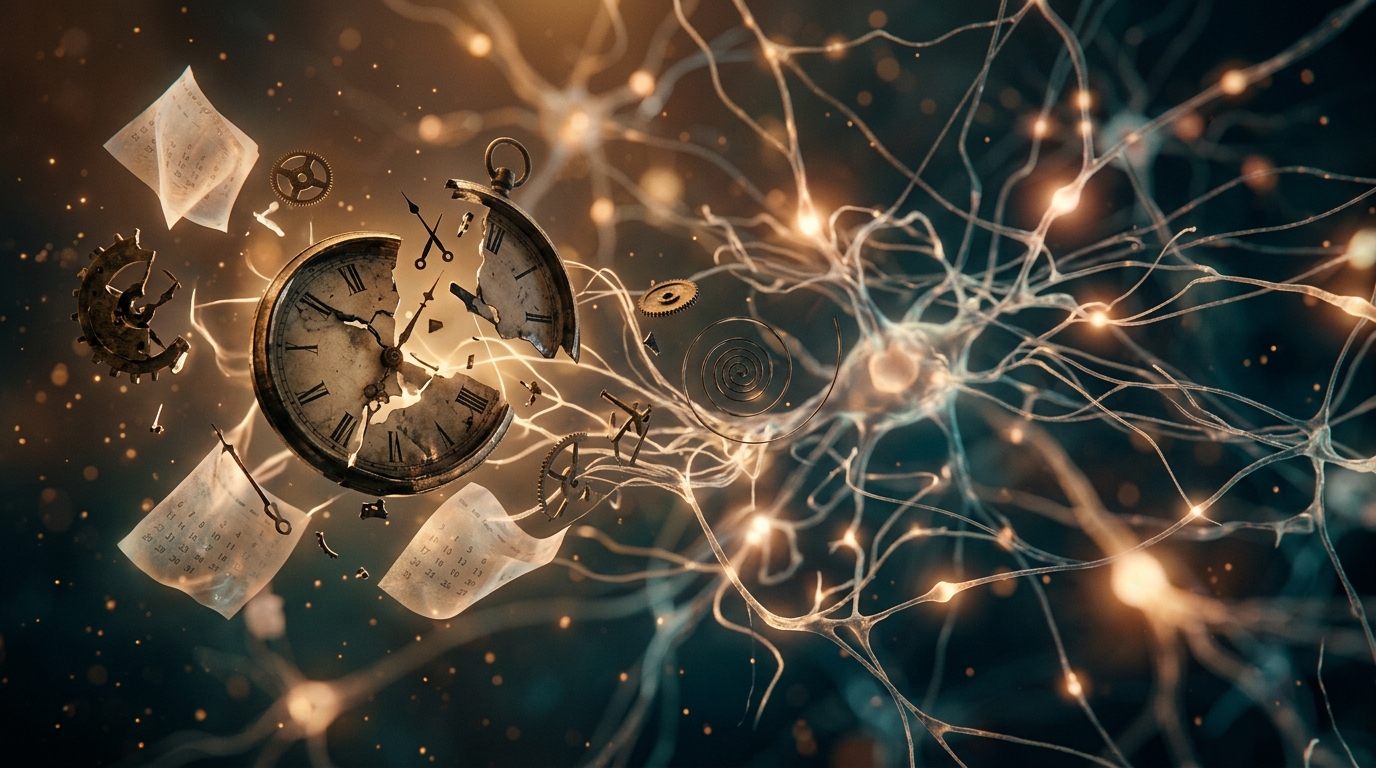
When the Timeline Itself Breaks Down
The third piece of evidence comes from a different direction: not the biology of fear, but the phenomenology of time itself.
Researcher E. Alison Holman and colleagues, writing in Clinical Psychological Science in 2023, examined a concept called temporal disintegration — the collapse of a person’s normal sense of past, present, and future as distinct and sequentially ordered states. Their research drew on two separate data sets: college students who had been on a campus during an active-shooter event, and longitudinal data collected following the September 11 attacks.
Their findings showed that temporal disintegration during and after collective trauma was associated with significantly higher levels of psychological distress. People who experienced the collapse of their linear time sense also showed more difficulty anticipating a future — they could not locate themselves on a timeline that extended past the traumatic event.
This is not simply emotional upset recast as a time problem. What Holman et al. describe is a disruption of what researchers call “mental time travel” — the cognitive capacity to place oneself backward into memory or forward into imagination. That capacity is a function the nervous system normally uses to regulate anticipation, planning, and a sense of biographical continuity. When it breaks down, the person is not simply sad or scared: they are unmoored from a temporal structure that normally organizes experience.
The researchers note the limits of their work clearly. Their studies examined collective trauma — shared, witnessed events — which may operate differently from interpersonal or prolonged individual trauma. Their findings establish an association between temporal disintegration and distress, not a mechanistic chain of cause and effect. What proportion of people exposed to a traumatic event experience temporal disintegration in a lasting way, and under what conditions it resolves, are questions their study was not designed to answer.
What the Three Mechanisms Share
The three threads — fear memory fragmentation, interoceptive conditioning, and temporal disintegration — are describing different parts of the same underlying problem.
The hippocampus normally provides the “when” of memory. If episodic integration weakens in the aftermath of threat — as Cortese et al. found in their laboratory paradigm — the nervous system loses the anchor that places a fear response in a retrievable past. The amygdala’s conditioned alarms remain robust; the narrative context that would mark them as historical does not.
The body’s interoceptive signals add a second layer. If the physiological sensations that accompanied a past threat reappear in the present for ordinary reasons, the nervous system may read them as evidence that the original threat context has returned. Without a strong episodic anchor, there is no internal signal to correct that reading: this is just your heart rate going up from the stairs, not from what happened years ago.
And temporal disintegration may represent the experiential outcome of both operating together: a nervous system whose fear associations remain active, whose interoceptive signals keep reissuing alarms, and whose narrative memory cannot place those alarms in a past it can clearly distinguish from now. The result is not confusion about what happened. It is something more specific: an inability to locate the event as over.
These are group-level findings, generated by different research teams using different populations and methods. They do not tell us what they mean for any particular individual. The mechanisms described here are real at the population level; how much weight they carry in any given nervous system depends on factors that differ substantially between people — developmental history, biological variability, the nature and duration of the traumatic exposure, and the presence or absence of social support in its aftermath.
What the Research Does Not Yet Establish
The studies in this article each identified something real under the conditions they examined. None of them produced a complete account.
Cortese et al. (2024) worked with healthy adults in a laboratory, using mild stressors. Their findings do not directly address what happens in severe trauma, chronic trauma, or trauma occurring during critical developmental windows. The jump from an analog fear-conditioning paradigm to clinical experience is large and not established by their data.
Joshi, Aupperle, and Khalsa (2023) wrote a theoretical review drawing substantially on animal-model research and proposing a framework for interoception in fear learning. The framework is plausible and well-grounded in related evidence, but it is not a clinical trial. How frequently interoceptive conditioning of this kind occurs in humans, how it interacts with the episodic memory system, and what distinguishes people in whom it becomes self-sustaining from those in whom it resolves naturally — these are open questions.
Holman et al. (2023) studied collective, public traumatic events. Interpersonal trauma, childhood trauma, and repeated or prolonged exposure may involve different temporal phenomenology. The association their data established between temporal disintegration and distress does not tell us which came first, or whether reducing one reduces the other.
Finally, all of these findings reflect group averages. Means and hazard ratios describe populations, not individuals. The mechanisms described here are real at the level of studied samples; what they predict for any specific person is a separate question — one that the research itself cautions against answering too readily.
Frequently Asked Questions
Why do some traumatic memories feel like they are happening now rather than in the past?
Research suggests at least two mechanisms may contribute. First, episodic memory — the brain’s record of the sequence of what happened and when — can become less coherent after a threatening event, while fear associations to specific cues remain strong. Without a clear episodic context, the fear response has no reliable anchor placing it in the past. Second, internal bodily sensations that accompanied a threatening event can become conditioned stimuli: when they reappear for ordinary reasons, the nervous system may register them as threat signals rather than background noise. These are findings from group-level studies, not predictions about how any individual’s nervous system will respond.
What does interoception mean, in plain language?
Interoception is the brain’s process of reading signals from inside the body — heart rate, breathing, gut sensations, temperature, muscle tension. It is distinct from the five external senses. Researchers at the Laureate Institute for Brain Research have proposed that in the context of fear learning, these internal signals can become associated with past threats in the same way that external cues — a sound or smell — become associated with danger. When those internal states reappear later, even for mundane reasons, they may carry a threat signal the nervous system acts on.
Is it normal for the body to react to past experiences as if they are currently happening?
The research described in this article suggests it reflects how the fear-learning system is built, not a malfunction in any simple sense. The amygdala’s associative encoding is fast, durable, and does not contain a timestamp. The bodily sensations that accompanied a threatening event can be re-encountered for entirely ordinary reasons years later. Whether this pattern becomes persistent or resolves over time appears to depend on factors including the coherence of episodic memory, the strength of safety learning, and biological variability between people. This article describes group-level mechanisms; what they mean for any individual is a separate question.
What is temporal disintegration, and why does it matter?
Temporal disintegration is a term researchers use to describe the collapse of a person’s normal sense of past, present, and future as distinct, sequential states. E. Alison Holman and colleagues, studying populations exposed to collective traumatic events, found that temporal disintegration was associated with higher distress and reduced capacity to anticipate a future. It matters because the ability to locate oneself on a timeline — to experience the past as past and to envision a future — is not merely a philosophical capacity. It is a cognitive function the nervous system uses for planning, self-regulation, and a sense of biographical continuity.
Do these findings apply equally to everyone who has experienced a traumatic event?
No, and the researchers are explicit about this. Each study examined a specific population under specific conditions: laboratory participants with mild stressors, college students exposed to a campus shooting, or large longitudinal samples following a national event. The mechanisms described are real at the group level — they reflect patterns observed across many participants — but they do not predict what will happen in any individual nervous system. Factors including developmental history, the nature and duration of the traumatic experience, biological differences in fear-learning circuitry, and post-event social support all influence how these mechanisms play out for a given person. Group findings cannot be directly applied to individuals.
Sources
- Holman EA et al. Temporal disintegration, distress, and fear of the future following collective trauma (2023) — PsyPost / Clinical Psychological Science
- Cortese A et al. Time-dependent neural arbitration between cue associative and episodic fear memories (2024) — Nature Communications
- Joshi SA, Aupperle RL, Khalsa SS. Interoception in Fear Learning and Posttraumatic Stress Disorder (2023) — Focus (American Psychiatric Association) / PubMed Central
Understand Your Nervous System
How the nervous system encodes threat, time, and safety is at the center of what we work with at NeuroBalance. If you’re curious about how these mechanisms show up in your own experience, or what it looks like to work with them one-on-one, we offer a free initial consultation. Our practice is private, one-to-one, and focused on understanding your specific nervous system — not applying a protocol to a category.
Schedule Your Free Consultation
Call us: (424) 625-5445 · Los Angeles, CA
Disclaimer: This content is for informational purposes only and does not constitute medical advice, diagnosis, or treatment. LENS Neurofeedback is not FDA-approved for all conditions mentioned. Please consult with a qualified healthcare provider before beginning any new treatment program.

A balanced brain is a better brain for a happier life