
Anxiety and Depression May Share More Brain Biology Than Their Labels Suggest
When researchers examine the brain biology of anxiety and depression side by side, they keep finding the same regions, the same inflammatory markers, the same treatment predictors. This is not a coincidence — and understanding it changes how we think about both conditions.
- The DSM separates anxiety and depressive disorders into distinct categories — a clinically useful distinction that does not always map onto the underlying brain biology.
- The anterior cingulate cortex, amygdala, and prefrontal cortex appear repeatedly in neuroimaging studies of both conditions, suggesting shared circuitry rather than completely separate systems.
- Inflammatory biomarkers — including CRP, IL-6, and TNF-alpha — are elevated in both anxiety and depression, with depression showing a more consistent signal and anxiety showing greater heterogeneity across studies.
- Research on treatment response shows overlapping neural predictors: prefrontal and anterior cingulate activity during emotion regulation predicts improvement in both internalizing disorders.
Two people, same clinic, same year. One can’t stop anticipating everything that might go wrong — the restlessness, the scanning for threat, the body that stays coiled even after the danger has passed. The other has gone flat: things that used to matter don’t anymore, effort takes more than it returns, and the future feels unreachable rather than threatening. Their diagnoses are different. Their medications may be different. And yet when researchers take those two people and look at the same biological markers — the brain circuits that regulate emotion, the inflammatory proteins in the bloodstream, the neural patterns that predict whether treatment will work — they keep finding the same territory.
This does not mean the two conditions are identical, or that the distinctions don’t matter. They do. But it raises a question that neuroscience has been quietly pressing on for the better part of two decades: if the biology looks this similar, what exactly are the labels describing?
Finding One: The Diagnostic Categories Draw a Line the Brain Doesn't Always Honor
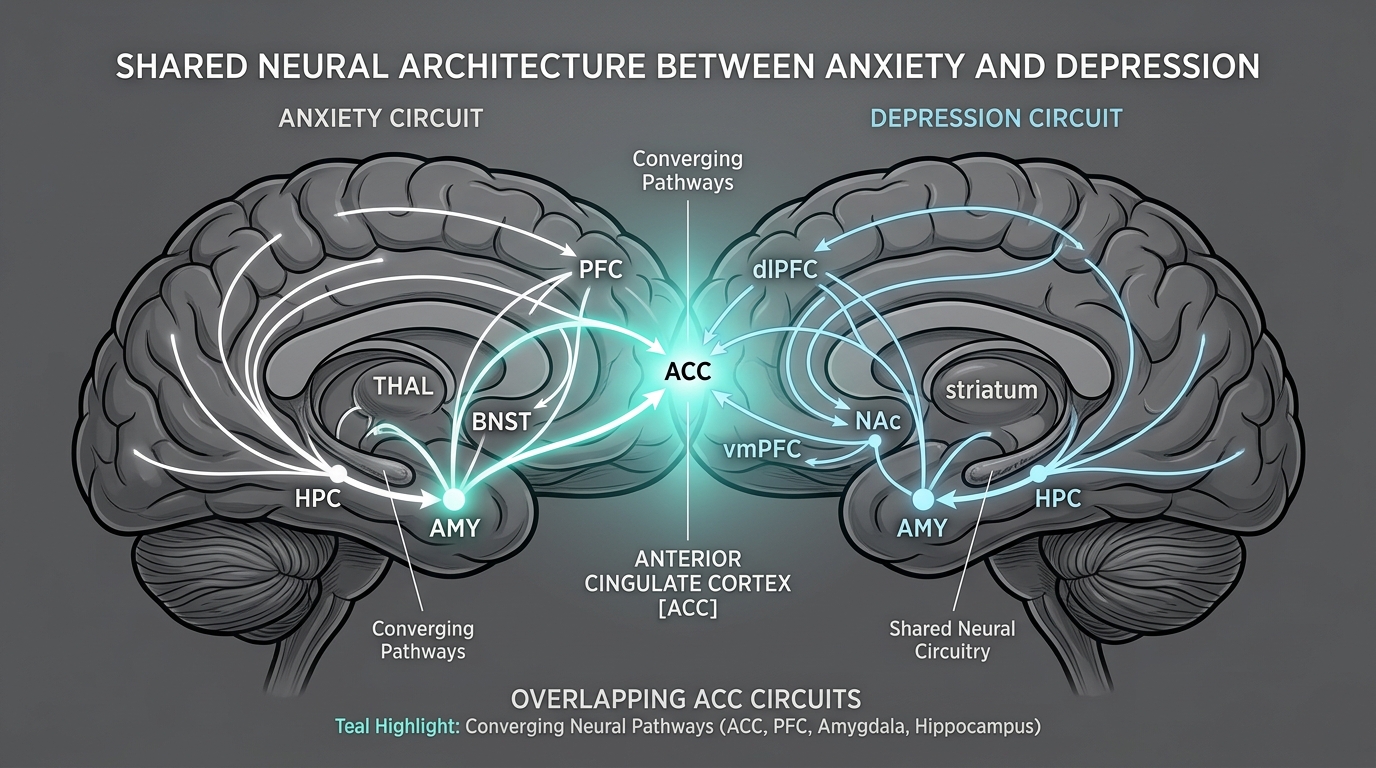
The Diagnostic and Statistical Manual of Mental Disorders separates anxiety disorders from depressive disorders across multiple chapters. This separation is clinically useful — anxiety involves a nervous system biased toward threat detection and avoidance, while depression involves impaired reward processing and reduced approach motivation. These are real and measurable differences. Specific anxiety disorders (panic disorder, generalized anxiety disorder, social anxiety disorder) have distinct natural histories and can respond differently to treatment than major depressive disorder does.
But the diagnostic categories carry a weight the epidemiology doesn’t fully support. Anxiety and depression co-occur so often that researchers have come to treat their joint presentation as a distinct clinical phenomenon worth studying on its own terms. A 2026 scoping review by Hu and Chen, published in a review covering 205 studies from 2010 to 2026, found that anxiety and depression frequently co-occur across childhood and adolescence, with shared symptom networks spanning what are otherwise treated as separate diagnoses (Hu R, Chen X; 2026, PMID 42803988). The symptom-network evidence is particularly telling: when researchers map which symptoms connect to which others, they find that sadness, fatigue, concentration difficulties, and sleep disturbance appear in both constellations and that they link the two together rather than keeping them separate.
This is not simply a matter of one condition causing the other, though that happens too. The point is that the symptoms themselves are not cleanly bounded by the diagnostic lines. The brain generating anxious vigilance and the brain generating anhedonic withdrawal are the same brain, running on circuits that overlap considerably.
Finding Two: The Same Brain Structures Keep Appearing in Both
If you take the neuroscience literature on anxiety and the neuroscience literature on depression and lay them side by side, certain regions appear in both columns almost every time.
The anterior cingulate cortex (ACC) is one of them. A comprehensive 2026 review by Dew, Jones, Saggu, Pozzo-Miller, and Wang examined the ACC’s role across the full range of anxiety-related circuits and disorders (Dew E et al.; 2026, PMID 42719594). The ACC, they found, functions as a hub: it integrates cognitive, emotional, interoceptive, and autonomic information, and it connects to the amygdala, the hippocampus, the insula, and the bed nucleus of the stria terminalis — a structure involved in sustained, diffuse anxiety rather than acute fear. The review documented structural, functional, connectivity, and neurochemical alterations of the ACC in anxiety-related disorders.
The same territory appears in the depression literature. ACC alterations — particularly in its subgenual portion — have been among the most consistently replicated findings in major depressive disorder research for decades. The region sits at an anatomical crossroads: its projections reach both the prefrontal cortex (which regulates emotion in a top-down direction) and the limbic structures (which generate emotional responses from the bottom up). When this hub is dysregulated, it can disrupt both the threat-detection bias characteristic of anxiety and the reward-processing failures characteristic of depression.
The amygdala is another point of convergence. In anxiety, the amygdala responds to threat cues with heightened activity; extinction — the process by which the brain learns that a threatening stimulus is no longer dangerous — is impaired. In depression, amygdala responses to negative stimuli are also heightened, though the mechanism differs: it is less about threat detection than about a general bias toward negative information. The same structure, implicated for different reasons, but implicated nonetheless.
This is not to say the two conditions affect the brain in the same way. They do not. But the overlap in neural territory means that an intervention targeting shared circuits — whether through therapy, medication, or other means — can affect both.
Where the Biology Converges Further: Inflammation as a Shared Signal
Beyond circuits and structures, a growing body of evidence points to shared inflammatory activity as a biological marker that both conditions carry, though not always in identical proportions.
A 2026 systematic review by Juhl, Park, Simanian, and Wang examined 53 primary studies from 2016 to 2026 that assessed depression or anxiety alongside peripheral inflammatory biomarkers (Juhl A et al.; 2026, PMID 42421531). The review found that depression was associated with alterations in pro-inflammatory markers — particularly C-reactive protein (CRP), interleukin-6 (IL-6)-related signalling, and tumour necrosis factor-alpha (TNF-alpha). Anxiety-related findings were present but more heterogeneous.
This distinction matters. It is not that anxiety is unrelated to inflammation, but that the relationship is less consistent across studies and populations. Depression appears to carry a more reliable low-grade inflammatory signature. For anxiety, the picture depends on the type of anxiety, the severity, the comorbidities present, and the inflammatory marker being measured.
What the Juhl review supports, together with the circuit research, is a picture of two conditions that share a biological substrate — one that involves both neural dysregulation and systemic inflammatory activity — while diverging in which aspects of that substrate are most prominently affected. Depression sits closer to the inflammatory and reward-system poles; anxiety sits closer to the threat-detection and autonomic-arousal poles. But neither sits cleanly in its own biological territory.
The clinical implication is that someone who presents with both anxiety and depressive symptoms is not simply carrying two diseases. They may be expressing different aspects of an underlying biology that generated both.

The Shared Neural Predictors of Treatment Response
If shared biology were only a theoretical matter, it might remain an interesting academic question. But it has direct consequences for understanding treatment.
A 2026 narrative review by Klumpp, Davey, and Langenecker examined functional neuroimaging studies that looked at neural predictors of treatment outcome in what they called ‘internalizing disorders’ — a category that intentionally groups depressive and anxiety disorders together (Klumpp H et al.; 2026, PMID 41794823). They reviewed studies on cognitive behavioral therapy, exposure therapy, and pharmacotherapy applied to major depressive disorder, anxiety disorders, and post-traumatic stress disorder.
The shared predictors they found were in the prefrontal cortex and the anterior cingulate cortex. Specifically: pre-treatment activity in medial and lateral prefrontal cortical regions during explicit emotion regulation tasks (like deliberately trying to reappraise a negative situation) predicted treatment response for both depression and anxiety disorders. Greater symptom improvement was generally associated with lower baseline activity in these regions, suggesting that patients with less pre-existing explicit regulation capacity may benefit more from treatment that teaches those skills directly.
For implicit regulation — the automatic, less deliberate kind — the direction reversed: more baseline activity in PFC and ACC regions predicted greater improvement. The interpretation is that some patients come with regulatory machinery that works under automatic conditions but not effortful ones; others show the opposite profile.
The point is not that all patients are the same, or that treatment should be identical regardless of diagnosis. It is that the neural architecture being targeted — and predicting whether the targeting will work — is shared across the diagnostic boundary. The brain region that learns to regulate threat response in anxiety is the same brain region that learns to regulate negative bias in depression. This is why the same treatment (cognitive behavioral therapy) is the most well-validated intervention for both: it trains the same circuitry.
This does not mean any one treatment works for everyone. The Klumpp review noted significant heterogeneity in findings and called for further precision-medicine research. Individual responses vary substantially, and the shared circuitry means only that the same tools can reach both conditions — not that those tools work for every person.
What the Labels Do Get Right: How the Two Conditions Diverge
Acknowledging the biological overlap does not erase the real differences, and it is worth being precise about what those are.
Anxiety’s defining feature at the neural level is a threat-detection system that does not fully shut off when the threat has passed or when the threat was never real. The amygdala, the ACC, and the autonomic nervous system remain on alert. Anticipation — the expectation that something bad is coming — generates physiological arousal even in the absence of any actual danger. This is why anxiety so often manifests in the body: racing heart, shallow breathing, muscle tension, hypervigilance.
Depression’s defining feature is a different failure: the systems that generate approach motivation, anticipate reward, and sustain engagement with the world go quiet. This is not merely feeling sad — sadness is an emotional state that often points outward, toward loss. Depression involves a flattening of the signal that makes future actions feel worth attempting. The brain regions most specifically affected include the basal ganglia circuitry involved in motivation and the ventral striatum involved in reward processing — areas that do not appear as prominently in the pure-anxiety literature.
These differences explain why the conditions feel so unlike each other from the inside, even as they share so much biological architecture. Anxiety involves the experience of too much signal — the nervous system producing warnings that exceed what the situation requires. Depression often involves too little — the motivational and reward systems generating insufficient signal to sustain engagement.
They also explain why the conditions require different treatment emphases. Anxiety often benefits from graduated exposure — deliberately confronting avoided situations until the nervous system learns that the expected threat does not materialise. Depression often benefits from behavioural activation — deliberately re-engaging with activities whose reward signal has gone quiet, even before motivation returns. Both approaches work through the shared prefrontal circuitry, but they target different aspects of it.
What the Evidence Does Not Yet Establish
Several limitations bear noting before drawing strong conclusions from this evidence base.
First, most studies examining inflammatory biomarkers in anxiety and depression are cross-sectional — they measure both the emotional state and the biological markers at a single point in time. This means it is not possible to determine the direction of the relationship from most of this data: does inflammation contribute to depression and anxiety, do depression and anxiety alter immune function, or are both driven by a third factor? The Juhl review describes the current evidence as ‘largely observational’ and calls for prospective and intervention studies to establish causality.
Second, the circuit research summarised here is largely drawn from neuroimaging studies and animal models. Neuroimaging studies detect correlations between brain activity and psychological states, but they cannot demonstrate that the activity caused the state rather than accompanied it. Animal models permit more causal investigation but raise questions about how well the findings translate to human experience.
Third, the ‘internalizing disorders’ framing — grouping anxiety and depression together — is clinically useful but not universal. A significant minority of people experience severe anxiety without notable depression, or severe depression without notable anxiety, and these pure presentations may have somewhat different biological profiles than the comorbid cases that dominate much of the research. Population-level findings about shared biology do not imply that any individual’s anxiety and depression arise from the same mechanism.
Frequently Asked Questions
Do anxiety and depression require different treatments?
The treatments overlap substantially. Cognitive behavioral therapy (CBT) is the most well-validated psychological treatment for both, and it appears to work partly because it trains the same prefrontal and anterior cingulate circuitry implicated in both conditions. However, the specific emphases differ: exposure-based work targets anxiety’s avoidance patterns; behavioral activation targets depression’s motivational flatness. Whether the same treatment approach is appropriate for a given person depends on their specific presentation, not on their diagnosis alone.
Is there one brain region responsible for both anxiety and depression?
No single region explains either condition, let alone both. The anterior cingulate cortex (ACC) is among the most consistently implicated shared hubs — it connects the prefrontal cortex with the amygdala and other limbic structures. But the research consistently points to networks rather than individual regions: dysregulation in the circuits that link these areas together, rather than a problem localized to any one node.
What does the term 'internalizing disorders' mean?
Internalizing disorders is a research category that groups conditions involving the dysregulation of internal emotional states — primarily depressive and anxiety disorders — as distinct from ‘externalizing disorders’ (which involve outward-directed behavior like aggression or substance use). The grouping reflects both the high rate of co-occurrence and the shared neural and cognitive features. It does not mean the conditions within it are identical.
Can a person have significant anxiety without depression, or vice versa?
Yes, and many people do. The biological overlap described in this research reflects findings at the population level — when researchers compare groups of people with each condition, they find considerable shared biology. This does not mean that individuals with only anxiety have the same brain biology as individuals with only depression. The overlap is a tendency, not a rule. Some people experience one condition in isolation throughout their lives; others experience both at different times or simultaneously.
Why do some people respond well to therapy while others need medication for these conditions?
The research on neural predictors suggests that different people enter treatment with different levels of baseline activity in the prefrontal and anterior cingulate regions involved in emotion regulation. These baseline differences appear to predict how well different treatment approaches work — but the research is at an early stage and not yet ready to guide individual treatment decisions. Currently, trial-and-error remains common in both psychotherapy and medication, and the field is working toward biological predictors that could make that process more targeted.
Sources
- Juhl A et al. (2026). Inflammatory biomarkers and oral microbiome alterations in depression and anxiety disorders. — PubMed / NCBI
- Dew E et al. (2026). The role of the anterior cingulate cortex in anxiety control, from circuits to disorders. — PubMed / NCBI
- Klumpp H et al. (2026). Neural predictors of treatment outcome through emotion regulation in internalizing disorders. — PubMed / NCBI
- Hu R, Chen X (2026). Symptom Networks, Developmental Pathways, and Intervention Evidence for Co-occurring Anxiety and Depression. — PubMed / NCBI
Understand Your Nervous System
If you are navigating symptoms that seem to combine elements of anxiety and depression — or if you have been told you have both — a one-to-one assessment at NeuroBalance can help clarify what is happening in your individual nervous system. Contact us to learn more about how we work.
Schedule Your Free Consultation
Call us: (424) 625-5445 · Los Angeles, CA
Disclaimer: This content is for informational purposes only and does not constitute medical advice, diagnosis, or treatment. LENS Neurofeedback is not FDA-approved for all conditions mentioned. Please consult with a qualified healthcare provider before beginning any new treatment program.

A balanced brain is a better brain for a happier life.