

Why Trauma Can Change Your Sense of Time
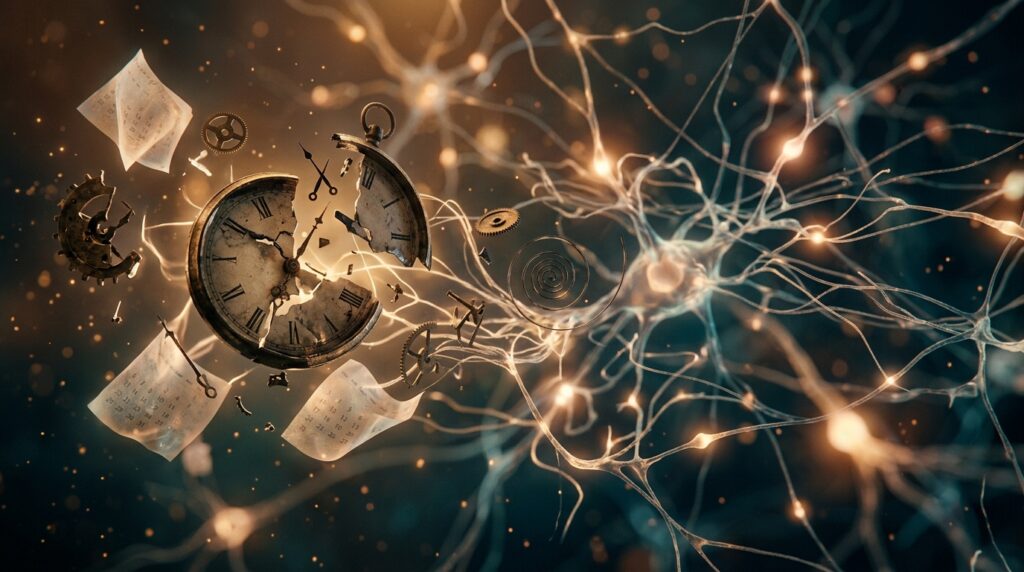
A biological look at why a past event can feel neurologically present — tracing how episodic memory fragments, bodily signals become conditioned alarms, and the brain loses its grip on when.
The Brain After a Frightening Event: Why Some Memories Fade and Others Won’t Let Go
After something frightening ends, why do some memories fade while others keep returning with full force? Research on the amygdala, hippocampus, and prefrontal cortex is mapping the circuit that determines which memories persist — and why the answer has less to do with forgetting than with which competing neural population is currently in control.
When PTSD and Concussion Overlap: What Can the Brain Tell Us?
For decades, medicine filed post-traumatic stress disorder and traumatic brain injury in separate folders. Neuroimaging research is showing why that filing system was never quite right — and what the overlap between these two conditions actually looks like at the circuit level.
Early Stress May Leave Biological Footprints—But What Does That Really Mean?
Researchers followed 225 young people from age nine, taking six biological measures across six years. The finding that matters is not that early stress leaves marks — it is which kind of stress left which kind of mark.
Why PTSD Isn’t Only About Memory
The popular account is flashbacks and intrusive memories. A 2026 proposal argues for measuring something wider — and a 2026 study found the most informative signal was not a memory at all.
Sleep After Trauma: Could Certain Brain Waves Be Protective?
Twenty-two people watched a distressing film before bed, twice, while researchers recorded their brains overnight. What happened during sleep predicted how often the images came back.
Can Trauma Disrupt the Brain’s Internal Clock?
A 2026 study fitted wearable sensors to 211 survivors of a mass-trauma event and 113 comparison participants, then followed them for the better part of a year. The signal was not how disturbed their sleep was on average.
Women’s Trauma and Sleep: What a Study of Nearly 28,000 Women Found
A sleep disorder first described in military patients has now been measured across a whole country. In a cohort of 27,938 Icelandic women, 6.9% reported it in the past month.
How Trauma Changes the Brain’s Communication Networks
Trauma is not stored as a bad memory. It changes how brain regions communicate — amygdala, prefrontal cortex and hippocampus — and that circuit-level change explains why insight alone rarely resolves it.
How the Brain Learns to Let Go
Holding onto painful memories, grudges, and anxiety isn’t a choice — it’s what an unregulated nervous system does automatically. Here’s the neuroscience of release, and how to support it.