

How Sleep Schedules Drift in Summer—and Why It Matters
Summer’s extended daylight and social flexibility cause a “social jet lag” that disrupts circadian rhythms, depletes sleep pressure, and creates measurable neurological debt affecting focus, mood, and learning for weeks after school restarts.
- Summer’s irregular sleep schedule creates a 2–3 hour circadian phase delay that doesn’t resolve quickly when routine resumes
- Late bedtimes reduce adenosine buildup and delay REM sleep, fragmenting memory consolidation and emotional regulation
- Cortisol timing becomes misaligned with wake time, causing morning grogginess and afternoon energy crashes that impair classroom performance
- This neurological debt accumulates over weeks—sleep extension on weekends cannot fully compensate for consistent circadian disruption
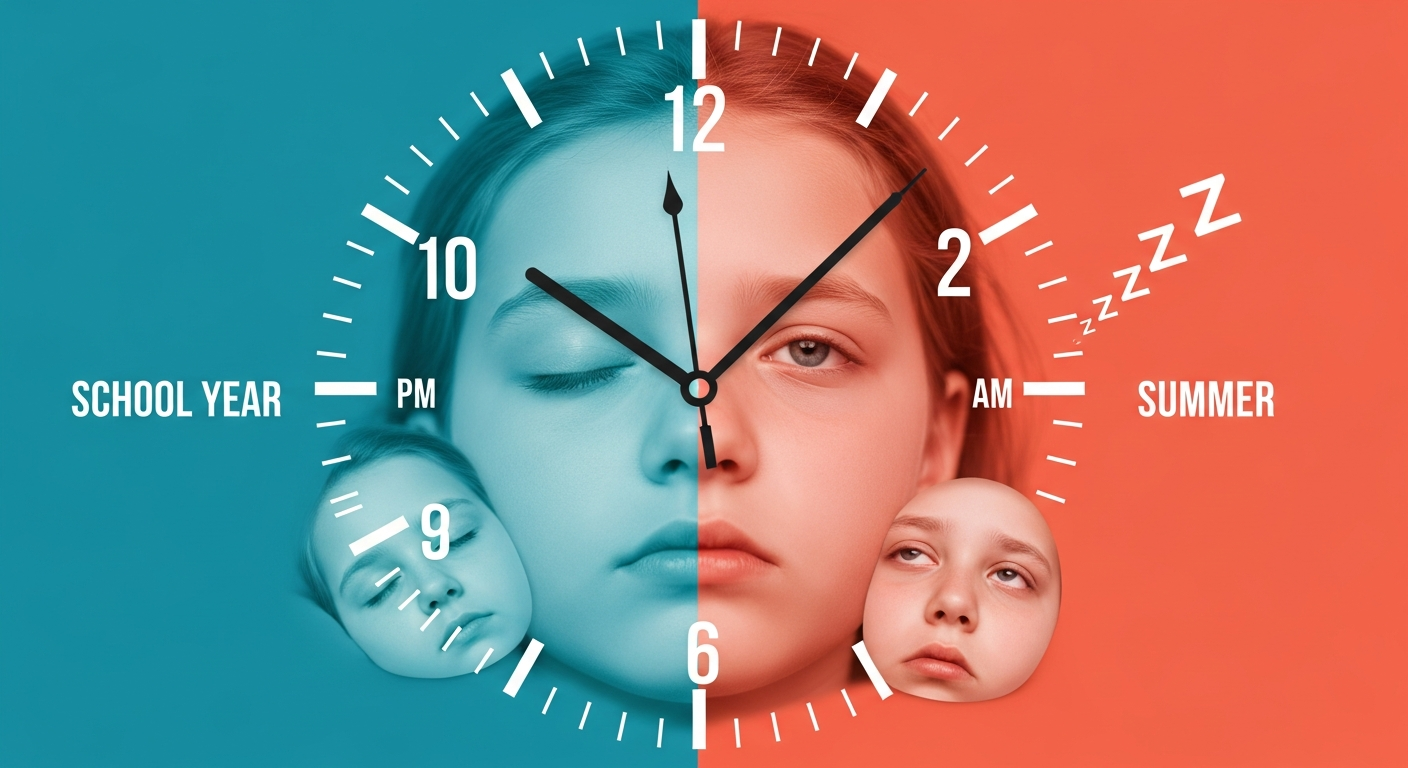
Summer break represents a dramatic shift in sleep architecture for children and adults alike. A 2023 study published in Sleep Health found that adolescents experience an average 1.5–2 hour delay in both sleep and wake times during summer months—a phenomenon researchers call “social jet lag.” Unlike traditional jet lag from travel, this drift is gradual, self-imposed, and often invisible until cognitive demands return. The brain’s circadian clock, hardwired to respond to sunrise and social cues, drifts into misalignment. Adenosine—the neurotransmitter that builds sleep pressure—accumulates differently. REM sleep, critical for memory consolidation and emotional regulation, shifts to suboptimal windows. The result is a cascading neurological debt that affects not just sleep quality, but attention span, mood stability, and academic performance for the entire fall semester. Understanding why this happens, and how it impacts the brain, is essential for protecting your family’s cognitive health.
The Circadian Phase Delay: Why Summer Bedtimes Creep Later
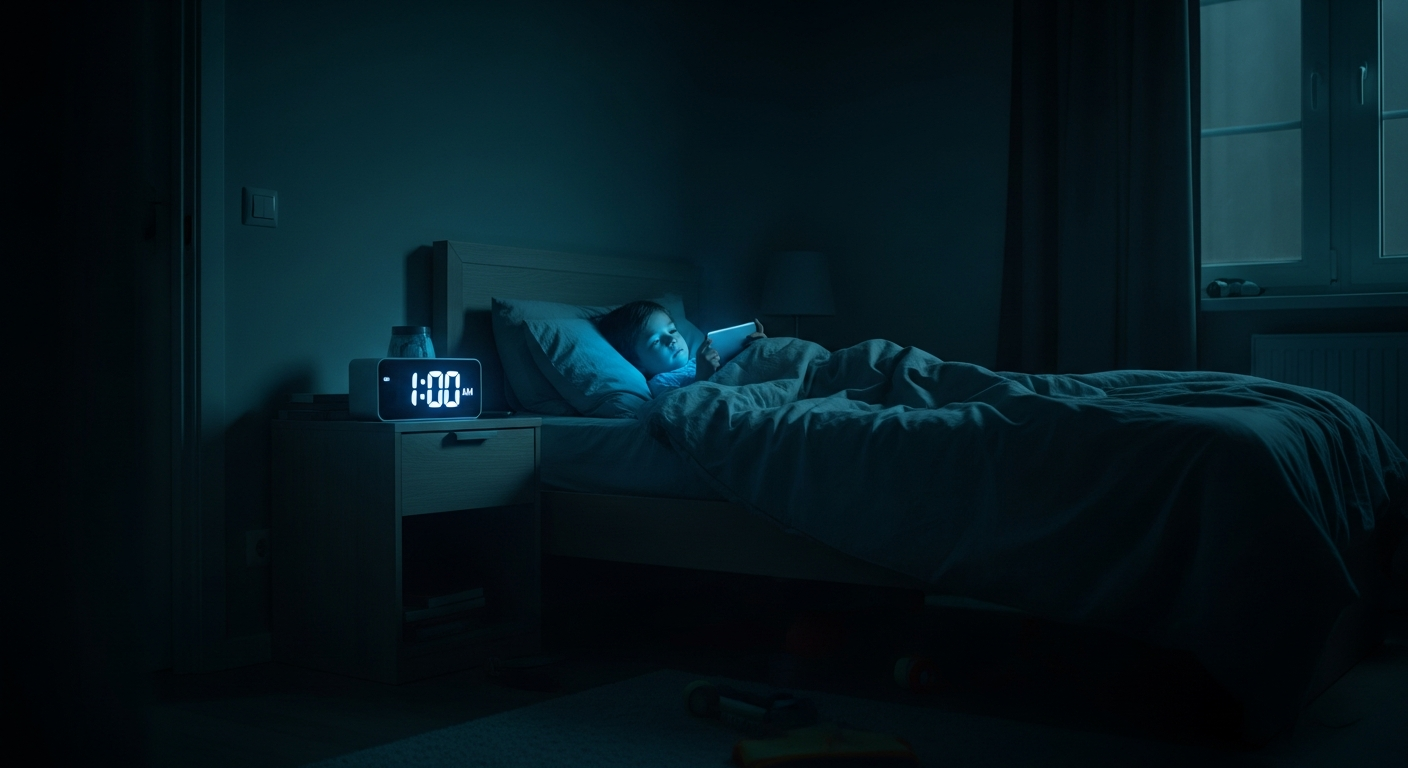
Your circadian rhythm—the internal 24-hour clock that governs sleep-wake timing—is exquisitely sensitive to light, temperature, and social schedules. In summer, three factors conspire to push bedtime later. First, extended sunlight delays the evening release of melatonin, the hormone that signals sleepiness. Sunsets in Los Angeles occur around 8:30 p.m. in June, compared to 5:15 p.m. in December. That extra three hours of daylight signals the brain to stay awake longer. Second, summer’s social flexibility—later gatherings, flexible schedules, fewer morning obligations—removes the hard wake-time anchor that usually stabilizes circadian timing. Without a 7 a.m. alarm forcing an early wake, the brain’s intrinsic circadian period (which averages 24.2 hours in humans) drifts later. Third, blue light from screens, often used later into the evening during unstructured summer nights, further suppresses melatonin. The result is a circadian phase delay averaging 1.5–2 hours by mid-summer—measurable in both bedtime and wake time. This isn’t laziness; it’s neurobiology. The concerning part: when August ends and school restarts, the brain cannot recalibrate its circadian rhythm and the brain quickly. Research from the University of Colorado shows it takes 4–7 days per hour of circadian shift to fully re-entrain. A two-hour delay requires 8–14 days of consistent early wake times before the circadian clock aligns with the school schedule again—time most families don’t have before cognitive demands spike.
Adenosine Dysregulation: The Forgotten Sleep Pressure Mechanism
Sleep pressure—the drive to sleep—builds throughout the day via adenosine, a byproduct of neural metabolism. When neurons fire, they burn ATP (cellular energy), which breaks down into adenosine. Adenosine accumulates in the extracellular space, blocking arousal signals and triggering sleepiness. The more hours you’re awake, the more adenosine builds. By bedtime, adenosine levels peak; during sleep, they clear. This cycle resets each morning. Summer’s delayed bedtimes disrupt this rhythm. When you stay awake until 11 p.m. instead of 9 p.m., you’ve added two hours of wakefulness—but you’re also going to bed later, compressing the total sleep window. More critically, if you wake at 8 a.m. instead of 7 a.m. (or don’t wake consistently), the adenosine clearance phase is truncated or irregular. The brain enters the next day with residual adenosine still present—you feel “hungover” or groggy not from total sleep loss alone, but from dysregulated adenosine timing. Research using microdialysis (direct measurement of brain chemistry in animal models) shows that inconsistent sleep-wake schedules prevent normal adenosine cycling, leaving the brain in a state of partial sleep debt even after 8 hours in bed. This explains why many teenagers report feeling tired all summer despite sleeping long hours—the adenosine system is decoupled from the circadian clock. By September, when consistent early wake times resume, adenosine hasn’t fully consolidated its buildup phase, and students experience attention deficits and increased irritability that persist for weeks.
REM Sleep Fragmentation: Why Memory and Mood Suffer
REM (rapid eye movement) sleep, comprising roughly 20–25% of sleep in adults and up to 30% in children, is when memory consolidation and emotional processing occur. The brain replays the day’s experiences, strengthening important memories and weakening irrelevant ones. It also regulates mood-related neurotransmitters—serotonin, dopamine, norepinephrine—which are synthesized and rebalanced during REM. Most REM sleep occurs in later sleep cycles, roughly 60–90 minutes before waking. This is why sleeping until noon on weekends doesn’t fully recover REM debt: the timing is wrong relative to the circadian clock. During summer, when bedtimes shift later and wake times become inconsistent, REM sleep is often truncated. If you go to bed at midnight instead of 10 p.m. but wake at 8 a.m. (rather than 6:30 a.m.), the shift preserves total sleep duration but misaligns REM with the circadian rhythm. More problematically, if sleep is fragmented—caused by heat, social interruptions, or inconsistent schedules—REM sleep is suppressed during the first night of fragmentation and “rebounds” over subsequent nights. This REM rebound creates turbulent sleep with intense dreams, frequent arousals, and incomplete restorative cycles. By September, when academic demands spike, the accumulated REM sleep debt manifests as poor memory consolidation (new facts don’t stick), emotional dysregulation (increased irritability and anxiety), and reduced resilience to stress. Studies using polysomnography (EEG recording of sleep stages) in college students show that circadian phase delays reduce REM sleep efficiency by 15–20%, a measurable deficit that correlates with impaired attention and mood in classroom settings. This is not just grogginess; it’s a neurochemical imbalance with real cognitive consequences.
Cortisol Misalignment: The Hidden Driver of Attention Deficits
Cortisol, the primary stress hormone, follows a strict circadian pattern. Levels spike 30–45 minutes after waking (the “cortisol awakening response”), providing the neurochemical kick needed for focus, motivation, and alertness. They gradually decline throughout the day, reaching their lowest point around midnight—necessary for sleep initiation. This 24-hour cortisol rhythm is one of the brain’s most robust circadian oscillations, and it’s deeply integrated with attention and executive function. When your wake time shifts from 7 a.m. to 9 a.m., cortisol still spikes according to the old circadian pattern—around 7:30 a.m.—when you’re still asleep. By the time you wake at 9 a.m., cortisol has already peaked and is declining. This means you start the day in a state of relative cortisol insufficiency: your brain is neurochemically primed for sleep, not wakefulness. The result is the familiar summer morning fog—difficulty getting out of bed, slow thinking, low motivation. Worse, cortisol doesn’t reset until you’ve maintained consistent early wake times for 5–7 days. If summer involves wake times drifting between 8 a.m. and 10 a.m., cortisol never stabilizes. By September, when school starts and you’re expected to wake at 6:30 a.m., your cortisol still peaks around 8:30 a.m. For the first two weeks of school, every morning feels like waking at 4 a.m. would feel in normal times—your brain is neurochemically mismatched to the task. Research from the Max Planck Institute shows that adolescents with circadian phase delays exhibit reduced prefrontal cortex activation (the brain region controlling attention and impulse control) in morning hours, explaining why fall grades often dip despite summer break. This isn’t a motivation problem; it’s a neurobiology problem. Cortisol dysregulation also contributes to afternoon energy crashes around 2–3 p.m., when cortisol reaches its minimum point, making the later school day cognitively harder to navigate. Understanding this mechanism is critical for both parents and educators—alarm clocks alone won’t fix it. Gradual bedtime shifts (15 minutes earlier every 2–3 days) starting 1–2 weeks before school help, as does bright morning light exposure to anchor the circadian clock earlier.
The Accumulation Effect: Why Weekend Sleep Recovery Fails
A common belief is that sleeping in on weekends “recovers” the sleep debt from the week. Neuroscience shows this is partly true—and partly false. You can recover some acute sleepiness by getting extra hours, but you cannot recover circadian misalignment or REM fragmentation through weekend sleep extension alone. A 2019 meta-analysis published in Current Biology examined sleep extension on weekends and found it provides only temporary alertness. The circadian clock, still entrained to the weekday schedule in some individuals and to the weekend schedule in others, remains in conflict. This “social jet lag”—the mismatch between your internal clock and your external schedule—persists. More critically, weekend sleep extension actually worsens the problem. If you wake at 7 a.m. Monday–Friday and 10 a.m. Saturday–Sunday, you’re asking your circadian clock to shift 3 hours twice per week. This is equivalent to traveling between time zones every few days. The brain cannot recalibrate; instead, it enters a chronic state of partial desynchronization. Over the course of summer—eight to twelve weeks of irregular sleep—this accumulated misalignment creates a neurological debt that’s not easily repaid. By late August, most adolescents have drifted 1.5–2 hours later, experienced hundreds of nights of fragmented REM sleep, and spent thousands of hours in cortisol insufficiency during morning academic times. A single week of consistent early bedtimes cannot undo this. The brain needs 2–3 weeks of strict sleep schedule consistency to re-entrain fully. This is why the “fall transition” feels so hard for families: the debt is real, the recovery period is long, and catching up on sleep alone cannot fix the underlying circadian disruption. Neurofeedback and strategic light exposure can accelerate this re-entrainment by directly targeting the brain regions (the suprachiasmatic nucleus and related clock structures) that control circadian timing, making the transition back to school faster and less cognitively costly.
Clinical Implications: Sleep Schedule Drift and Neurological Health
For children and adolescents with ADHD and sleep disorders, summer schedule drift is particularly problematic. The prefrontal cortex—already underactive in ADHD—depends on optimal circadian alignment and REM sleep to regulate attention and impulse control. When circadian rhythm is disrupted, ADHD symptoms intensify markedly. Parents report increased impulsivity, emotional lability, and difficulty focusing in late-summer weeks. Similarly, individuals with mood disorders, anxiety, or subsyndromal insomnia and sleep disorders experience worsening symptoms during periods of circadian misalignment. The relationship between sleep timing and mental health is bidirectional and neurochemically precise: poor sleep schedule timing worsens mood and anxiety; worsening mood and anxiety further disrupt sleep. This feedback loop can spiral across a summer, leaving families exhausted and stressed by August. For adults, summer social jet lag contributes to productivity loss, increased error rates at work, and higher risk of accidents. A 2022 study in Accident Analysis & Prevention found that circadian phase delays correlate with 1.6x increased vehicle accident risk. Addressing summer sleep schedule drift is not a luxury; it’s a fundamental health intervention. Early intervention—maintaining consistent sleep-wake times even during summer, using bright morning light to anchor the circadian clock, and avoiding late evening screen time—can prevent the accumulation of neurological debt. For families struggling with re-entrainment in August and September, neurofeedback for sleep can be a powerful tool. By training the brain’s sleep-wake regulation centers directly, neurofeedback accelerates circadian re-synchronization and improves REM sleep efficiency, helping individuals transition back to school or work schedules with minimal cognitive cost.
How Neurofeedback Addresses This
Restores Circadian Timing
LENS targets the brain regions that control circadian phase—the suprachiasmatic nucleus and related structures—helping realign your internal clock with external schedules faster than behavioral interventions alone.
Improves REM Sleep Efficiency
By optimizing sleep-stage architecture, neurofeedback increases the percentage of REM sleep obtained during each night, accelerating memory consolidation and mood stabilization after weeks of summer fragmentation.
Resets Cortisol-Attention Coupling
Neurofeedback strengthens the synchronization between cortisol release and wake time, restoring morning alertness and focus—critical for school and work performance in fall.
Reduces Adenosine Fragmentation
By stabilizing sleep architecture and wake times, neurofeedback normalizes adenosine buildup patterns, reducing the grogginess and cognitive fog that persist after weeks of inconsistent schedules.
Frequently Asked Questions
How much sleep schedule drift is “normal” in summer?
Most people experience a 45-minute to 2-hour shift toward later bedtimes and wake times during summer, driven by extended daylight and reduced schedule constraints. This is neurobiologically typical and doesn’t necessarily indicate a disorder. However, if the shift exceeds 2–3 hours or creates daytime impairment (grogginess, attention problems, mood changes), it warrants intervention—especially for children or those with ADHD or mood disorders.
Can you “catch up” on sleep during summer to prepare for fall?
Partially, but not completely. Sleeping longer on weekends or taking extra naps can temporarily reduce acute sleepiness, but it does not reverse circadian misalignment or restore fragmented REM sleep if the underlying schedule is chaotic. The circadian clock needs consistent sleep-wake timing to re-entrain, not just more total sleep. Strategic sleep extension (sleeping until 8:00 a.m. instead of noon on weekends) is more restorative than sleeping until 11 a.m., because it maintains circadian consistency.
When should I start re-establishing a school-year sleep schedule?
Ideally, begin 2–3 weeks before school starts. Shift bedtime 15 minutes earlier every 2–3 days, and use bright light exposure (outdoor sunlight) immediately after waking to anchor the circadian clock. Consistency matters more than perfection—even weekends should maintain the same wake time during this transition period. If your child or teen has significant circadian drift (more than 2 hours), starting earlier (3–4 weeks before) and using additional tools like neurofeedback or strategic light therapy can ease the transition and prevent attention and mood problems in early fall.
Why do kids seem extra irritable and unfocused in late August despite sleeping more?
Late-summer irritability and poor focus reflect accumulated neurological debt, not sleepiness alone. Circadian misalignment reduces prefrontal cortex activation (impairing impulse control and emotional regulation), REM sleep fragmentation dysregulates mood neurotransmitters (serotonin, dopamine), and cortisol dysrhythmia impairs attention networks. These changes are measurable on brain imaging and neurochemical assays. Extra sleep doesn’t repair them without schedule consistency. Recognizing this as a neurobiological issue—not a motivation or maturity problem—helps families approach the transition with compassion and effective intervention.
Can neurofeedback help with summer sleep schedule recovery?
Yes. LENS neurofeedback directly targets the brain circuits controlling sleep-wake timing, REM regulation, and cortisol-circadian coupling. Research shows that individuals receiving neurofeedback re-entrain to new schedules 3–5 days faster than those relying on behavioral methods alone. For children with ADHD, the combination of neurofeedback and schedule consistency produces the fastest restoration of attention and emotional regulation. Starting neurofeedback 3–4 weeks before school can be particularly effective, creating a buffer for the transition and minimizing fall semester performance problems.
Ready to Support Your Brain Health?
If your child or teen is struggling with summer sleep drift, or you’re concerned about the transition back to school, MyNeuroBalance can help. Our LENS neurofeedback therapy restores circadian alignment, improves sleep architecture, and enhances focus and mood—without medication. Start your recovery now, before the fall semester begins.
Schedule Your Free Consultation
Call us: (424) 625-5445 · Los Angeles, CA
Disclaimer: This content is for informational purposes only and does not constitute medical advice, diagnosis, or treatment. LENS Neurofeedback is not FDA-approved for all conditions mentioned. Please consult with a qualified healthcare provider before beginning any new treatment program.