

Overthinking and Inefficient Brain Network Switching
Understanding Brain Wellness and How LENS Neurofeedback May Help
Do you find yourself trapped in endless loops of thinking, unable to quiet your mind even when you want to relax? You’re not alone. Recent neuroscience research reveals that overthinking isn’t just a habit—it’s often the result of inefficient brain network switching that keeps your mind stuck in analytical mode when it should be able to rest and reset.
Understanding how your brain’s networks communicate—and sometimes fail to communicate effectively—can provide valuable insights into why overthinking happens and what approaches like LENS neurofeedback therapy may help support your brain’s natural ability to find balance.
⚕️ Important Medical Disclaimer:
The information provided is for educational purposes only and is not intended as medical advice, diagnosis, or treatment. LENS neurofeedback is a wellness modality NOT intended to diagnose, treat, cure, or prevent any disease. Always consult a qualified healthcare professional before beginning any wellness program. Individual results vary. NeuroBalance does not provide medical services.
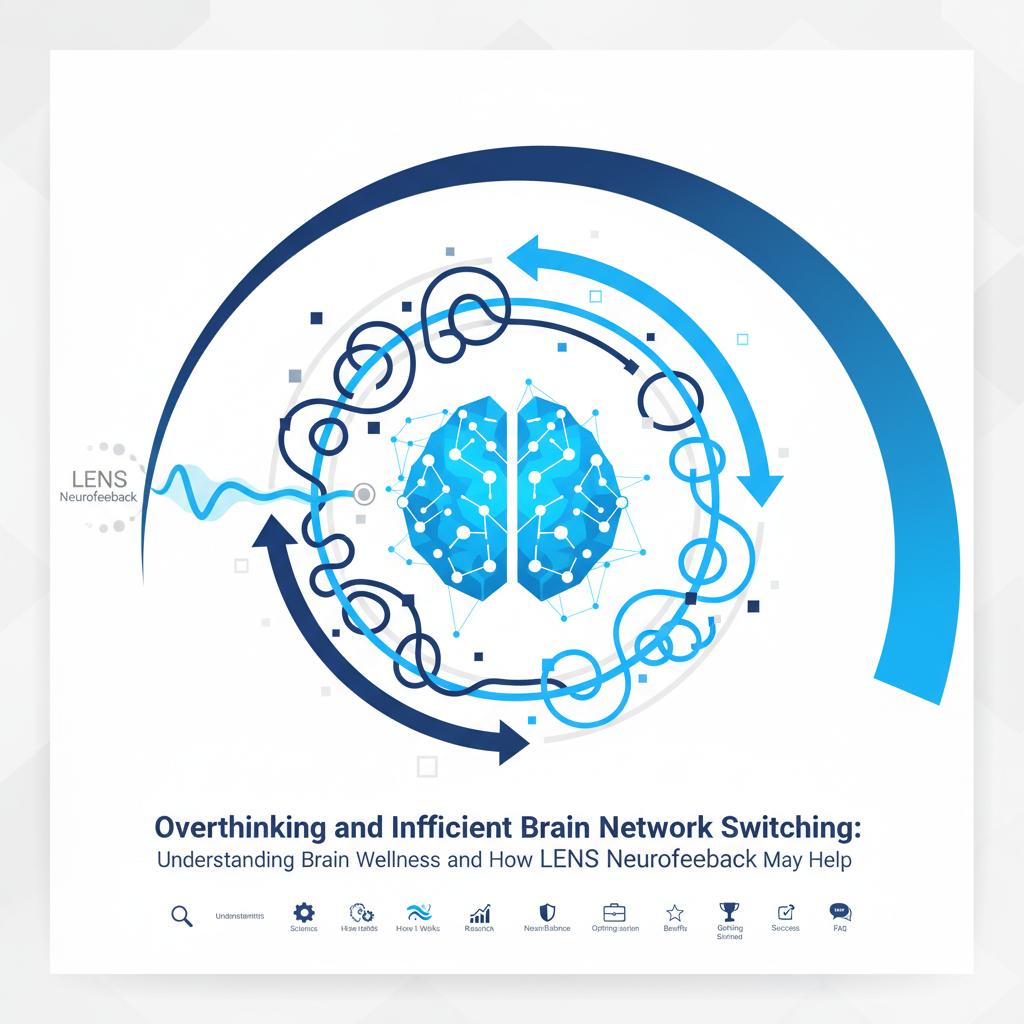
Understanding Overthinking and Brain Network Function
Recent fMRI research from Ohio State University has observed correlated shifts in brain connectivity associated with overthinking, revealing that rumination involves specific patterns of neural network activity
. This groundbreaking research helps us understand that overthinking isn’t simply a matter of willpower—it’s often the result of how different brain networks communicate and switch between modes of operation.
Your brain operates like a busy operations center with different departments handling logic, emotion, habits, and evaluation. Psychologist Daniel Kahneman’s research describes two primary systems: System 1 (fast, emotional, automatic) and System 2 (slow, rational, deliberate). Your brain constantly switches between these systems depending on the situation
.
When this switching becomes inefficient, you may find yourself experiencing:
- Persistent worry loops that feel impossible to stop
- Difficulty transitioning from work mode to relaxation
- Racing thoughts at bedtime when you need to sleep
- Feeling mentally “stuck” even during leisure activities
- Emotional exhaustion from constant mental activity
🧠 Key Research Insight:
Overthinking tends to happen when your brain is overwhelmed with information. The prefrontal cortex tries to examine every detail and possibility, but with no clear answer, it stalls. The anterior cingulate cortex keeps flagging potential risks, causing hesitation to grow even stronger
.
At NeuroBalance, we understand that overthinking often reflects your brain’s attempt to solve problems or stay safe, but when network switching becomes inefficient, this protective mechanism can become counterproductive. Our LENS neurofeedback approach may help support your brain’s natural ability to switch between different modes of operation more flexibly.
The Science Behind Inefficient Network Switching
The discovery of resting-state networks shifted the focus from the role of local regions in cognitive tasks to the ongoing spontaneous dynamics in global networks. Recent research investigates how the interaction between these networks emerges as an organizing principle in human cognition
.
Your brain contains several major networks that need to coordinate effectively:
The Default Mode Network (DMN)
This network is active when your mind is at rest and not focused on external tasks. It’s involved in self-referential thinking, mind-wandering, and introspection.
Research has found less signaling between the amygdala (linked to emotions) and the default mode network in individuals with trauma history, affecting how the brain processes emotional information during rest
.
The Executive Control Network
Often called the CEO of the brain, the prefrontal cortex handles logical reasoning, long-term planning, and impulse control. It’s what helps you pause, think, and weigh your options
.
Research shows that trauma-exposed individuals make compensations in their brain processes by engaging the executive control network as a coping tool more than those who weren’t traumatized
.
The Salience Network
The amygdala acts as the brain’s emergency responder, dealing with strong emotions like fear, excitement, and anger. It reacts quickly, which is helpful in life-or-death moments—but not always in everyday decisions
.
Recent research published in Communications Biology showed changes in the salience network of the brain, which is used for survival and learning in those with mental health issues including depression, anxiety and PTSD
.
💡 Educational Insight:
Your brain relies on neurotransmitters—chemical messengers that help different brain regions communicate and function. These chemicals play a key role in how you make decisions and manage emotions
. When these systems become imbalanced, network switching can become inefficient.
How LENS Neurofeedback Works
The Low Energy Neurofeedback System (LENS) developed by Dr. Len Ochs uses feedback in the form of a radio frequency carrier wave, administered at a positive offset frequency from the person’s own dominant EEG frequency. Although it is an unusual biofeedback procedure, the feedback being invisible and the subject passive, clinical evidence supports the efficacy of the LENS across a spectrum of conditions
.
LENS neurofeedback helps the entire brain to regulate and rebalance itself by “dis-entraining” or freeing the brain from its frozen maladaptive state or defensive looping mechanisms caused by trauma or stress. LENS effectively disrupts the old neural connectivity that causes the dysfunctional patterns and resets them for much faster and lasting results
.
The LENS approach works through several key mechanisms that may support healthier network switching:
Real-Time Brain Feedback
The process is personalized because the computer software program allows the signal to adapt in real time, to what is most appealing to the brain that it’s connected to. Then it reads the data it receives just milliseconds before and makes the proper adjustments in frequencies to the specific area of the brain in need
.
Gentle Disruption of Stuck Patterns
This “feedback” is understood to cause adaptive disruptions to patterns of neural-firing and may induce healthier, more plastic, brain states according to emerging evidence over the last two decades
.
The LENS signal goes directly to the problem area to gently disrupt it, helping the brain to make positive changes, naturally
.
This approach differs from traditional neurofeedback brain training methods. Instead of requiring active participation, LENS works passively while you simply relax.
The patient doesn’t do or say anything, and each session lasts about 20-30 minutes. It’s the difference of resetting the brain and nervous system instead of training it
.
What Research Suggests
Clinical research provides encouraging evidence about neurofeedback’s potential for supporting brain network function.
A comprehensive study showed significant improvements (p < .0001) from beginning to end of treatment. After an average of only 20 treatments, the mean average of patient symptom ratings (0-10) declined from 7.92 to 3.96, a 50% improvement
.
Connectivity and Network Function
Studies examining oscillatory brain connectivity during emotion regulation strategies across delta, theta, alpha, and beta bands found that attachment orientations modulate these connectivity patterns
. This research suggests that improving brain connectivity may support better emotional regulation and reduce overthinking patterns.
Research suggests that biological systems function as an integrated whole that can be perturbed and guided into different physiological states. When the intention is to normalize the system, via neurofeedback, this is described as self-directed neuroplasticity, whose outcome is persistent functional, structural, and behavioral changes
.
Neuroplasticity and Lasting Changes
Neurofeedback leverages the brain’s capacity for neuroplasticity, defined as the ability to reorganize neural connections through experience. As with music or meditation training, repeated sessions induce enduring structural/functional changes by reinforcing specific oscillation patterns
.
What makes these findings particularly encouraging is the duration of benefits. Research indicates that LENS therapy benefits often persist long-term, with many patients maintaining improvements 6-12 months post-treatment
.
🔬 Research Findings:
Research shows that neurofeedback training is a non-invasive method that has proven effective for attention deficit disorders and various psychiatric conditions, with 13 studies specifically examining its effectiveness for patients with mild cognitive impairment
.
The NeuroBalance Approach to Brain Network Support
At NeuroBalance, our certified LENS neurofeedback specialist Jon S. Haupers brings over 12 years of experience helping Los Angeles clients address overthinking and support healthier brain network function.
More than 90% of our clients report noticeable improvements in their cognitive symptoms within the first few sessions, though individual results vary based on many factors including the severity and duration of symptoms
.
Our approach recognizes that overthinking often stems from underlying patterns of network dysregulation that may be related to:
- Anxiety and stress responses
- ADHD and attention difficulties
- Depression and mood regulation challenges
- PTSD and trauma responses
- Brain injury recovery needs
- Sleep disorders and circadian rhythm issues
The software technology and treatment plans are custom designed to follow a “repair route” or map each brain makes that is used to follow in a specific order that leads to the fastest way towards health. The direct low energy and precise timing along with the patented computer based software is at the heart of LENS neurotherapy success
.
📍 NeuroBalance Los Angeles
Located in Mar Vista, serving clients throughout Southern California. Home visits also available.
4029 Alla Road, Los Angeles, CA 90066 • 424.625.5445
Brain Optimization and Neuroplasticity
The brain’s remarkable capacity for change—known as neuroplasticity—forms the foundation of LENS neurofeedback therapy’s effectiveness.
Research shows that creativity and optimal brain function depend on balanced interactions between different brain networks, particularly dynamic switching between the Default Mode Network (DMN) and Executive Control Network (ECN)
.
Understanding Network Efficiency
Modern neuroscience reveals that efficient brains don’t work harder—they work smarter.
Research using PET scans demonstrates that the most intelligent brains actually use less energy, not more, with selective activation of only essential brain regions during tasks
. This principle directly applies to addressing overthinking patterns.
📊 What Research Suggests:
Studies involving over 2,400 participants from five countries found that creativity can be reliably predicted by the number of DMN-ECN switches, but not general intelligence
. This suggests that brain flexibility, rather than pure processing power, determines optimal function.
How LENS Promotes Neural Optimization
LENS therapy creates gentle disruptions to stuck neural patterns, encouraging the brain to reorganize into more efficient configurations.
Each time someone engages in overthinking, the brain strengthens these circuits, making the pattern progressively more automatic
. LENS helps interrupt these self-reinforcing cycles.
At NeuroBalance, we observe how LENS neurofeedback therapy helps clients develop more balanced brain network interactions. This optimization process supports better emotional regulation, clearer thinking, and reduced mental fatigue.
The Science of Brain Network Coordination
Current neuroscience identifies three major brain networks involved in optimal cognitive function: the salience network (filtering sensory input like an air traffic controller), the central executive network (focused attention and effort), and the default mode network
.
| Brain Network | Function | Overthinking Impact |
|---|---|---|
| Default Mode Network | Self-referential thinking, mental wandering | Hyperactive during rumination |
| Executive Control | Focused attention, cognitive control | Overworked during worry cycles |
| Salience Network | Filtering input, network coordination | Dysregulated switching patterns |
💡 Understanding Brain Health:
Healthy brain function requires seamless coordination between these networks.
Mindfulness training acts like “cognitive yoga,” helping train the brain to toggle between networks more efficiently
. LENS therapy provides similar benefits through gentle electrical feedback.
Practical Benefits for Daily Life
The improvements from addressing inefficient network switching extend far beyond reduced overthinking. Clients at our Los Angeles practice consistently report transformative changes across multiple life areas, from enhanced work performance to improved relationships.
Enhanced Cognitive Performance
When brain networks switch more efficiently, mental energy that was previously trapped in overthinking cycles becomes available for productive thinking. Many clients report improved decision-making, better problem-solving abilities, and increased creativity. Peak performance neurofeedback specifically targets these cognitive enhancements.
💬 What Clients Share:
“I used to spend hours going in mental circles before making decisions. Now I can think clearly and trust my judgment. It’s like someone cleared the fog from my brain.” – Individual results vary
Improved Emotional Regulation
The amygdala, the brain’s emotional alarm system, shows heightened activity during overthinking states
. LENS therapy helps create better balance between emotional and rational brain centers, leading to more stable moods and reduced anxiety.
Clients often notice they can handle stress without their minds immediately jumping to worst-case scenarios. Anxiety treatment through LENS specifically addresses these emotional regulation challenges.
Better Sleep and Energy Levels
Overthinking often interferes with sleep quality, creating a cycle of fatigue that makes mental efficiency even more challenging.
Chronic overthinking activates stress response systems excessively, resulting in sustained high cortisol levels that affect sleep, mood, and physical health
.
As LENS therapy helps optimize brain network switching, clients typically experience improvements in sleep quality and daytime energy. The brain becomes more efficient at transitioning between active thinking and restorative states.
Enhanced Focus and Attention
Inefficient network switching often appears as attention difficulties, with the mind jumping between thoughts rather than maintaining focus on important tasks. ADHD treatment with LENS addresses these attention challenges at their neural source.
| Life Area | Before Optimization | After Improvement |
|---|---|---|
| Work Performance | Mental fatigue, analysis paralysis | Clear decisions, sustained focus |
| Relationships | Anxiety, worry about conversations | Present, authentic interactions |
| Sleep Quality | Racing thoughts, restless nights | Peaceful transitions to sleep |
| Daily Activities | Chronic mental exhaustion | Energy for enjoyable activities |
Getting Started with LENS
Beginning LENS neurofeedback therapy at NeuroBalance involves a systematic approach designed to understand your unique brain patterns and develop an effective treatment plan. Our process ensures that each client receives personalized care tailored to their specific needs and goals.
Initial Consultation and Assessment
Your journey begins with a comprehensive consultation where Jon S. Haupers, our certified LENS specialist, reviews your health history and discusses your concerns about overthinking, anxiety, or other challenges. This initial assessment helps identify how inefficient network switching may be affecting your daily life.
We utilize LENS technology to conduct a brainwave analysis that identifies specific areas where neural networks may be stuck in inefficient patterns. This data provides objective information about your brain’s current functioning.
Treatment Sessions and Frequency
LENS sessions typically last 30-45 minutes and involve gentle feedback signals delivered through small sensors placed on the scalp. The process is completely non-invasive and most clients find it relaxing. Many people read, listen to music, or simply rest during treatment.
💡 Understanding the Process:
LENS works by providing very small electromagnetic signals to the brain—much weaker than those from everyday devices like cell phones. These signals help encourage the brain to release stuck patterns and develop more efficient network switching.
Most clients begin with sessions 2-3 times per week, with frequency adjusting based on progress and individual response. Over 90% of our Los Angeles clients notice improvements within the first few sessions, though lasting changes typically develop over 10-20 treatments.
Monitoring Progress and Adjustments
Throughout treatment, we track changes in your symptoms and overall well-being. Many clients notice early improvements in sleep quality, emotional stability, and mental clarity before seeing reductions in overthinking patterns. This progression reflects the brain’s natural optimization process.
Getting started is straightforward—we offer a free 15-minute phone consultation to discuss your specific situation and answer any questions about the LENS approach.
What to Expect in Your First Session
During your first visit, we’ll conduct the initial brain mapping to establish baseline measurements. This assessment helps us understand how your brain networks are currently functioning and where inefficient switching patterns may be occurring.
The treatment itself begins gently, allowing your brain time to respond to the feedback. Some people notice subtle changes immediately, while others experience gradual improvements over several sessions. Each person’s response is unique and reflects their individual brain patterns and healing process.
Safety and Considerations
LENS neurofeedback therapy has an excellent safety profile, with minimal side effects and no known long-term risks. Understanding the safety aspects and what to expect helps ensure you feel comfortable and confident throughout your treatment journey.
Non-Invasive Nature of LENS
LENS therapy uses extremely low-energy electromagnetic signals—far weaker than those emitted by cell phones or other common devices. The system only reads and responds to your brain’s existing electrical activity, providing gentle feedback that encourages natural optimization.
There are no medications involved, no invasive procedures, and no permanent changes to brain structure. Neurofeedback brain training works with your brain’s natural neuroplasticity to promote healthier patterns.
Potential Temporary Responses
Some clients experience mild temporary responses as their brain begins reorganizing neural patterns. These may include slight fatigue, changes in sleep patterns, or temporary mood fluctuations. These responses typically indicate that the brain is responding to treatment and usually resolve within 24-48 hours.
⚕️ Important Note:
Individual responses vary significantly. Always consult with your healthcare provider before beginning any new treatment, especially if you have existing medical conditions or are taking medications. LENS therapy is not intended to diagnose, treat, cure, or prevent any disease.
Who May Benefit from LENS
LENS neurofeedback has been used successfully with a wide range of individuals, from children to seniors. It may be particularly helpful for those experiencing overthinking, anxiety, attention challenges, sleep difficulties, and stress-related concerns.
The therapy is gentle enough for sensitive individuals and has been used safely alongside traditional medical treatments. Many clients find it complements other wellness approaches such as therapy, meditation, or cognitive rehabilitation.
Special Considerations
While LENS is generally safe for most people, certain considerations apply. Individuals with active seizure disorders, pregnant women, or those with certain electronic implants require careful evaluation before beginning treatment. We thoroughly review medical history during the initial consultation to ensure safety.
For those dealing with severe mental health conditions, LENS may be used as a supportive therapy alongside appropriate medical care. Our FAQ page addresses common safety questions and concerns.
💬 Client Experience:
“I was concerned about side effects, but LENS has been incredibly gentle. The only ‘side effect’ I’ve noticed is sleeping better and feeling more like myself again.” – Individual results may vary
At NeuroBalance, safety remains our top priority. Jon S. Haupers brings over 12 years of experience working with LENS technology and maintains ongoing training to ensure the highest standards of care. We encourage open communication about any concerns or questions throughout your treatment experience.
Success Outcomes and Expectations
Research consistently shows that
neurofeedback therapy demonstrates impressive success rates with research showing 70-85% effectiveness for conditions like ADHD, anxiety, depression, and PTSD
. For individuals struggling with overthinking patterns and inefficient network switching, these success rates are particularly encouraging because the same brain networks involved in attention, emotional regulation, and cognitive flexibility respond well to neurofeedback interventions.
Clinical research from the Journal of Neurotherapy demonstrates that after an average of only 20 LENS sessions, patient symptom ratings declined from 7.92 to 3.96, representing a 50% improvement
. This substantial improvement typically occurs across multiple symptom areas, including the racing thoughts, rumination, and mental fatigue that characterize overthinking patterns.
Timeline of Improvements
Most clients experience a gradual progression of improvements that follow a predictable pattern.
Research shows that LENS treatment produces particularly rapid improvements in the first five to six sessions
, which means many people notice initial changes within their first weeks of treatment.
📈 Typical Progress Timeline:
- Sessions 1-3: Initial brain assessment and mild improvements in sleep or mood
- Sessions 4-8:
Clients often experience better focus, increased energy and improved mood, with anxiety and depression symptoms beginning to lift - Sessions 9-15: Noticeable reduction in overthinking patterns and improved emotional regulation
- Sessions 16-20:
The average number of sessions to achieve optimal brain functioning is generally between 15-20
Long-Term Sustainability
One of the most encouraging aspects of LENS neurofeedback is the durability of results.
Studies following clients 6-12 months post-treatment show that 80-90% maintain their improvements without ongoing sessions
. This sustainability occurs because LENS works by facilitating genuine neuroplastic changes rather than temporarily masking symptoms.
Neuroplasticity—the brain’s ability to reorganize itself by forming new neural connections—is a key factor in the long-term benefits of LENS Neurofeedback. By facilitating neuroplasticity, LENS helps the brain to “relearn” healthier patterns of activity, leading to long-lasting improvements in brain function
. For those dealing with overthinking patterns, this means the brain can literally rewire itself to support more efficient thought processes and better emotional regulation.
Individual Factors That Influence Success
While success rates are consistently high, several factors can influence individual outcomes.
Age plays a significant role with children and adolescents often responding more quickly due to increased neuroplasticity
. However, adults of all ages can achieve excellent results, particularly when they maintain consistent session attendance and realistic expectations.
At our Los Angeles neurofeedback practice, we’ve found that clients who struggle with overthinking patterns often respond particularly well to LENS because the passive nature of the treatment doesn’t require them to “do” anything or actively manage their thoughts during sessions. This can be especially beneficial for individuals whose overthinking patterns make traditional meditation or mindfulness practices challenging.
Frequently Asked Questions
Your Next Steps
If you recognize yourself in the patterns described throughout this article—the constant mental chatter, difficulty turning off worrying thoughts, or feeling mentally exhausted from overthinking—you’re not alone. Millions of people struggle with these challenges, but there are evidence-based solutions available.
At our Los Angeles clinic, we track detailed outcome measures and consistently see results that align with published research
.
Our patients feel the difference and our success speaks for itself
. Whether you’re exploring options for yourself or a loved one, understanding your options is the first step toward finding relief.
🌱 Take Your Next Step:
Learn more about getting started with NeuroBalance, explore our client testimonials, or browse our FAQ for more information.
Ready to Explore Neurofeedback?
Take the first step toward supporting your brain wellness journey. Schedule a consultation to learn if LENS neurofeedback might be right for you.
📞 424.625.5445 | ✉️ [email protected]
📍 4029 Alla Road, Los Angeles, CA 90066
Your Brain Wellness Journey
Understanding the neuroscience behind overthinking and inefficient network switching provides valuable insight into why these patterns feel so difficult to break. When brain networks become stuck in repetitive loops or struggle to coordinate effectively, traditional willpower-based approaches often fall short. However, research-backed interventions like LENS neurofeedback offer hope by addressing these challenges at their neurological root.
The encouraging news is that
the long-term benefits of LENS Neurofeedback extend beyond cognitive and emotional improvements to contribute to a better overall quality of life. Clients often report feeling more focused, balanced, and capable of managing life’s challenges, which empowers individuals to live more fulfilling and productive lives
.
Whether you’re exploring options for anxiety support, looking to understand ADHD and brain function, or interested in peak performance optimization, we’re here to provide educational resources and support.
This content is for educational purposes only and is not intended as medical advice. Always consult with qualified healthcare professionals regarding your health concerns.