
Sleep After Trauma: Could Certain Brain Waves Be Protective?
A 2026 study recorded 64-channel EEG overnight after participants watched a distressing film, then counted their intrusive memories for six days. Greater sleep spindle and theta activity predicted fewer intrusions. It is a genuinely interesting finding from a very small study — twenty-two healthy young women — and both halves of that sentence matter.
- 22 female healthy participants (mean age 23.14), each their own control across two nights (Translational Psychiatry, 2026).
- One night followed a well-validated film clip with ‘traumatic’ content; the other followed a neutral clip.
- Overnight brain activity was recorded with 64-channel high-density EEG; intrusive memories were logged in a six-day diary.
- Greater sleep spindle and theta activity predicted fewer intrusive memories — the study’s title states it as a prediction, not a demonstrated cause.
The link between disturbed sleep and intrusive memories after a traumatic event is well established as a correlation. What has been missing is the mechanism — which specific activity during sleep, if any, is doing the work. A 2026 study went after that question with an unusual design: rather than waiting for trauma to happen to people, it created a small, ethically manageable analogue in a laboratory and watched what happened that night.
The Design, Which Is the Interesting Part
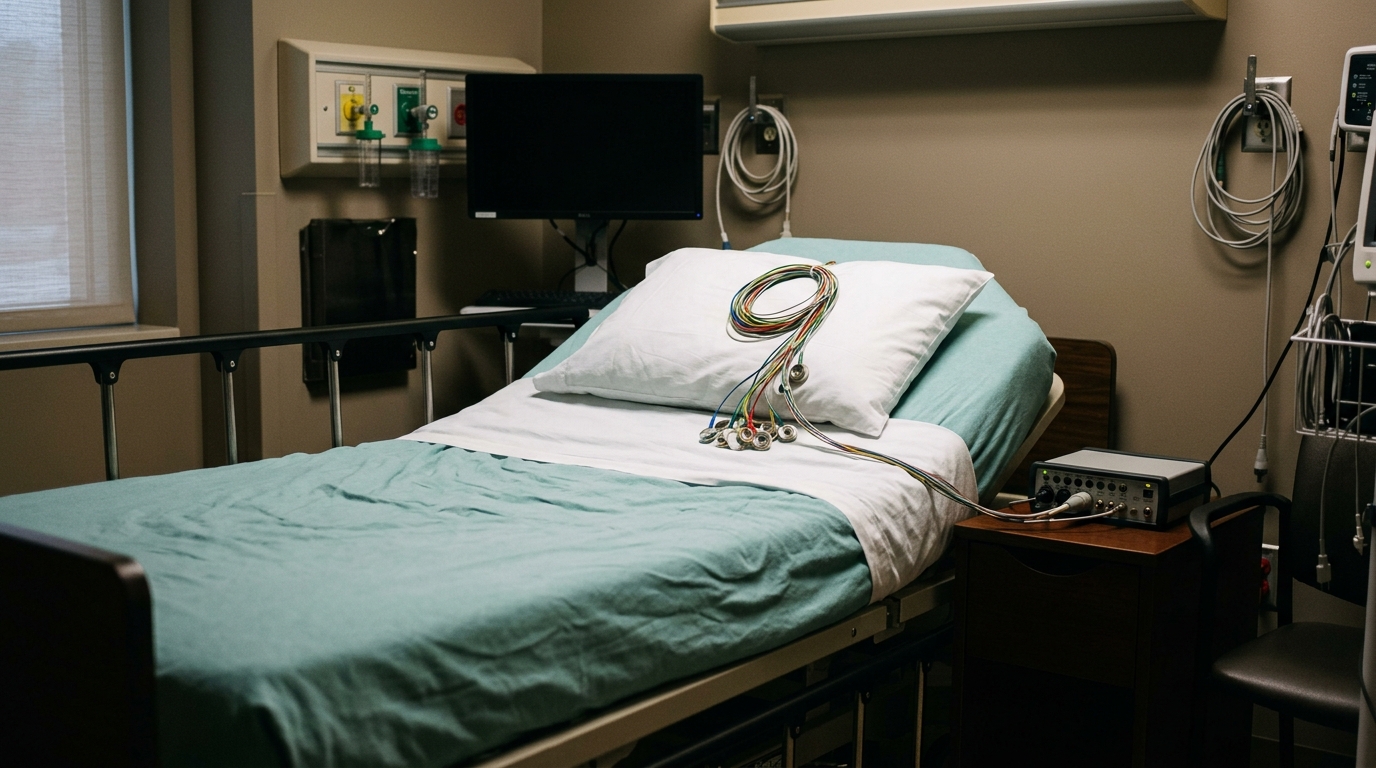
Twenty-two healthy female participants, mean age 23.14, took part in a randomised within-subject comparison — meaning each person served as her own control rather than being compared with someone else.
On one night, before bed, they watched a well-validated film clip containing ‘traumatic’ content. On a separate night, a neutral clip. Heart rate was recorded during each viewing, and nocturnal brain activity afterwards with 64-channel high-density EEG.
Intrusive memories — the involuntary re-appearance of images from the film — were then logged in a six-day diary, and negative affect was assessed a week later using reminders of the film.
The within-subject arrangement is what makes twenty-two people enough to see anything. Comparing a person’s traumatic-film night with her own neutral-film night removes most of the variation that would otherwise swamp the signal.
The Experimental Trauma Paradigm
Some readers will stop at ‘a film clip’ and reasonably ask what this has to do with trauma. It is worth being direct about that.
The trauma film paradigm is a long-established laboratory method. It reliably produces intrusive memories — genuine involuntary images that recur over subsequent days — in healthy volunteers, which is what makes it useful for studying the mechanism of intrusion formation.
It is also, obviously, not trauma. Nobody was in danger, the participants knew they were watching a film, and the intrusions fade within days. It is a model of one specific process, chosen because the process can be triggered ethically and measured precisely — and everything below inherits that limitation.
What Was Measured During Sleep
Two features of sleep activity are central here, and both are well characterised.
Sleep spindles are short bursts of oscillatory activity, roughly a second long, generated in thalamocortical circuits and appearing mostly in non-REM sleep. They are among the most studied signatures in sleep research and are associated with memory consolidation.
Theta activity is slower rhythmic activity that is prominent during REM sleep, the phase most implicated in processing emotional material.
The study asked how the individual affective response to the film predicted changes in these oscillatory measures during the subsequent night, and how those changes in turn predicted how the experimental trauma was processed.
The Finding
The paper’s title states the result plainly: increased sleep spindle and theta activity predict fewer intrusive memories.
Read in the direction that matters, that is a claim about protection rather than damage. Most of this literature describes what disturbed sleep costs; this frames particular sleep activity as doing something useful with the material.
The verb is predict, and the study is correlational in its central analysis even though the trauma exposure was experimentally controlled. Higher spindle and theta activity going with fewer intrusions is not the same as showing that producing more of either would reduce them.
Why This Is Worth Reading Carefully
Twenty-two participants is very small. The within-subject design makes it defensible for detecting a within-person effect and it does not make the result robust. Findings of this size and kind have a poor replication record, and this one has not been replicated.
All participants were female, healthy, and young. Mean age 23. Whether the same relationship holds in men, in older adults, or in people with existing sleep or mental health difficulties is not addressed.
A film is not an event. Intrusions from a laboratory clip resolve on their own within days. Intrusions after real trauma frequently do not, and the processes may not be the same one at different intensities.
And nothing here is actionable at home. Spindle and theta activity are not things anyone can measure or increase deliberately. There is no intervention implied, and treating this as advice about how to sleep after something difficult would be reading far past the data.
The population-scale version of the same question — how common trauma-associated sleep disturbance actually is — is covered in a study of nearly 28,000 women, and the question of whether the rhythm’s stability matters is covered in what wearable monitoring found after a mass-trauma event.
Why It Still Matters
Because it points at a mechanism rather than another correlation. The observation that poor sleep and intrusive memories travel together has been available for a long time; what the field has lacked is a candidate for what specifically sleep is doing when it goes well.
Spindles and theta are plausible candidates precisely because they are already implicated in memory consolidation and emotional processing respectively. A finding that connects them to intrusion frequency is the kind of result that tells the next, larger study where to look.
That is the honest framing: an early, small, well-designed study that makes a specific prediction testable. Not a discovery about how to recover from trauma.
What This Study Supports — and What It Doesn't
A Specific Mechanism Candidate
Spindle and theta activity, both already implicated in memory and emotional processing, linked to intrusion frequency.
A Strong Small Design
Within-subject, each participant her own control across a traumatic-film and a neutral night, with 64-channel EEG.
Very Limited Generalisability
22 healthy young women, a film-clip analogue, intrusions that resolve in days. Not replicated.
Nothing Actionable
Spindle and theta activity cannot be measured or increased deliberately. No intervention follows from this.

Frequently Asked Questions
What are sleep spindles?
Short bursts of oscillatory brain activity, roughly a second long, generated in thalamocortical circuits and occurring mostly during non-REM sleep. They are among the most studied features of sleep physiology and are associated with memory consolidation.
Does this mean good sleep protects against traumatic memories?
It is more limited than that. In 22 healthy young women exposed to a distressing film, greater spindle and theta activity predicted fewer intrusive memories over the following six days. That is an association within a small laboratory study using a film analogue, not a demonstration that sleep protects against the effects of real trauma.
Is watching a distressing film really comparable to trauma?
No, and the study does not claim it is. The trauma film paradigm is a long-established method that reliably produces genuine involuntary intrusive images in healthy volunteers, which makes it useful for studying how intrusions form. The intrusions fade within days, nobody was in danger, and the model captures one process rather than the experience.
Can I do anything to increase spindle or theta activity?
Not deliberately, and nothing in this study suggests trying. These are features of brain activity measured with high-density EEG in a laboratory. No consumer method exists to alter them specifically, and no intervention follows from a correlational finding of this size.
How much confidence should this result carry?
Modest. Twenty-two participants, all female, healthy and young, with a laboratory analogue of trauma and no replication. The within-subject design is a genuine strength for detecting a within-person effect; it does not compensate for the sample size or the narrowness of the group.
Sources
- Sleep to remember, sleep to protect: increased sleep spindle and theta activity predict fewer intrusive memories — Translational Psychiatry, February 2026
- Unnarsdottir AB, Hauksdottir A, Aspelund T, et al. Trauma-associated sleep disturbances among women in a nationwide study — Communications Medicine (Nature Portfolio), June 2026
When Sleep Has Not Recovered
Laboratory studies measure one night’s activity in a small group. Understanding one person’s sleep means measuring that person. NeuroBalance is a small independent practice in Los Angeles — private one-to-one sessions, the same practitioner each visit, in a quiet setting, over fourteen years. A brain health assessment is where that starts.
Schedule Your Free Consultation
Call us: (424) 625-5445 · Los Angeles, CA
Disclaimer: This content is for informational purposes only and does not constitute medical advice, diagnosis, or treatment. LENS Neurofeedback is not FDA-approved for all conditions mentioned. Please consult with a qualified healthcare provider before beginning any new treatment program.

A balanced brain is a better brain for a happier life.