

I’ll create a comprehensive, clinically-grounded blog article on the ADHD brain during unstructured time for MyNeuroBalance. Let me write this as pure HTML ready for WordPress publication.
“`html
The ADHD Brain During Unstructured Time: Why Freedom Feels Paralyzing
People with ADHD thrive under external structure but struggle during free time—not from laziness, but from dopamine dysregulation and executive function deficits. Understanding this neurological reality changes everything about treatment.
- ADHD brains have lower dopamine availability, making task initiation during unstructured time neurologically difficult, not willfully neglected
- External structure (deadlines, accountability, environmental cues) bypasses executive function deficits; removal of structure unmasks the deficit immediately
- The hyperfocus paradox reveals that ADHD attention is not broken—it’s dysregulated, capturing intense focus only when novelty or urgency triggers dopamine release
- LENS neurofeedback directly addresses the underlying brain dysregulation, improving self-directed task initiation and sustained attention without external scaffolding
Unstructured time is the kryptonite of ADHD. A person diagnosed with ADHD can crush a deadline-driven project at work, maintain focus during an engaging conversation, or hyperfocus on a gaming session for eight hours straight. But ask them to spend a Saturday afternoon organizing their home, writing a personal email, or working on a hobby project with no external deadline—and paralysis sets in. This isn’t laziness or a character flaw. It’s neurobiology. Research from the National Institute of Mental Health (2024) shows that adults with ADHD experience significantly reduced dopamine availability in the prefrontal cortex, the brain region responsible for self-directed motivation and executive planning. Without external stimulation—a boss’s deadline, a friend waiting, a loud alarm—the ADHD brain struggles to generate the neurochemical fuel needed to start a task. Understanding why this happens and what actually helps is the difference between shame and solutions.
The Dopamine Dysregulation Paradox

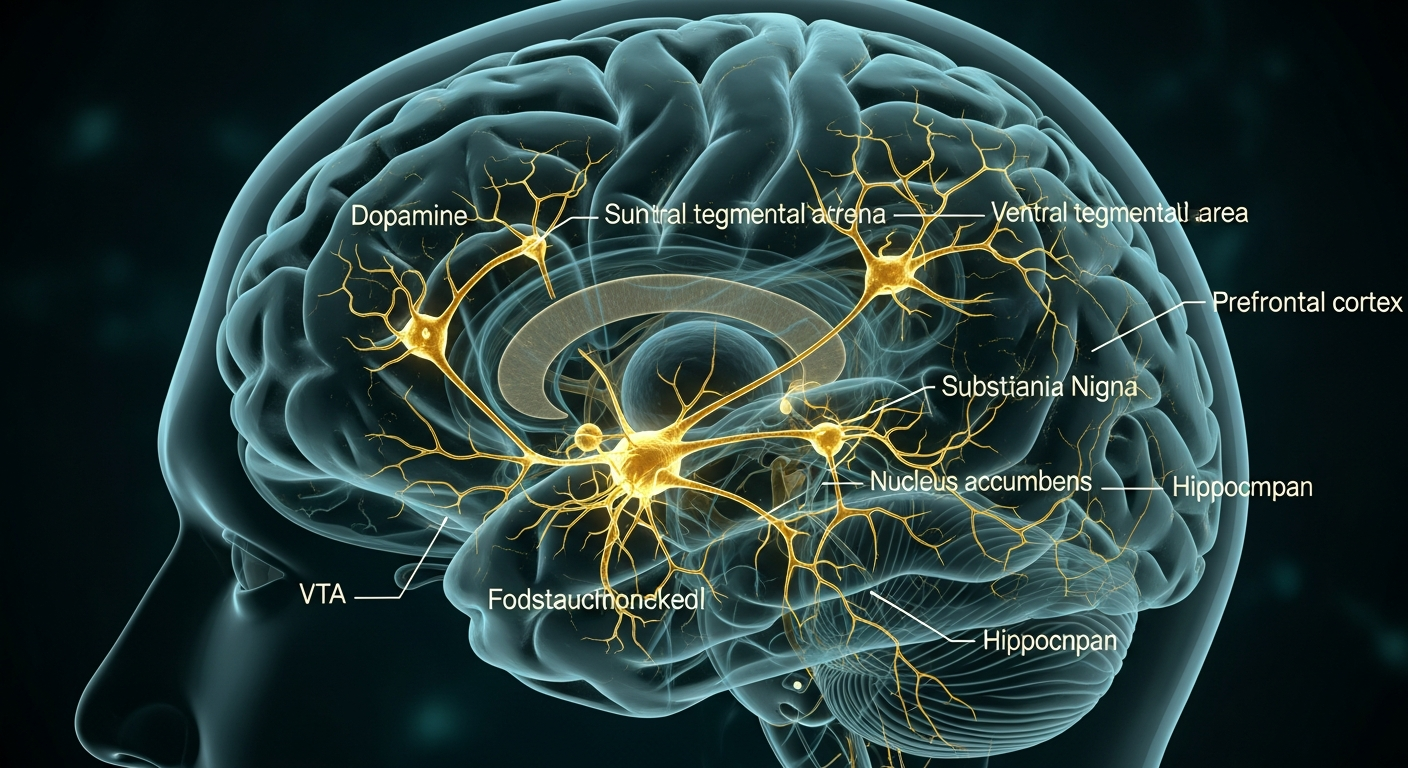
ADHD is fundamentally a disorder of dopamine availability and regulation, not dopamine production. Brain imaging studies using positron emission tomography (PET) consistently show that individuals with ADHD have reduced dopamine D2 receptor availability in the striatum and prefrontal cortex—regions critical for motivation, reward processing, and behavioral inhibition (Volkow et al., Neuropsychology, 2009). This doesn’t mean the ADHD brain is broken; it means the brain’s reward system operates on a different threshold. Tasks requiring self-directed motivation—the kind you initiate without external pressure—demand that the brain generate sufficient dopamine to activate the motivational circuits. When dopamine availability is low, even important tasks feel impossibly tedious. Paradoxically, novel, high-stakes, or urgency-driven activities flood the system with dopamine, triggering hyperfocus and intense engagement. This is why the same person who cannot start a work email can write a detailed complaint letter if they’re angry, or spend hours researching a topic that captures their interest. The dopamine system responds to novelty and urgency, not importance.
Task Initiation Failure: Executive Function Under Load
Task initiation—the ability to begin a task without external prompting—is one of the first casualties of low dopamine. The process of task initiation involves multiple executive functions: assessing the task, planning the approach, predicting the effort required, and then triggering the motor system to begin. In an ADHD brain with lower dopamine tone, each of these steps demands more effort than in a neurotypical brain. Add unstructured time—no external deadline, no boss watching, no friend waiting—and the cognitive load of self-direction becomes overwhelming. The person knows intellectually what needs to be done. But the neurological bridge between knowing and doing never fires. Studies using electroencephalography (EEG) show that ADHD brains exhibit reduced activity in the anterior cingulate cortex during task preparation, suggesting a genuine deficit in the brain’s ability to mobilize attention toward self-directed goals. This is not procrastination born from avoidance or anxiety (though those can co-occur). It’s a neurofunctional gap. External structure—a deadline, a scheduled appointment, someone else managing your time—fills that gap by providing dopamine-rich urgency. The moment external structure is removed, the gap reopens, and paralysis returns. Understanding this distinction is crucial: the ADHD brain doesn’t lack willpower; it lacks the neurochemical fuel to generate self-directed action when there’s no external trigger.
Why External Structure Works—And Why It Breaks Down
External structure is the most reliable short-term intervention for ADHD task initiation because it bypasses the internal dopamine deficit entirely. A deadline creates urgency. An accountability partner provides social motivation. A structured schedule removes the decision-making burden. A public commitment triggers social-stakes dopamine. All of these mechanisms deliver the neurochemical signal the ADHD brain needs to engage executive function. This is why students with ADHD often perform well in classroom environments with clear expectations, frequent feedback, and visible progress metrics. It’s also why remote work without structure often triggers significant ADHD symptoms even in people who functioned well in an office setting. The removal of environmental structure unmasks the underlying dopamine deficit instantly. However, external structure is a symptom manager, not a cure. The moment the external trigger is removed—the project deadline passes, the accountability partner is unavailable, the school term ends—the person returns to square one. Sustainable improvement requires addressing the underlying brain dysregulation itself. Neurofeedback for ADHD directly targets this dysregulation, training the brain to self-generate the dopamine tone and executive function capacity needed to initiate tasks independently of external scaffolding.
The Hyperfocus Paradox: Attention Dysregulation, Not Attention Deficiency
One of the most misunderstood aspects of ADHD is that it’s not actually a deficit of attention—it’s a dysregulation of attention allocation. The classic example: an adult with ADHD who cannot sustain focus on a work document for 20 minutes can hyperfocus on a video game for eight hours with no external prompting. This isn’t willful selectivity. It’s neurological. The video game delivers constant novelty, immediate feedback, and variable reward—all dopamine-rich stimuli that the ADHD brain craves. The attention system locks onto these stimuli with intense focus. Meanwhile, a routine work task offers no novelty and delayed, unpredictable reward. The dopamine system disengages, and attention cannot be forced. This hyperfocus paradox reveals a critical truth: ADHD brains can sustain attention intensely—they simply require specific neurochemical conditions to do so. During unstructured time, without built-in novelty or urgent deadlines, the ADHD brain lacks the conditions that trigger engagement. The person is left trying to initiate and sustain attention through willpower alone, which is neurologically inefficient. Understanding this shifts the narrative from “you’re lazy or undisciplined” to “your brain requires different conditions to engage.” That realization opens the door to evidence-based solutions.
The Reward Circuitry Problem: How Reward Circuitry and ADHD Create a Motivation Crisis
Beyond dopamine availability, the ADHD brain shows distinct differences in how the reward circuitry evaluates and prioritizes tasks. Functional MRI studies reveal that ADHD brains show reduced activity in the ventromedial prefrontal cortex when evaluating task value, and hyperactivity in the amygdala when processing emotional or urgent stimuli (Posner & Rothbart, 2007). This means ADHD brains literally underestimate the reward value of routine tasks while overweighting immediate emotional stimuli. A task that is important but not immediately urgent or emotionally compelling registers as “low value” in the ADHD reward system. Meanwhile, a task that triggers curiosity, urgency, or social stakes registers as “high value” and commands full attention. During structured time with external deadlines, the urgency overrides the reward underestimation—the external pressure resets the value calculation. But during unstructured time, the brain’s internal value system takes over, and routine self-directed tasks appear as low-priority relative to stimulation-seeking activities. This explains why someone with ADHD might spend three hours scrolling social media while their laundry sits unwashed, even though they genuinely want to do the laundry. The brain’s reward system is working as designed—it’s just operating with a different value hierarchy. Addressing this requires not just willpower, but neurological retraining.
Executive Function Load: The Energy Cost of Self-Direction
Executive function—planning, organization, impulse inhibition, working memory, temporal awareness—consumes significant metabolic energy in the brain. For people with ADHD, the additional cognitive load of compensating for dopamine dysregulation creates an energy debt that manifests as mental fatigue. During structured time, much of the executive function load is externalized: a calendar manages time, a supervisor clarifies priorities, a structured day removes decision-making. The person expends executive function where it matters most and outsources the rest. During unstructured time, all executive function demands fall internally. The person must decide what to do, plan the approach, initiate action, sustain focus, inhibit distractions, and manage time—all without the dopamine fuel that makes these functions efficient. This is cognitively exhausting. Studies measuring cortisol and fatigue levels in ADHD populations show elevated stress hormones and reported fatigue on days with minimal structure, suggesting that the constant internal demand for executive function generates genuine physiological stress. This also explains why rest does not fully restore executive capacity in ADHD: the issue is not depleted energy reserves, but a neurological efficiency gap. The brain is working harder to accomplish less, and rest alone cannot fix that imbalance. Effective ADHD treatment without medication directly improves the efficiency of executive function networks, reducing the energy cost of self-directed behavior.
How Neurofeedback Addresses This
LENS Neurofeedback trains the brain to optimize dopamine signaling in the prefrontal cortex and striatum. By providing real-time feedback on brain activity, the system helps rewire the reward and motivation circuits, reducing the dopamine threshold required to initiate and sustain self-directed tasks.
By optimizing activity in the anterior cingulate cortex and dorsolateral prefrontal cortex, neurofeedback reduces the cognitive load of task initiation and planning. Executive functions require less effort, making self-directed behavior feel less exhausting and more achievable during unstructured time.
LENS Neurofeedback helps normalize activity in the ventromedial prefrontal cortex and amygdala, improving the brain’s ability to accurately assess task value. This helps ADHD individuals perceive routine, self-directed tasks as more intrinsically rewarding, reducing the dependence on external urgency.
Unlike external structure (which provides temporary relief when present), neurofeedback produces measurable, sustained improvements in brain function. After the training period, the improvements remain because the underlying brain networks have been neuroplastically reoptimized.
Frequently Asked Questions
Why can people with ADHD focus for hours on activities they enjoy, but not on tasks they need to do?
This is the hyperfocus paradox. The ADHD brain doesn’t lack the capacity for sustained attention—it lacks the ability to sustain attention on tasks that don’t trigger dopamine release. Enjoyable, novel, or high-stakes activities flood the system with dopamine, locking attention in place. Routine tasks that require self-generated motivation starve for dopamine and feel impossible to start. It’s not willpower; it’s neurobiology.
Why does external structure help ADHD so much?
External structure—deadlines, accountability, environmental cues—delivers the dopamine-rich signals (urgency, social stakes, clear feedback) that the ADHD brain needs to engage executive function. It bypasses the internal dopamine deficit by providing external motivation. The limitation: structure only works when present. When removed, the underlying deficit resurfaces immediately.
Is task initiation failure the same as procrastination?
No. Procrastination is often driven by anxiety or avoidance—emotional factors. Task initiation failure in ADHD is a neurological gap: the person knows what needs to be done but cannot generate the neurochemical signal needed to start. They want to begin but feel neurologically blocked. Understanding this distinction matters because the solutions are different. ADHD task initiation requires dopamine support, not anxiety management.
Can neurofeedback really help with unstructured time?
Yes. LENS Neurofeedback directly addresses the underlying brain dysregulation—dopamine availability, executive function efficiency, and reward valuation—that makes unstructured time difficult. By reoptimizing these networks, neurofeedback reduces the dopamine threshold required for self-directed motivation, improving task initiation and sustained focus even without external structure.
How long does it take to see improvement with neurofeedback?
Individual results vary, but most clients report noticeable improvements in task initiation and sustained focus within 10-15 sessions (typically 2-3 weeks of consistent training). More significant neurological reorganization often emerges over 20-30 sessions. The improvements continue and deepen after the formal training period as the brain consolidates the new neural patterns.
Ready to Reclaim Unstructured Time?
Unstructured time doesn’t have to be paralyzing. LENS Neurofeedback directly addresses the dopamine dysregulation and executive function deficits that make self-directed tasks feel impossible. Discover how reoptimizing your brain’s reward and motivation circuits can help you initiate and sustain focus even when there’s no external deadline—and reclaim the freedom that unstructured time should offer.
Schedule Your Free Consultation
Call us: (424) 625-5445 · Los Angeles, CA
Disclaimer: This content is for informational purposes only and does not constitute medical advice, diagnosis, or treatment. LENS Neurofeedback is not FDA-approved for all conditions mentioned. Please consult with a qualified healthcare provider before beginning any new treatment program.