

The Brain's Sensory Filters: Why Some People Feel Everything
The brain continuously discards most incoming sensory information before it reaches awareness. This filtering — sensory gating — varies between people. When it filters less aggressively, ordinary environments deliver far more signal, which is genuinely exhausting rather than a matter of tolerance.
- Sensory gating discards most incoming signal before it reaches awareness
- Differences in filtering appear across ADHD, autism, migraine, anxiety and high sensitivity
- Reduced filtering means more signal arriving, not weaker willpower
- Fatigue in busy environments reflects processing load, not social reluctance
Right now your skin is detecting the pressure of your clothing, your ears are receiving background noise, and your visual periphery is full of information. Almost none of it reaches your awareness, because the brain discards the overwhelming majority of incoming sensory data before it becomes conscious. That filtering is a continuous, active process — and when it operates differently, the world arrives at a genuinely different volume.
What Is Sensory Gating?
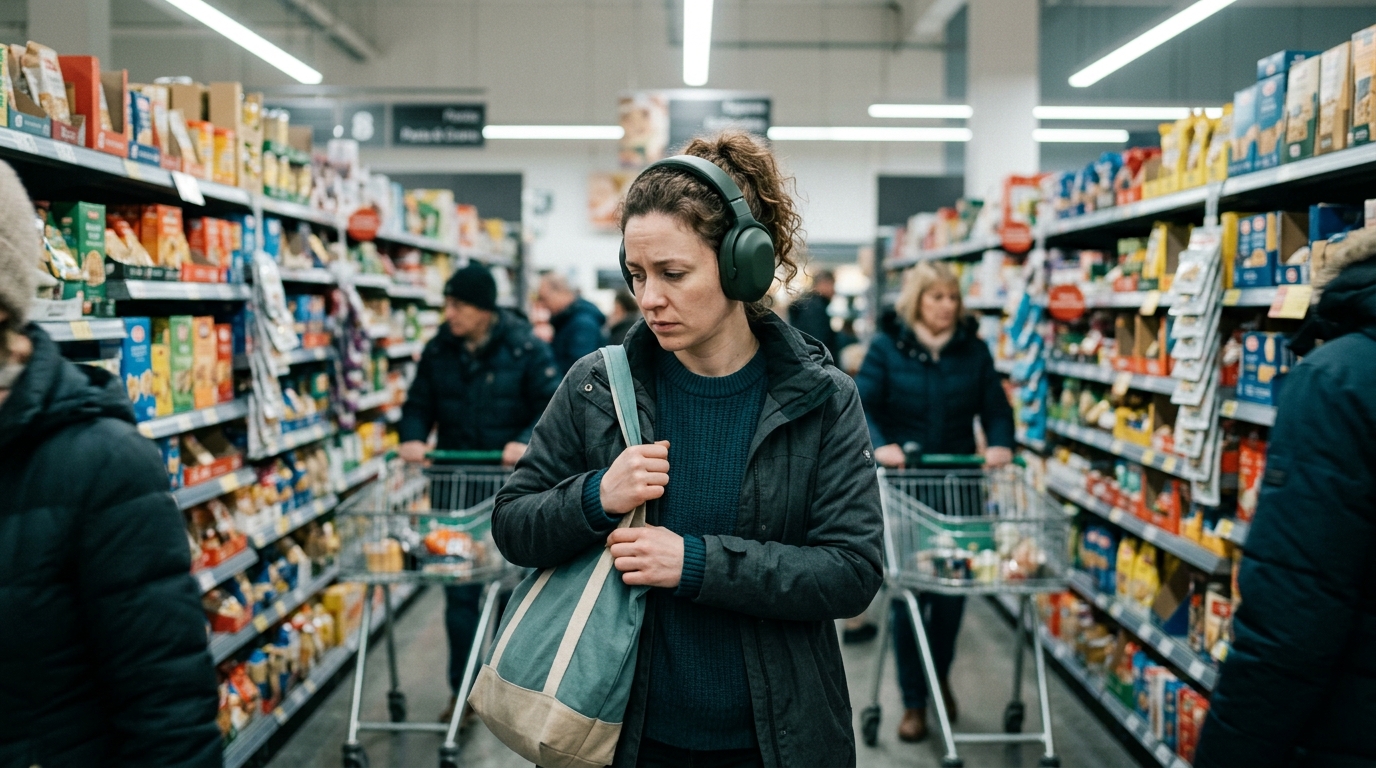
It is the process of suppressing irrelevant or repetitive sensory input so that limited attention can go to what matters. Your senses gather far more than consciousness could possibly handle, so selection is mandatory rather than optional.
A useful demonstration: you were not aware of your clothing until the previous paragraph mentioned it. The sensation was being detected continuously; it was being filtered out because it carried no new information. That is gating operating correctly.
The key insight for anyone who has been told they are oversensitive is that the sensors are usually normal. The difference is in what gets suppressed. Someone whose filtering is less aggressive is not detecting more; they are discarding less of what everyone detects.
Our June article on why some people feel everything more intensely describes the experience; this piece focuses on the filtering mechanism itself.
Why Is a Supermarket So Exhausting?
Because it is close to a worst case for a filtering system. Bright unnatural lighting, often with imperceptible flicker. Continuous background music competing with announcements. Dense visual information engineered specifically to capture attention. Unpredictable movement of other people. Temperature changes between aisles.
For a well-filtering nervous system most of this is suppressed and the experience is unremarkable. For a less aggressively filtering one, much of it arrives, and each arriving signal requires processing.
This is why the fatigue afterwards is real and disproportionate. It is not reluctance or anxiety about shopping — it is the metabolic cost of processing a far larger volume of input than the environment appears to contain.
It also explains why the same person may function well in a quiet office and poorly in an open-plan one, and be genuinely puzzled by their own inconsistency.
Why Does This Show Up Across So Many Conditions?
Because filtering is a general mechanism, so differences in it appear in several distinct conditions without those conditions being the same thing.
In autism, sensory processing differences are a recognised diagnostic feature, and the specific profile varies considerably between individuals — including both heightened and reduced responsiveness across different modalities. Our page on autism spectrum disorder covers this.
In ADHD, difficulty suppressing irrelevant input is closely tied to the attention picture — filtering and attention are two descriptions of the same selection problem. See the brain’s attention network.
In migraine the change is episodic: during an attack, gating loosens and ordinary light and sound become genuinely painful — see what happens during a migraine. And in anxiety, a nervous system running threat monitoring is actively scanning rather than suppressing, since a system expecting danger cannot afford to discard information.
Shared mechanism, different conditions. That does not make them equivalent, and treating them as interchangeable would be wrong.
Is High Sensitivity a Disorder?
Not in itself, and this distinction matters practically. Variation in sensory filtering exists across the population as a normal trait, in the same way height does.
Being toward the more-sensitive end has genuine advantages: noticing detail others miss, picking up subtle changes in environments and in people, aesthetic and emotional responsiveness. Many roles benefit from it directly.
It becomes a clinical concern only when it significantly impairs functioning — when someone cannot work in available environments, avoids activities they want to do, or experiences distress that meaningfully limits life. The threshold is impact, not intensity.
That said, sensitivity that appeared or worsened noticeably is different from lifelong sensitivity, and worth investigating. New sensory sensitivity can accompany migraine, concussion, chronic stress or anxiety, and treating a change as a fixed trait can delay identifying something addressable.
Why Does Stress Make It Worse?
Because filtering and threat monitoring are in direct tension. A nervous system that has judged the environment to be potentially dangerous cannot afford to discard information — filtering out the wrong signal could be costly.
So elevated arousal reduces filtering by design. Someone under chronic stress will experience a genuinely noisier world, and this is one of the most common reasons for sensitivity that fluctuates rather than staying constant.
The loop is unhelpful: reduced filtering means more input, more input is more demanding, more demand raises stress, and higher stress reduces filtering further. People often notice they became more sensitive during a difficult period and did not fully return afterwards.
Sleep sits inside this loop too. Insufficient sleep both increases reactivity and reduces the prefrontal regulation involved in suppression, which is why sensitivity is markedly worse when tired.
What Actually Helps?
Environmental modification first, because it is immediate and effective and requires nobody’s permission. Noise-reducing headphones, warmer and non-fluorescent lighting, sunglasses in bright environments, choosing quieter times for errands. These are not avoidance; they are reducing unnecessary load.
Recovery time is not indulgence either. If a busy environment costs more processing, that cost has to be repaid, and building recovery into the plan prevents the accumulation that produces shutdown.
Sleep and stress regulation matter more than most people expect, because both directly affect filtering. Sensitivity that worsened during a stressful period often improves substantially when baseline arousal comes down.
Where filtering difficulty is significant and persistent, it can be measured rather than inferred. Brain mapping shows what the underlying rhythms are doing, and LENS neurofeedback therapy works on the regulation involved. New or worsening sensitivity should also be medically evaluated.
How Regulation Affects Sensory Filtering
Arousal and Filtering Are Linked
A nervous system in a heightened state suppresses less by design, because a system expecting threat cannot afford to discard information.
Fluctuating Sensitivity Is a Clue
Sensitivity that varies with stress and sleep suggests a regulation component, which is more modifiable than a fixed trait.
Measurement Beats Inference
Brain mapping shows what the underlying rhythms are doing rather than leaving sensitivity to be judged from behaviour.
Accommodation Is Legitimate
Reducing sensory load is not avoidance. Lowering unnecessary input frees capacity for what actually matters to you.

Frequently Asked Questions
Am I really more sensitive, or just less tolerant?
The distinction is real and it is not about tolerance. Sensory gating — the suppression of irrelevant input before it reaches awareness — varies between people. Someone who filters less aggressively receives more signal from the same environment, so the processing load is genuinely higher. The sensors are typically normal; what differs is how much gets discarded. The resulting fatigue reflects actual workload.
Does sensory sensitivity mean I'm autistic?
Not on its own. Sensory processing differences are a recognised feature of autism, but they also appear in ADHD, migraine, anxiety and chronic stress, and as a normal trait in people with none of these. Sensory sensitivity alone is not diagnostic. If you are considering assessment, that should be based on a fuller picture including social communication and developmental history, evaluated by a qualified clinician.
Why has my sensitivity got worse recently?
Increasing sensitivity often reflects changed regulation rather than a changed trait. Elevated arousal reduces filtering by design, since a nervous system anticipating threat cannot afford to discard information, and insufficient sleep compounds this. New or worsening sensitivity can also accompany migraine, concussion or other medical conditions, so a noticeable change is worth medical evaluation rather than assuming it is permanent.
Are noise-cancelling headphones avoidance?
No — reducing unnecessary sensory load is a reasonable accommodation, not avoidance of something you need to face. Avoidance in the clinical sense maintains a fear by preventing corrective learning. Managing sensory input frees processing capacity for what you actually want to do. The distinction is whether the strategy expands your life or progressively narrows it.
Can sensory filtering be improved?
The regulation component often can. Where sensitivity fluctuates with stress and sleep, addressing baseline arousal frequently reduces it, because filtering is directly affected by arousal state. Lifelong constitutional sensitivity is less likely to change fundamentally, and the realistic goal there is managing load and building in recovery rather than expecting to become a different kind of nervous system.
Sources
- Role of cortical spreading depression in the pathophysiology of migraine — National Library of Medicine (PMC)
- ADHD in Children Ages 5-17 — CDC NCHS Data Brief No. 499 (March 2024)
- Impact of Stress on Brain Morphology — National Library of Medicine (PMC)
- Brain circuit dysfunction in post-traumatic stress disorder — National Library of Medicine (PMC)
When the World Arrives Too Loud
Sensory filtering is directly affected by arousal — so sensitivity that worsens with stress and poor sleep often has a modifiable component. At MyNeuroBalance in Los Angeles we measure the underlying regulation. Schedule a brain health assessment.
Schedule Your Free Consultation
Call us: (424) 625-5445 · Los Angeles, CA
Disclaimer: This content is for informational purposes only and does not constitute medical advice, diagnosis, or treatment. LENS Neurofeedback is not FDA-approved for all conditions mentioned. Please consult with a qualified healthcare provider before beginning any new treatment program.