
What Is the Brain Trying to Protect? Rethinking Symptoms Through the Lens of Adaptation
A closer look at why the brain produces symptoms like anxiety, pain, and hypervigilance — and what that function reveals about how nervous system flexibility, rather than suppression, may be the more useful goal.
There is a widely held assumption about symptoms: that they are things going wrong. Anxiety is the nervous system misfiring. Chronic pain is the body deceiving itself. Hypervigilance is threat detection stuck in overdrive. On this view, the therapeutic task is to stop the symptom — to quiet the alarm, reduce the signal, restore baseline.
The picture that emerges from several decades of neuroscience research is more complicated, and in some ways more useful. Symptoms, in many cases, are not malfunctions. They are the brain doing exactly what a brain does: generating protective responses based on its best available predictions about what the situation requires. The alarm is not stuck. It is, at least initially, doing its job.
This reframing does not make symptoms less real, less distressing, or less in need of attention. It does change what the relevant question is. Rather than asking "how do we stop this signal", the more informative question becomes: "what is this signal protecting, and why does the brain believe the protection is still necessary?"
The Brain as a Prediction Engine, Not a Reaction Machine

A common mental model of the brain treats it as primarily reactive: stimuli come in, responses go out. Danger appears; the stress response fires. Pain occurs; the brain registers it. On this model, symptoms are direct read-outs of events in the world or in the body.
Research into interoception and predictive processing has shifted that picture substantially. A landmark 2017 study by Kleckner and colleagues, published in Nature Human Behaviour, mapped a large-scale brain network spanning the insula, anterior cingulate cortex, and prefrontal regions that supports what the authors describe as allostasis: the brain's continuous anticipatory regulation of the body's internal state. Allostasis is not reactive — it is prospective. The brain is constantly generating predictions about what the body will need before the need fully arrives, and adjusting physiology accordingly.
This matters for understanding symptoms because it means the brain is not simply detecting and reporting. It is predicting, preparing, and acting on those predictions. Anxiety, in this framework, is not just the experience of fear — it is a predictive mobilisation of physiological resources in anticipation of something the brain has classified as threatening. The mobilisation precedes the confirmed threat. In an environment where that classification is often correct, this is an asset. The question is whether the classification remains calibrated as circumstances change.
Pain, similarly, is now understood in much of the contemporary neuroscience and clinical literature not as a direct signal from damaged tissue, but as an output the brain generates when it concludes that protection is warranted. Butler and Moseley's extensively cited Explain Pain framework makes this explicit: pain is always a brain decision, even when tissue damage is involved. The decision is protective in intent. The brain is trying to limit use of a structure it has assessed as at risk.
This reframing is not semantic. It repositions the brain as an active agent generating responses with a coherent functional logic — not a passive recorder of events.
Reading the Signal: What Different Symptoms May Be Doing
If symptoms are protective predictions rather than malfunctions, it becomes possible to read them functionally — to ask what specific adaptive purpose each one may be serving. This is not the same as saying symptoms are always appropriate or that their costs are acceptable. It is a question about their origin and logic.
Symptoms associated with anxious arousal — increased heart rate, heightened attention, muscular tension — represent a coordinated physiological preparation for action. Resources are redistributed from longer-term maintenance functions toward systems relevant to immediate threat response. In a genuine threat context, this redistribution is efficient. When the threat context becomes chronic or ambiguous, the redistribution persists, and the sustained metabolic cost accumulates.
Avoidance behaviors follow a related logic. When the brain has associated a context, situation, or class of stimuli with danger, steering around those stimuli reduces the predicted probability of harm. Avoidance works — in the short term. The problem, well documented in the fear conditioning literature, is that avoidance prevents the exposure events through which the brain could update its predictions. The association remains because it has never been disconfirmed.
Hypervigilance — an elevated baseline scanning for threat signals — increases the probability of detecting genuine danger early. The brain is, in effect, trading specificity for sensitivity: it will generate more false positives in exchange for missing fewer real threats. In contexts where threats are frequent and serious, this trade may be adaptive. In contexts where threats are rare, it becomes costly to maintain.
Freeze and shutdown responses, which can appear as numbness, dissociation, or profound fatigue, are less often discussed in protective terms but carry their own functional interpretation. Across many species, immobility responses are associated with conditions where active defense is unlikely to succeed and resource conservation or behavioral invisibility may serve survival. These responses are not failures of the nervous system. They represent a different class of protective strategy.
Persistent pain in the absence of ongoing tissue damage is among the most counterintuitive symptoms to understand in adaptive terms, yet the protective logic holds: if the brain's predictive model continues to classify a body region as vulnerable or at risk, it will continue generating protective outputs. The prediction, not the tissue, drives the signal.
When Protection Becomes Costly: Allostatic Overload
Protective adaptations carry costs. Sustained mobilization of physiological resources, maintained across time or at high intensity, depletes the systems that support long-term regulation. This is the concept Santamaría-García and colleagues examined in a 2024 paper in Biological Psychiatry that synthesized evidence on what they call allostatic interoceptive overload — a condition in which the brain's adaptive mechanisms, originally calibrated for a specific threat environment, continue operating at elevated intensity beyond the circumstances that originally demanded them.
The authors reviewed evidence across a range of psychiatric and neurological presentations, identifying a common pattern: chronic activation of the predictive-protective systems that regulate internal body states. The finding is not that these systems are broken or misfiring. It is that they are running a well-designed protective program in conditions where the original threat has changed, passed, or been overstated by an outdated predictive model.
Allostatic overload can be understood as the accumulated cost of sustained protection. The metabolic load of keeping the stress response primed, the attentional load of maintaining hypervigilance, the structural and functional effects of chronic elevated cortisol — these represent a real physiological burden. The brain is spending resources on protection that are no longer returning proportionate benefit.
A key implication of this framing is that the problem is not the protective response per se, but its persistence and intensity relative to current circumstances. The brain's model of what the current situation requires has not been updated. It is still running predictions calibrated to a prior threat environment. The nervous system is protecting the person from something that is no longer there at the same level — or at least, that is what a recalibrated nervous system might assess.
This distinction has practical significance. Interventions aimed purely at suppressing the symptom address the output without engaging the prediction. Interventions that help the nervous system update its model — revise its assessment of what current circumstances require — work at the level of the underlying process.
Why Suppression Often Fails: Rigid Circuits and Prediction Loops
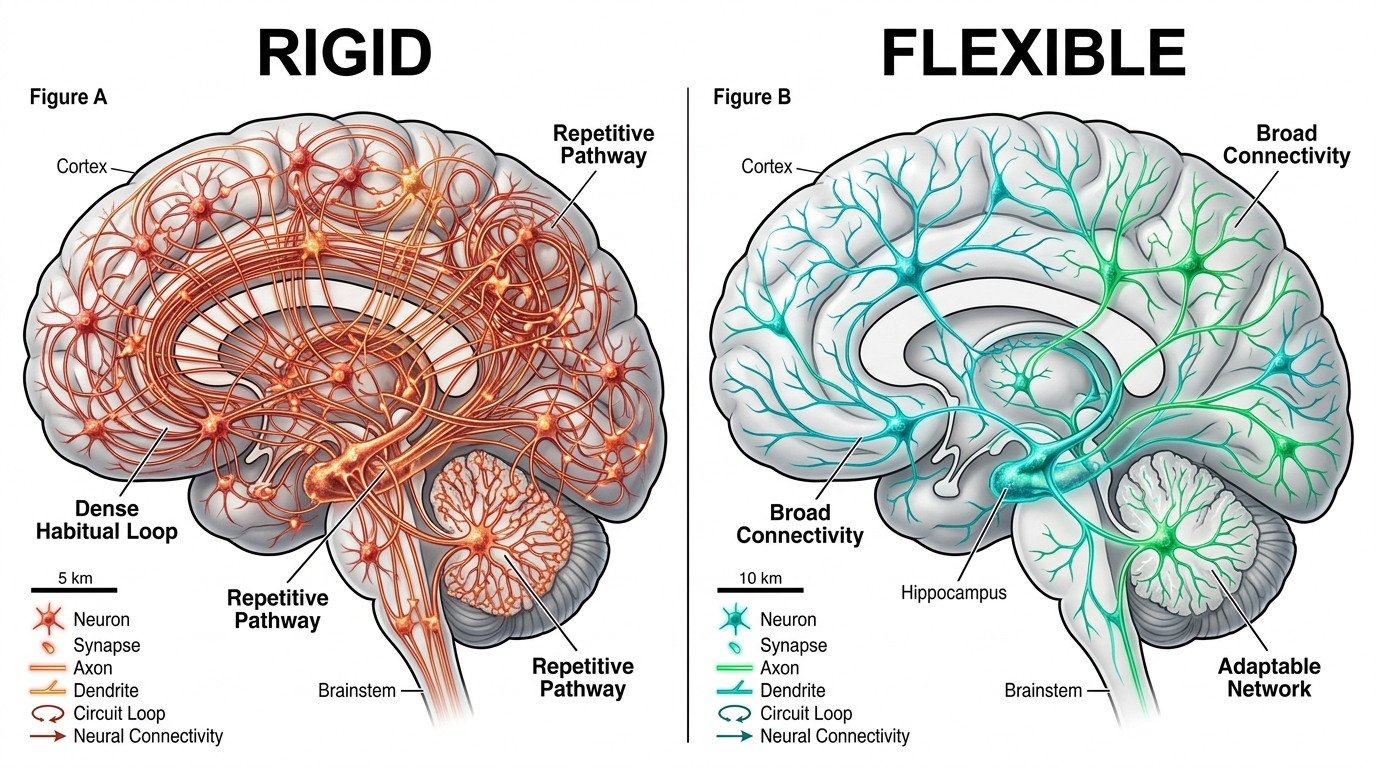
Understanding why symptom suppression is often an incomplete strategy requires looking at how predictions are stored and updated in the brain. Associative learning — the process by which the brain links stimuli, contexts, and predicted outcomes — produces neural circuits that are, by design, persistent. Stability is a feature, not a bug: a nervous system that discarded its predictions after a single disconfirmation would not function well in environments where threats recur.
Fear extinction, the process by which previously threatening associations lose their force, is not simple deletion. The original association is not erased; a competing prediction is layered on top of it. Research on the hippocampus-prefrontal cortex-amygdala circuit has documented this extensively. The prefrontal cortex, particularly the ventromedial portion, plays a central role in regulating the amygdala's threat-response output based on contextual information. When this regulatory circuit is functioning flexibly, the brain can appropriately modulate a fear association depending on whether contextual cues signal that the original threat conditions are present.
When the circuit is less flexible — whether from chronic stress, early adversity, or other factors that affect prefrontal function — the modulation becomes less reliable. The protective association generalizes beyond its original context. The brain responds as if the threat conditions are present in situations where they are not. This is not a failure of will or attention. It is a property of how the circuitry is operating.
Suppression strategies that attempt to directly override the symptom — to simply stop the anxiety, force the pain signal away, or push through the freeze — are attempting to address the output of this circuit from the outside. They may reduce the symptom in the short term. They do not engage the predictive model generating it. In some cases, particularly where suppression itself becomes effortful and chronically maintained, the long-term costs of suppression can compound the original burden.
The more tractable target, from a neural systems perspective, is the flexibility of the predictive circuit itself: the capacity of the brain to update its models, discriminate between contexts, and revise the assessments that drive protective outputs.
Restoring Flexibility: What the Evidence Points Toward
If the underlying problem is a nervous system running a well-designed protective program past its useful range, the question becomes what shifts the system toward updating — toward recalibrating rather than simply suppressing.
Cognitive flexibility, defined as the capacity to shift between cognitive frameworks, update predictions in response to new information, and modulate responses depending on context, has received substantial research attention as both a target and a marker of nervous system adaptability. A 2023 editorial in Frontiers in Human Neuroscience by Colombo, Brem, and Oosterman reviewing research directions on protecting and boosting cognitive flexibility notes that flexibility involves distributed networks — not a single region — and that approaches supporting this networked adaptability are receiving increasing research attention.
The direction the evidence consistently points is toward working with the brain's own update mechanisms rather than against its protective outputs. Approaches that support the prefrontal modulation of threat-response circuits, that expose the nervous system to disconfirming information in tolerable doses, or that support the regulation of internal body-state predictions are engaging the circuitry that determines whether the brain continues running its old protective program or begins revising it.
This does not resolve quickly or uniformly. The brain's predictive models accumulated over real experience; updating them takes time and repeated encounters with contrary evidence. Individual variation in baseline flexibility, life history, and current circumstances affects the pace of change. Population-level research describes group trends, not individual trajectories.
What this framework offers is a different frame for understanding what is happening when someone experiences persistent symptoms: not a brain that is broken, but a brain that is still protecting, for reasons that once made sense, in a nervous system that has not yet had sufficient evidence to conclude the protection is no longer needed at that level.
A note on the limits of this framework: The allostatic and predictive processing models described here are active areas of neuroscience research. They offer explanatory frameworks for understanding symptom generation and maintenance — they are not confirmed mechanisms for any individual's specific experience. Population-level findings describe patterns across groups; they cannot predict what any one person's nervous system is doing or will do. The discussion above is informational and does not describe any clinical protocol or outcome.
Frequently Asked Questions
Does calling a symptom "adaptive" mean it doesn't need attention?
No — the adaptive framing describes the brain’s intent, not the symptom’s cost or urgency. A protective response that has become chronic, generalized, or disproportionate to current circumstances is still causing real distress and impairment, and that warrants attention. Understanding the function helps clarify what kind of attention may be most useful: working with the brain’s update mechanisms rather than simply suppressing the output.
What is allostasis, and how is it different from homeostasis?
Homeostasis describes the body returning to a fixed set point after a disturbance. Allostasis, as used in the Kleckner et al. 2017 Nature Human Behaviour research, refers to the brain’s prospective regulation of internal states — anticipating what conditions will require and adjusting physiology before the demand fully arrives. It is predictive rather than reactive. Allostatic overload occurs when this predictive protective system remains activated at a cost that exceeds the benefit the protection is returning.
Is pain always "in the brain" in the sense of being imagined?
No — the statement that pain is a brain output does not mean it is imagined or less real. Butler and Moseley’s Explain Pain framework, widely cited in contemporary pain research, holds that pain is always generated by the brain as a protective signal, but that this process is real, physiologically mediated, and experienced as genuinely painful. The point is that the presence or absence of tissue damage is not a reliable predictor of pain intensity, because the brain’s assessment of threat, not tissue state alone, drives the output.
Why does avoidance feel helpful in the moment even if it maintains the problem long-term?
Avoidance is genuinely effective at reducing predicted danger in the short term — the brain receives a signal that the threat was avoided. What avoidance prevents is the exposure through which the brain could discover that its prediction was overstated or that the situation is now different from when the association was formed. The protective logic is intact; what is missing is the updating experience. This is a well-documented dynamic in the research on fear conditioning and extinction.
What does "nervous system flexibility" mean in practical terms?
Flexibility in this context refers to the nervous system’s capacity to update its predictions based on new information, discriminate between contexts that differ in relevant ways, and modulate responses proportionally to current circumstances rather than running fixed patterns from prior experience. Research reviewed in the 2023 Frontiers in Human Neuroscience editorial by Colombo and colleagues describes cognitive flexibility as a distributed, network-level capacity — not a single skill or region — and notes that both lifestyle factors and targeted approaches can support or diminish it.
Sources
- Kleckner IR et al. (2017). Evidence for a Large-Scale Brain System Supporting Allostasis and Interoception in Humans. Nature Human Behaviour. — Nature Human Behaviour
- Santamaría-García H et al. (2024). Allostatic interoceptive overload across psychiatric and neurological conditions. Biological Psychiatry. — Biological Psychiatry
- Colombo B, Brem AK, Oosterman J. (2023). Maintain that brain — protecting and boosting cognitive flexibility. Frontiers in Human Neuroscience. — Frontiers in Human Neuroscience
- Butler DS, Moseley GL. (2015). Explain Pain, 2nd ed. Noigroup Publications. — Noigroup Publications
Understand Your Nervous System
Questions about how brain flexibility and nervous system regulation connect to your own experience? Our practice offers one-to-one LENS neurofeedback sessions in a private setting. Schedule a free consultation to learn more about what the process involves.
Schedule Your Free Consultation
Call us: (424) 625-5445 · Los Angeles, CA
Disclaimer: This content is for informational purposes only and does not constitute medical advice, diagnosis, or treatment. LENS Neurofeedback is not FDA-approved for all conditions mentioned. Please consult with a qualified healthcare provider before beginning any new treatment program.

A balanced brain is a better brain for a happier life