
Why PTSD Isn't Only About Memory
PTSD is usually described as a memory problem: the past arriving uninvited in the present. The research increasingly measures things that are not memories — sleep timing, heart rate, activity, attention — and a 2026 proposal argues assessment should capture physiological, behavioural and cognitive features together rather than symptoms alone.
- A 2026 paper proposes a framework using wearables, phones and AI to capture multimodal physiological, behavioural and cognitive features of PTSD (npj Digital Medicine, 2026).
- It is explicitly a proposal — a framework and measurement model, not new data.
- Separately, a study of 211 survivors of a mass-trauma event found reduced circadian stability — day-to-day variability in sleep timing, not a memory measure (Translational Psychiatry, 2026).
- Both point the same way: the informative signals are increasingly physiological and continuous rather than retrospective and verbal.
Ask most people what post-traumatic stress disorder is and the answer will be about memory — flashbacks, intrusive images, the past arriving uninvited. That description is accurate as far as it goes, and it is where the popular account stops. What the measurement side of the field has been doing for several years is different, and the direction of travel is worth noticing.
The Assumption
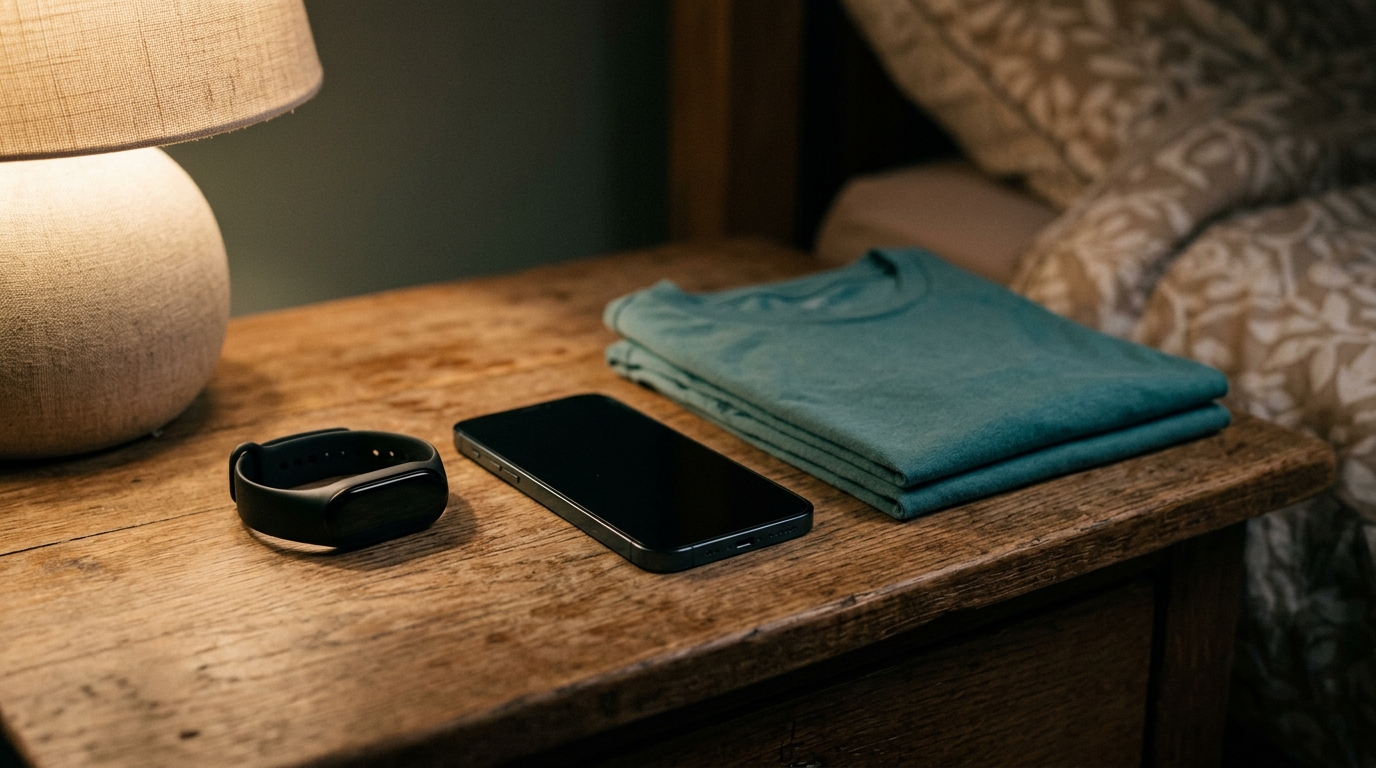
If the condition is essentially about memory, then assessment should be about memory too: what someone recalls, how intrusively, how often. That is broadly how clinical assessment works — a structured conversation about symptoms, conducted retrospectively.
It is not a foolish model. Intrusive re-experiencing is a defining feature, and asking is the only way to reach much of what matters.
But it has two limitations that are structural rather than incidental. It depends on recall of symptoms, which is itself affected by the condition. And it samples a person at the moments they happen to be in a clinic.
Both limitations point the same way. A person is asked, at an appointment, to summarise weeks they may have experienced as a blur, using a faculty the condition itself disturbs — and whatever happened on the nights and mornings between appointments is reconstructed rather than observed.
What Else Is Being Measured
A 2026 paper in npj Digital Medicine proposes a framework built on the observation that a great deal of what PTSD affects is neither verbal nor retrospective.
The authors propose a novel framework and measurement model that frames PTSD in the context of brain health capital, using advances in smart devices — wearables and phones — together with AI, to better capture the multimodal physiological, behavioural and cognitive features of the condition.
Their stated intention includes giving patients complex information in a meaningful way, with the aim of identifying personal change mechanisms and supporting empowered, patient-led decision-making.
The label matters and is easy to lose in summary: this is a proposal. The authors say so — they propose a framework and a measurement model. No new data are reported, no validation is presented, and nothing in it has been shown to improve assessment yet.
What Continuous Measurement Actually Found
A separate 2026 study did collect data of exactly the kind the framework describes, and its result is the strongest argument for the wider view.
It monitored 211 survivors of the Supernova music festival mass-trauma event and 113 matched comparison participants with wearable sensors tracking heart rate, activity and sleep–wake cycles, in real-world settings, for a month at two to six months post-event. PTSD was assessed again at eight to eleven months (Translational Psychiatry, 2026).
Survivors showed reduced circadian stability — greater interday variability in sleep timing.
Notice what that signal is not. It is not a memory, not a symptom report, not something anyone could have described in an interview. It is a pattern only visible by measuring the same person continuously across weeks, and it is covered at length in what the wearable data showed.
Why the Wider Frame Fits the Condition Better
Sleep, autonomic tone, attention and daily activity are not incidental accompaniments to PTSD; they are among the things people most consistently report as difficult, and they are continuously measurable in a way that recall is not.
A condition that disturbs sleep architecture, resting heart rate, attentional allocation and daily patterning is not well summarised as a disorder of memory, even if intrusive memory is its most recognisable feature.
There is also a difference in what the two approaches detect. An interview is unmatched for meaning — what an experience was like, what it changed, what someone is afraid of — but it samples a person occasionally and relies on recall. Continuous physiological measurement is unmatched for pattern: regularities and irregularities across weeks that nobody is positioned to notice about themselves, gathered without asking anything. Neither substitutes for the other, and the interesting proposals use both.
What Should Not Be Read Into This
A framework is not a finding. The 2026 proposal offers a way to organise measurement. It does not demonstrate that digital biomarkers improve diagnosis, prediction or treatment, and it should not be cited as though it did.
Wearable data is not diagnostic. The circadian study reports a group-level association in a research cohort after one specific event. No threshold exists, no device reports anything clinically meaningful about trauma, and reading a personal sleep-variability figure as a risk indicator would be a serious over-extension.
Continuous measurement raises its own problems. Data collected from someone’s phone and watch across months is intimate, and ‘AI to interpret it’ is a claim requiring validation that this proposal does not contain.
And a wider footprint is not a wider diagnosis. Measuring sleep, heart rate and activity in people with PTSD does not make every disturbance of those things a sign of trauma. They are affected by a great many ordinary conditions, which is exactly why a signal found in a research cohort does not transfer to an individual reading.
And none of it displaces the memory account. Intrusive re-experiencing remains central to the diagnosis. The argument is that it is not the whole of what the condition does.
What is genuinely supported: the measurable footprint of PTSD extends well beyond what a person can report, and the field is building the tools to look at the rest of it.
What This Evidence Supports — and What It Doesn't
A Wider Measurable Footprint
Sleep timing, heart rate, activity and attention are affected and are continuously measurable, unlike recall.
A Real Continuous Finding
324 people monitored in ordinary life; survivors showed reduced circadian stability — not a memory measure.
The Framework Is a Proposal
The 2026 digital-biomarker paper proposes a measurement model. It reports no new data and no validation.
Nothing Diagnostic
No device, threshold or personal reading indicates anything clinically meaningful about trauma.

Frequently Asked Questions
Isn't PTSD a memory disorder?
Intrusive re-experiencing is a defining feature and remains central to the diagnosis. What the measurement research shows is that the condition’s footprint extends well beyond memory — into sleep timing, autonomic activity, attention and daily patterning — much of which cannot be captured by asking someone to recall symptoms.
Can a smartwatch detect PTSD?
No. The 2026 study using wearables reports a group-level association in a research cohort following one specific event, with no clinical threshold derived from it. The separate framework proposing digital biomarkers is explicitly a proposal and presents no validation. Nothing here supports a consumer device indicating anything about trauma.
What is the advantage of continuous measurement?
It does not rely on recall and it does not sample only the moments someone is in a clinic. A symptom interview captures what a person can report at one point in time; wearable monitoring captures patterns across weeks, including ones nobody could describe — such as day-to-day variability in sleep timing.
How established is the digital biomarker approach?
Early. The 2026 paper is a framework and measurement model that the authors describe as a proposal, using smart devices and AI to capture multimodal features. It reports no new data, and whether such measures improve assessment or outcomes is an open question.
Does this change how PTSD is diagnosed?
Not currently. Diagnosis remains clinical. The research described here concerns what might eventually be measured alongside a clinical assessment, and none of it has been validated for that use.
Sources
- A brain-health framework for PTSD: integrating digital biomarkers into multimodal assessment — npj Digital Medicine, May 2026
- Circadian instability following mass trauma predicts PTSD risk — Translational Psychiatry, May 2026
When More Than Memory Has Been Affected
Research cohorts are measured with sensors and statistics across months. Understanding one person means measuring that person. NeuroBalance is a small independent practice in Los Angeles — private one-to-one sessions, the same practitioner each visit, in a quiet setting, over fourteen years. A brain health assessment is where that starts.
Schedule Your Free Consultation
Call us: (424) 625-5445 · Los Angeles, CA
Disclaimer: This content is for informational purposes only and does not constitute medical advice, diagnosis, or treatment. LENS Neurofeedback is not FDA-approved for all conditions mentioned. Please consult with a qualified healthcare provider before beginning any new treatment program.

A balanced brain is a better brain for a happier life.