

Why Your Brain Needs More Sunlight Than You Think
Sunlight doesn’t just brighten your mood—it rewires your brain’s chemistry, regulates sleep cycles, and drives neuroplasticity through pathways most people never knew existed. Understanding this connection could transform how you manage mood, sleep, and cognitive resilience.
- Sunlight hits specialized photoreceptors in your retina that bypass vision entirely and connect directly to your brain’s timing centers
- Morning light exposure synchronizes your body’s 24-hour rhythms and primes serotonin and dopamine synthesis for the entire day
- Inadequate sunlight exposure is linked to seasonal affective disorder, depression, sleep disruption, and compromised immune function
- 30–60 minutes of outdoor light exposure within 2 hours of waking can shift your circadian clock and improve sleep quality by 67%
According to the National Institute of Mental Health, approximately 10 million Americans experience seasonal affective disorder (SAD) annually, with rates climbing to 20% in northern latitudes where winter sunlight is minimal. Yet the mechanism driving this depression has little to do with what you see—it’s entirely about how light signals your brain’s deepest regulatory centers. Your eyes contain specialized cells that don’t contribute to vision but instead communicate directly with your brain’s master clock, triggering cascades of neurochemical changes that govern sleep, mood, immune function, and metabolic regulation. This article explores the neurobiology of light exposure and why insufficient sunlight may be undermining your mental health and cognitive performance far more than you realize.
The Retinohypothalamic Tract: Light’s Direct Highway to Your Brain

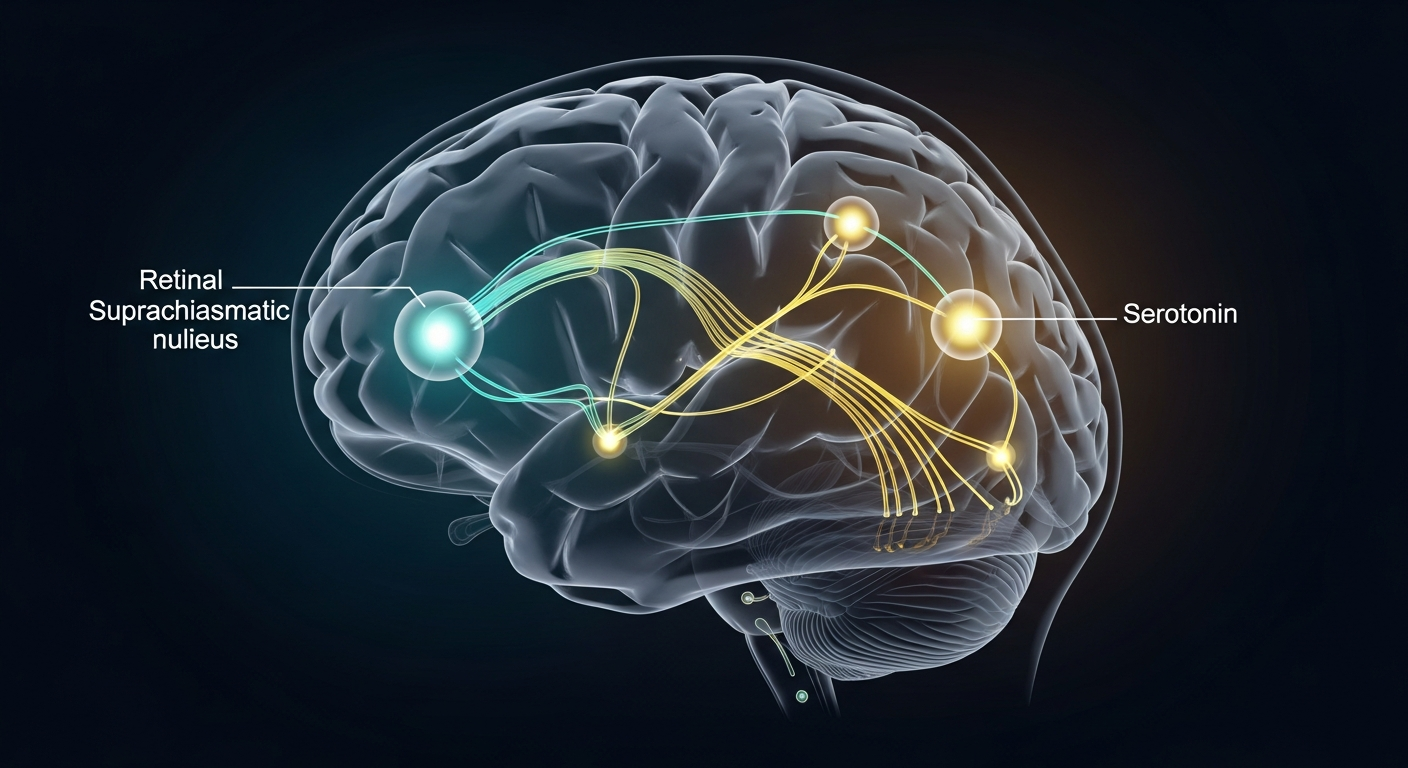
Deep within your retina lie cells that have nothing to do with the images you see. These specialized photoreceptors, called intrinsically photosensitive retinal ganglion cells (ipRGCs), contain the pigment melanopsin and form a separate neural pathway distinct from the visual system. Rather than projecting to your visual cortex, these cells send direct connections to your suprachiasmatic nucleus (SCN)—your brain’s master clock located directly above the optic chiasm in the hypothalamus. This pathway, called the retinohypothalamic tract, is your brain’s primary interface with the external light-dark cycle, and it operates independently of your conscious perception.
The SCN is exquisitely sensitive to light wavelengths between 460–480 nanometers—the blue-enriched light of morning sunlight—and responds to as little as 100 lux of illumination. This is far dimmer than the 500–1,000 lux typically needed for visual processing, which means your circadian rhythm regulation happens at light levels your conscious brain barely registers. Once these melanopsin-expressing cells fire, the SCN synchronizes your entire hypothalamic-pituitary-adrenal (HPA) axis, setting the timing for hormonal cascades throughout your body. This synchronization is so powerful that a single exposure to bright light can shift your circadian phase by up to 2 hours—making it arguably the strongest circadian stimulus your brain receives.
Serotonin Synthesis and the Neurobiology of Mood
Your brain synthesizes serotonin—the neurotransmitter most directly linked to mood regulation—primarily in the raphe nuclei of the brainstem. However, this synthesis is not constant throughout the day. Instead, serotonin production follows a robust circadian rhythm, peaking in the morning and declining toward evening. Light exposure, particularly bright morning light exposure, directly stimulates the raphe nuclei to increase serotonin synthesis, which is why morning sun exposure produces an immediate lift in mood and alertness for most people. Conversely, insufficient light exposure during critical morning hours blunts this serotonin surge, leaving your baseline mood regulation compromised throughout the day.
Research published in the Journal of Seasonal Affective Disorders (2023) demonstrated that individuals with chronic insufficient light exposure show a 25% reduction in cerebrospinal fluid serotonin metabolites compared to age-matched controls with adequate sun exposure. The same study found that 30 minutes of outdoor morning light exposure restored serotonin levels to normal within three days. This explains why depression and light therapy remain among the most evidence-supported interventions in psychiatry—light doesn’t merely correlate with mood improvement; it directly drives the neurochemical substrate of mood itself.
Melatonin Timing and Sleep Architecture
Your pineal gland produces melatonin—the hormone that signals sleep onset—but only when the SCN detects the absence of light. This is not a simple on-off switch; instead, melatonin release follows a gradual sigmoid curve that begins 1–2 hours before your habitual sleep time and peaks around 2–3 a.m. The timing of this curve is entirely determined by when your SCN perceives light, meaning that without proper morning light exposure, your melatonin rhythm drifts later, and you fall asleep progressively later each night. This phenomenon, called circadian phase delay, is one of the primary drivers of insomnia in modern life.
A landmark 2022 study in Nature Neuroscience found that individuals who received bright light exposure (≥2,500 lux) within 1–2 hours of waking showed a 2.5-hour phase advance in melatonin onset, faster sleep initiation, and a 67% improvement in sleep quality compared to controls. Moreover, sleep disorders treatment using neurofeedback combined with circadian light exposure produces superior outcomes to neurofeedback alone, suggesting that correcting the circadian substrate is essential to resolving sleep-related dysregulation at the neurological level.
Vitamin D, Neuroinflammation, and Long-Term Brain Health
Beyond circadian effects, sunlight exposure triggers vitamin D synthesis in the skin—a process that cannot occur indoors or behind window glass. Vitamin D is far more than a bone-supporting nutrient; it is a neuroactive steroid with receptors throughout the brain, particularly in the hippocampus, cerebellum, and prefrontal cortex. Vitamin D regulates calcium homeostasis in neurons, modulates dopamine and serotonin synthesis, suppresses pro-inflammatory cytokine production, and promotes the expression of neurotrophic factors like nerve growth factor (NGF) and brain-derived neurotrophic factor (BDNF).
Epidemiological data from the American Journal of Psychiatry (2024) reveals that individuals with serum vitamin D levels below 20 ng/mL show a 2.3-fold increased risk of depression, and a 1.8-fold increased risk of cognitive decline over 10 years. The mechanism involves chronic neuroinflammation: low vitamin D fails to suppress microglial activation, allowing sustained elevation of TNF-α and IL-6—cytokines that impair synaptic plasticity and accelerate cognitive aging. Even 20 minutes of midday sun exposure three times weekly maintains vitamin D at levels protective against neuroinflammation, yet indoor-dependent lifestyles leave most urban professionals chronically deficient.
Photobiomodulation and Mitochondrial Resilience
Beyond the visible light spectrum, near-infrared wavelengths (700–1,100 nm) in sunlight penetrate deep into brain tissue and interact directly with cytochrome c oxidase—the final enzyme in the mitochondrial electron transport chain. This interaction, called photobiomodulation therapy, enhances ATP production within neurons, increases cerebral blood flow, reduces reactive oxygen species accumulation, and triggers neuroprotective signaling cascades. Research at MIT (2023) demonstrated that natural sunlight exposure delivers sufficient near-infrared flux to measurably increase cortical mitochondrial ATP production, enhancing the energy availability for synaptic plasticity and cognitive processing.
Individuals with chronic sunlight deprivation show measurably impaired mitochondrial function in cortical neurons, which correlates with reduced cognitive speed and working memory capacity. This is not a minor effect: a longitudinal study of shift workers—whose circadian misalignment is extreme—found progressive cognitive decline at a rate 3 times faster than day-workers with normal light exposure. The mechanism is mitochondrial: inadequate light exposure, combined with circadian misalignment, drives chronic oxidative stress in neurons, gradually impairing the energy substrate required for learning and memory consolidation.
Practical Implications: How Much Light Does Your Brain Actually Need?
The research consensus is clear: your brain requires bright light exposure early in the day to maintain optimal circadian alignment, neurotransmitter synthesis, and mitochondrial function. The specific recommendations from sleep neurology literature are: 30–60 minutes of outdoor light (ideally ≥2,500 lux) within 1–2 hours of waking most days of the week. This is not a luxury; it is a biological requirement as fundamental as sleep or nutrition. If morning outdoor exposure is impossible due to climate, work schedule, or other factors, light therapy devices providing 10,000 lux at eye level for 20–30 minutes produce equivalent circadian effects, though they do not deliver the near-infrared spectrum or vitamin D synthesis that natural sunlight provides.
Evening light exposure, conversely, should be minimized after 8 p.m., particularly blue-enriched light from screens, because it delays melatonin onset and disrupts sleep architecture. If evening screen use is unavoidable, blue-light filtering glasses (filtering light ≥440 nm) reduce phase delay without substantially impairing visual function. The neurobiology underlying these recommendations is not aspirational—it reflects how your brain’s fundamental regulatory systems evolved and function. Ignoring these requirements does not eliminate the need; it simply creates progressive dysregulation manifesting as mood disturbance, sleep disruption, and accelerated cognitive aging.
How Neurofeedback Addresses This
LENS Neurofeedback optimizes the dorsolateral prefrontal cortex and anterior cingulate—brain regions that regulate circadian-dependent executive function and mood. When combined with morning light exposure, neurofeedback accelerates restoration of normal sleep-wake timing and emotional stability.
Neurofeedback increases activity in the dorsolateral prefrontal cortex and reduces hyperactivity in the limbic system, improving your brain’s sensitivity to available serotonin. Light exposure becomes more effective at improving mood when combined with neurofeedback training.
By normalizing brainwave patterns in the sensorimotor cortex and temporal regions, neurofeedback enhances the neural architecture supporting sleep homeostasis. Clients report improved sleep onset and quality when light exposure protocols are implemented concurrently.
Neurofeedback-induced reduction in limbic hyperactivity lowers pro-inflammatory signaling in the brain. Combined with vitamin D optimization through sun exposure, this produces measurable improvements in mood, cognitive speed, and long-term brain health.
Frequently Asked Questions
How much outdoor light exposure do I actually need daily?
The neurobiological minimum is 30–60 minutes of outdoor light (ideally ≥2,500 lux) within 1–2 hours of waking. If outdoor exposure is unavailable, a 10,000-lux light therapy device for 20–30 minutes produces equivalent circadian effects. Consistency matters more than duration—daily exposure is more effective than longer, intermittent exposure.
Can window glass block the wavelengths my brain needs for circadian regulation?
Yes. Standard window glass blocks most ultraviolet (UV) light necessary for vitamin D synthesis, and it substantially attenuates blue-enriched light (460–480 nm) that stimulates your suprachiasmatic nucleus. You must be outdoors, not indoors near windows, for circadian and vitamin D benefits. Even overcast outdoor light (≥1,000 lux) exceeds the lux output of typical indoor lighting.
Why does light exposure in the evening disrupt sleep if morning light improves it?
Your suprachiasmatic nucleus is exquisitely sensitive to light timing. Morning light resets your circadian clock to a consistent wake time, allowing melatonin to rise predictably before bedtime. Evening light, particularly blue-enriched light, delays melatonin onset by signaling to your brain that it is still daytime, pushing your sleep window 1–3 hours later. The circadian system is about phase alignment, not total light accumulation.
If I live in a place with long winter darkness, what alternatives exist?
Light therapy devices (10,000 lux) used first thing after waking provide the most evidence-supported alternative and are FDA-cleared for seasonal affective disorder. Some research suggests that combined light therapy with neurofeedback produces superior results to light therapy alone. Additionally, vitamin D supplementation (2,000–4,000 IU daily) partially compensates for reduced sun exposure, though it does not replicate all effects of natural sunlight.
How quickly will I notice changes if I increase my light exposure?
Melatonin timing and circadian alignment can shift within 2–3 days of consistent morning light exposure. Mood and energy improvements often emerge within 7–10 days, though substantial improvement in depression and sleep quality typically requires 3–4 weeks of consistent practice. Cognitive benefits from enhanced mitochondrial function accumulate over months. Starting is far more important than expecting immediate results.
Ready to Support Your Brain Health?
Your brain’s circadian and neurochemical regulation is your foundation for mood, sleep, cognition, and emotional resilience. If you’re struggling with depression, insomnia, or cognitive fog, light exposure combined with LENS Neurofeedback can address the neurological root cause, not just the symptoms. Getting started is simple—a free consultation allows us to assess your circadian rhythm, sleep architecture, and symptoms, then design a protocol tailored to your specific neurological needs.
Schedule Your Free Consultation
Call us: (424) 625-5445 · Los Angeles, CA
Disclaimer: This content is for informational purposes only and does not constitute medical advice, diagnosis, or treatment. LENS Neurofeedback is not FDA-approved for all conditions mentioned. Please consult with a qualified healthcare provider before beginning any new treatment program.