

Can the Brain Heal Itself? What Neuroplasticity Really Means
Yes — within limits. Neuroplasticity is the nervous system’s ability to reorganize its structure, functions and connections in response to experience. It lets the brain recover function after injury, reverse some effects of chronic stress, and relearn regulation. It does not regrow lost tissue, and it does not happen without repeated, targeted input.
- Neuroplasticity means reorganization — rerouting and rewiring — not regrowing lost brain tissue
- Structural change is measurable: one year of aerobic exercise grew older adults’ hippocampus about 2%, while the control group shrank 1.4%
- Chronic stress physically remodels the brain, and much of that remodeling is reversible
- Plastic change requires repetition and specificity — insight alone does not rewire a circuit
In a randomized trial of 120 older adults published in PNAS, one year of regular aerobic exercise increased anterior hippocampal volume by roughly 2%, while the control group showed the expected 1.4% decline — a difference the authors described as adding back between 1 and 2 y worth of volume
to a brain region central to memory. That single finding captures why neuroplasticity has become one of the most hopeful — and most misunderstood — ideas in modern neuroscience. The adult brain is not fixed. But it also does not change simply because we want it to.
What Does "Neuroplasticity" Actually Mean?
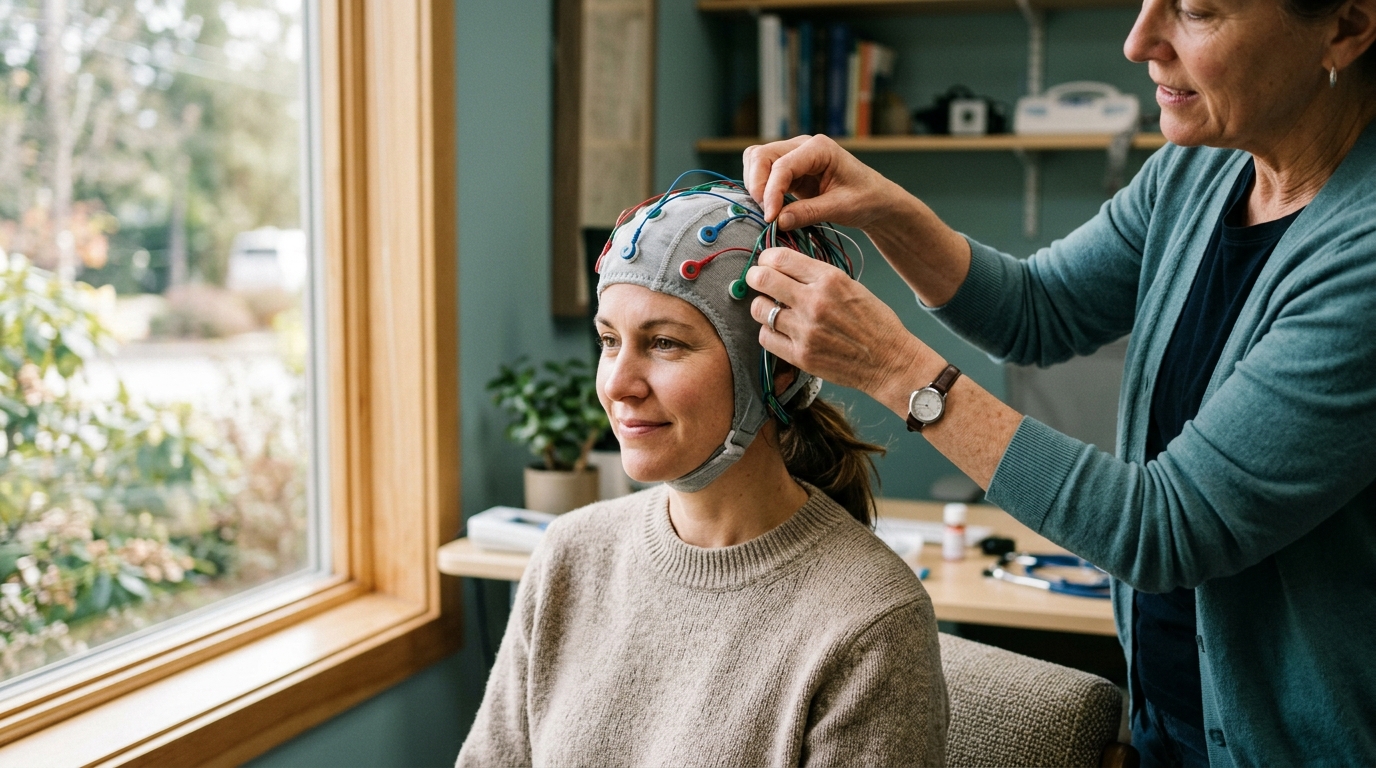
Neuroplasticity is the nervous system’s ability to change its activity by reorganizing its structure, functions or connections in response to intrinsic or extrinsic stimuli. That is the clinical definition, and the key word in it is reorganizing. The brain is not adding new parts. It is rewiring the parts it already has.
This happens through several distinct mechanisms: synapses strengthen or weaken with use, new synaptic connections form, dendrites branch or retract, and in a few specific regions — notably the hippocampus — new neurons are generated. Alongside these cellular changes, whole networks can functionally reorganize, redistributing a job across different territory when the original region is damaged.
The reason this matters clinically is that it reframes many persistent symptoms. If a brain state is maintained by patterns of connection and activity rather than by fixed damage, then that state is a candidate for change. Our earlier guide to what neuroplasticity really means covers the underlying biology in more depth; this article focuses on the harder question of what genuinely heals.
Can the Brain Really Heal Itself After an Injury?
Partly — and the distinction matters enormously. When brain tissue dies, as in a stroke or a significant traumatic injury, that tissue does not grow back. What can recover is function. Surviving regions take over tasks the damaged region used to perform, a process clinicians call functional reorganization.
This is why two people with similar-looking scans can have very different outcomes. Recovery depends less on the size of the lesion than on how much targeted, repetitive practice the surviving network gets. Rehabilitation works precisely because it supplies the repeated, specific input that drives rewiring.
The same principle applies to milder injuries. After a concussion, symptoms often persist not because tissue is still damaged but because the brain’s regulatory rhythms have not resettled. That is the rationale behind neurofeedback for traumatic brain injury — working on the regulation pattern rather than the structural damage.
The honest limit is this: plasticity is a capacity, not a guarantee. It has a timeline, it varies between people, and it does not restore everything.
What Does Chronic Stress Change — and Is It Reversible?
Chronic stress is one of the clearest demonstrations that the adult brain remodels itself, because it remodels in a direction nobody wants. Sustained stress exposure is associated with structural change across three regions in particular: the hippocampus, the amygdala and the prefrontal cortex.
The pattern is not uniform. In the hippocampus and prefrontal cortex, chronic stress is associated with dendritic atrophy — branches retract, connections thin. In the basolateral amygdala it does the opposite, strengthening connectivity through dendritic growth. In plain terms: the threat detector gets better connected while the regions that regulate it and lay down context get less so.
That asymmetry explains a great deal of lived experience. It is why prolonged stress tends to produce a brain that reacts faster and reasons more slowly, and why anxiety so often outlasts the circumstances that created it.
The encouraging half is that much of this remodeling is not permanent. Because the changes are structural adaptations to sustained input, altering the input alters the adaptation. This is plasticity working in the recovery direction rather than the damage direction.
Why Doesn't the Brain Simply Fix Everything on Its Own?
Because plasticity is agnostic. It reinforces whatever is practiced, not whatever is healthy. A brain that has spent three years rehearsing hypervigilance becomes efficient at hypervigilance. The same mechanism that enables recovery also entrenches the pattern you are trying to leave.
There is a second constraint. Plastic change is driven by signals that mark an experience as worth encoding — attention, repetition, and a nervous system regulated enough to consolidate what happened. A brain stuck in a chronically activated state is comparatively poor at all three, which is why people often feel they are working hard at change without much traction.
This is the practical trap. Insight is not repetition. Understanding why a pattern exists does not, by itself, supply the thousands of repetitions a circuit needs to reorganize. That gap between knowing and changing is not a personal failing — it is a straightforward consequence of how plasticity operates.
What Actually Drives Plastic Change?
Four conditions consistently show up in the research. Repetition, because synaptic change tracks use. Specificity, because the brain reorganizes the exact circuit being exercised rather than a general capacity. Sufficient challenge, because a task that is already easy provides no signal to adapt. And a regulated nervous system, because consolidation depends on states the brain can only reach when it is not braced against threat.
Physical exercise is the best-evidenced general lever, and the mechanism is reasonably well understood: aerobic activity upregulates brain-derived neurotrophic factor (BDNF), which supports neurogenesis in the hippocampal dentate gyrus and strengthens synaptic plasticity. It is a broad, non-specific boost to the brain’s capacity to change.
Sleep is the second. Consolidation — the process that turns a temporary change into a durable one — happens substantially during sleep, which is why disrupted sleep quietly undermines every other effort.
The fourth condition is where targeted intervention earns its place. If a nervous system cannot reach a regulated state on its own, approaches like LENS neurofeedback therapy aim to make that state reachable — not by replacing effort, but by restoring the conditions under which effort produces change.
What Does This Mean If You've Been Struggling for Years?
It means duration is a weaker predictor than most people assume. A pattern held for a decade is well practiced, but it is still a pattern of connection and activity rather than a fixed structural fact. Well-practiced patterns take longer to change; they are not exempt from change.
It also means the question worth asking shifts. Instead of is something wrong with me?
, the more useful question is what is my nervous system currently practicing, and what conditions would let it practice something else?
That is an answerable question, and often a measurable one — brain mapping exists to make the current pattern visible rather than inferred.
Realistic expectations matter here as much as hope does. Neuroplasticity does not promise that everything reverses, or that change is quick. What the evidence supports is narrower and still substantial: the adult brain retains a genuine capacity to reorganize, that capacity responds to specific and repeated input, and it does not switch off with age.
How Neurofeedback Works With Neuroplasticity
It Targets Regulation, Not Symptoms
Rather than managing individual complaints separately, neurofeedback addresses the dysregulated patterns underneath them — the level at which plastic change actually happens.
It Supplies Repetition and Specificity
Plastic change needs repeated, targeted input. Sessions provide exactly that: consistent feedback to a specific pattern, rather than general advice to relax.
It Works With the Brain's Own Mechanism
Nothing is added or forced. Feedback gives the nervous system information about its own activity, and the reorganization that follows is the brain’s own.
It Measures Before It Trains
Brain mapping establishes the current pattern first, so training is aimed at what is actually happening rather than at a general assumption.

Frequently Asked Questions
Does neuroplasticity mean the brain can regrow damaged tissue?
No, and this is the most common misunderstanding. Neuroplasticity is reorganization — the brain rerouting functions through surviving networks and changing the strength of existing connections. Dead tissue is not replaced. What can recover is function, when undamaged regions take over the work through repeated, targeted practice. New neuron generation does occur in limited regions such as the hippocampus, but it is not tissue regrowth in the way people usually imagine.
Does neuroplasticity stop after childhood?
No. Plasticity is greatest during childhood developmental windows, and some capacities are far easier to acquire early. But the adult brain retains genuine capacity for structural and functional change throughout life. The randomized exercise trial cited above found measurable hippocampal growth in adults with a mean age of about 66. Adult change is typically slower and requires more deliberate repetition — it is not absent.
How long does it take to change an established pattern?
It depends on how long the pattern has been practiced, how specific and repeated the new input is, and how regulated the nervous system is while learning. There is no fixed number, and any provider offering one is overstating what the evidence supports. What is consistent is the shape of the process: change tends to be gradual and cumulative rather than sudden, and it depends more on consistency than on intensity.
If the brain is plastic, why hasn't mine changed on its own?
Because plasticity reinforces what is practiced, not what is beneficial. A nervous system that has spent years in a heightened state has become efficient at that state — the same mechanism that permits recovery is what entrenched the pattern. Change usually requires deliberately different, repeated input, plus a regulated enough state for the brain to consolidate it. That is a mechanical constraint, not a lack of willpower.
Can neurofeedback speed up neuroplastic change?
Neurofeedback is designed to work with plasticity rather than around it, by supplying repeated, specific feedback about the brain’s own activity and supporting the regulated states in which consolidation occurs. Individual responses vary, and it is not a substitute for sleep, exercise or appropriate medical care. If you have tried other approaches without the traction you expected, it is reasonable to ask whether the underlying regulation was ever addressed.
Sources
- Neuroplasticity — StatPearls, NCBI Bookshelf
- Exercise training increases size of hippocampus and improves memory — PNAS (Erickson et al., 2011), PMC mirror
- Impact of Stress on Brain Morphology — National Library of Medicine (PMC)
- Exercise-Mediated Neurogenesis in the Hippocampus via BDNF — National Library of Medicine (PMC)
Ready to Find Out What Your Brain Is Practicing?
Neuroplasticity is only useful when it is pointed in the right direction. At MyNeuroBalance in Los Angeles, we start by mapping your current brainwave patterns, then build a training plan around what we actually find. Schedule a brain health assessment and see what is genuinely changeable.
Schedule Your Free Consultation
Call us: (424) 625-5445 · Los Angeles, CA
Disclaimer: This content is for informational purposes only and does not constitute medical advice, diagnosis, or treatment. LENS Neurofeedback is not FDA-approved for all conditions mentioned. Please consult with a qualified healthcare provider before beginning any new treatment program.